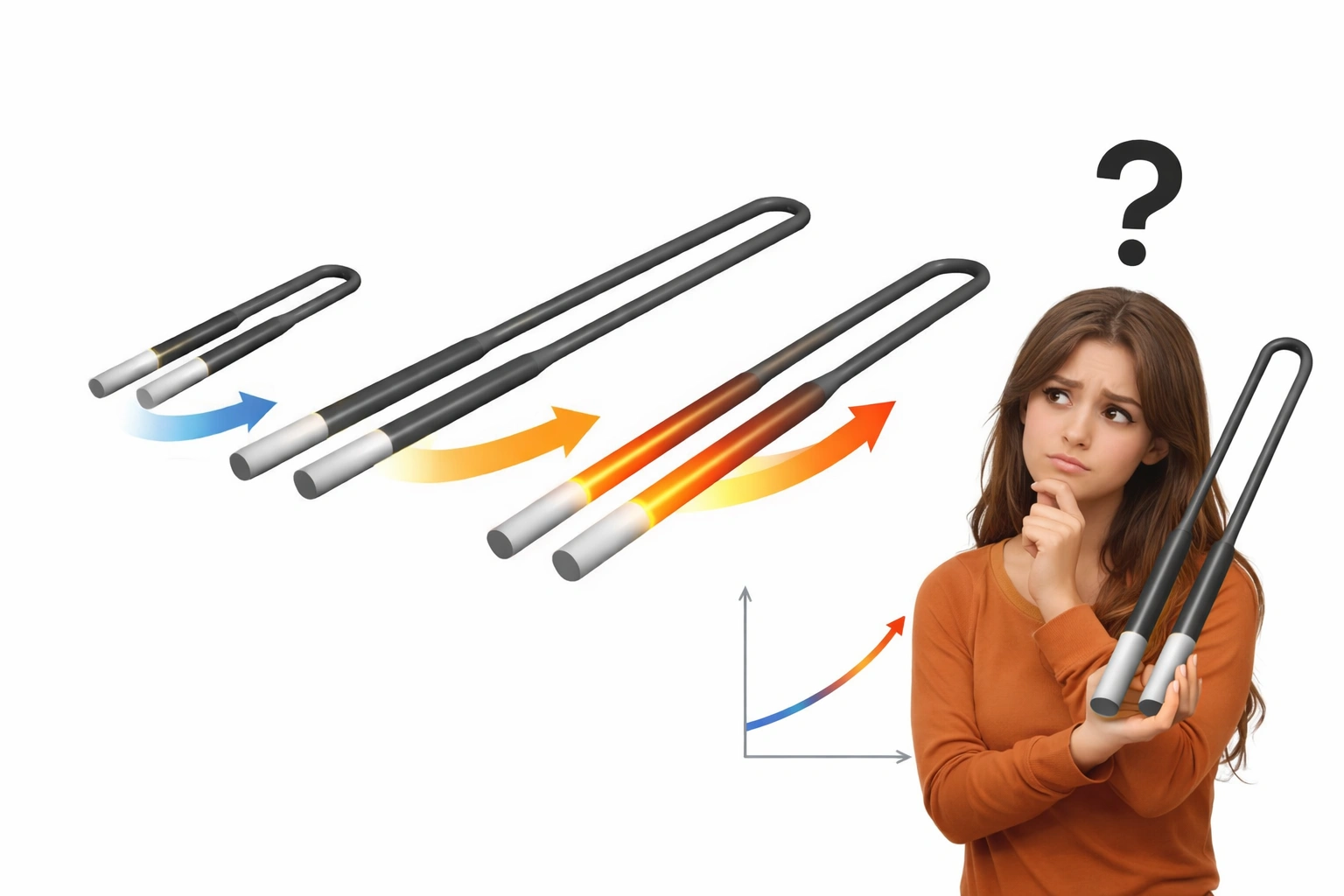
In the realm of high-temperature industrial furnaces (up to 1850 °C), molybdenum disilicide (MoSi2) heating elements are the preferred choice due to their exceptional oxidation resistance and ability to withstand extremely high wattage loads. However, a common mistake in thermal design is attempting to increase the power of a system without adjusting the physical dimensions of the elements.
This technical article, developed for Heatecx Limited, explains the physical fundamentals and thermodynamic laws that dictate why the size of an MoSi2 heater must necessarily change when the required power is modified.
Intellectual Property and Copyright (Heatecx Limited)
This document, “Critical Sizing: Why MoSi2 Element Size Must Change with Power,” is the exclusive intellectual property of Heatecx Limited. Its copying, reproduction, distribution, or multiplication, in whole or in part, is strictly prohibited without the express written consent of Heatecx Limited. All rights reserved.
Ohm’s Law and the Variable Resistivity of MoSi2
MoSi2 is a ceramic-metallic material whose electrical resistivity (\rho) increases drastically with temperature. At 1600 °C, its resistance can be up to 10 times greater than at room temperature. This characteristic is fundamental, as the design must calculate the element’s resistance at the operating temperature.
Any change in the desired power requires an adjustment in the hot zone length (Le) or the element diameter (D1) to compensate for the change in the necessary resistance. An increase in power requires a decrease in resistance (R), which is achieved by increasing the area (A) or decreasing the length (L). However, the decision is limited by the thermal factor.
2. The Determining Factor: Watt Loading
The most critical reason for changing the element size when increasing power is the Watt Loading, measured in watts per square centimeter (W/cm²).
2.1. The Material’s Thermal Limit
Each MoSi2 element has a maximum watt loading limit for a given furnace temperature. If we increase the power without increasing the element’s surface area (i.e., without making it larger or thicker), the watt loading skyrockets.
“If the watt loading exceeds recommended limits (typically between 10 and 25 W/cm² depending on temperature), the element will internally overheat, causing material melting or detachment of the protective quartz layer (SiO2), resulting in immediate catastrophic failure.”
2.2. Relationship between Surface and Power
To maintain a safe watt loading when increasing power, it is imperative to increase the heat transfer area. This is achieved in two ways:
1.Increasing the Diameter: A thicker element has more surface area per unit length.
2.Increasing the Hot Zone Length: Allows the total power to be distributed over a larger physical extent.
3. Hot Zone vs. Cold Zone Dynamics
MoSi2 elements consist of a hot zone (where heat is generated) and terminals or cold zones (of larger diameter to reduce resistance and heat at the connections).
| Parameter | Effect when Increasing Power | Design Requirement |
| Hot Zone Diameter | Increases current capacity. | Must be larger to withstand higher amperages without melting. |
| Hot Zone Length | Defines the radiation area. | Must be longer to keep the watt loading (W/cm²) within safe limits. |
| Terminal Diameter | Prevents overheating at the terminals. |
3.1. The Importance of Current and Diameter
Increasing power (P) at a constant voltage (V) implies a direct increase in current (I) according to I = P/V. The element must be capable of conducting this current without overheating. Current density (J = I/A) must be kept within safe limits. Therefore, an increase in power requires an increase in the cross-sectional area (A), which translates into a larger diameter (D1) of the hot zone.
4. Technical Illustration of Critical Dimensions
To understand the interdependence of variables, a technical diagram of a U-shaped MoSi2 element, the most common format, is used. The critical dimensions that must be adjusted when changing power are:
| Symbol | Dimension | Description |
| D1 | Hot Zone Diameter | Determines resistance and radiation surface. Increases with power. |
| D2 | Cold Zone Diameter (Terminal) | Must be larger than D1 to reduce resistance at the terminals. Increases with current. |
| Le | Hot Zone Length | The effective length that radiates heat. Increases to reduce Watt Loading. |
| Lu | Cold Zone Length (Terminal) | Length extending outside the furnace. Does not affect power, but affects total resistance. |
| A | Center-to-Center Spacing | Distance between the axes of the element legs. Determined by furnace design. |
5. Consequences of Incorrect Sizing
Ignoring the relationship between power and size leads to serious operational risks that Heatecx Limited recommends avoiding:
1.Accelerated Aging: Operating at excessive watt loading reduces lifespan from thousands of hours to just a few cycles.
2.Thermal Instability: Elements too small for the required power can cause temperature fluctuations difficult for the furnace’s PID to control.
3.**
Pinching Failure**: Localized overheating can deform the element, causing short circuits with the furnace refractory lining.
6. Technical Conclusion: The Need for Resizing
The size of an MoSi2 resistor is not an aesthetic choice, but a thermodynamic and electrical necessity. When power is changed, the energy flow that the material must manage is altered. Without a proportional increase in physical dimensions (D1 and Le) to dissipate that heat and handle the electrical load, the structural integrity of the molybdenum disilicide is compromised.
The design of MoSi2 elements is an exercise in balancing Ohm’s Law and the limitation of Watt Loading. To safely increase power, the engineer must increase the surface area of the hot zone to keep the power density below the critical threshold, thus ensuring the longevity and efficiency of the heating system.
Technical Disclaimer
The technical information and manufacturing processes described in this guide represent the generally accepted engineering standards and principles in the tubular electric heater industry. However, Heatecx Limited warns that the manufacturing method, material selection, and quality control parameters may vary significantly depending on the specific heater design, the final application (immersion, air, conduction), customer specifications, and applicable regional regulations. This guide is for informational purposes only and should not be considered a manufacturing manual or a binding technical specification for any particular product. Users should always consult the detailed specifications of each product and the recommendations of a qualified engineer for any specific application.