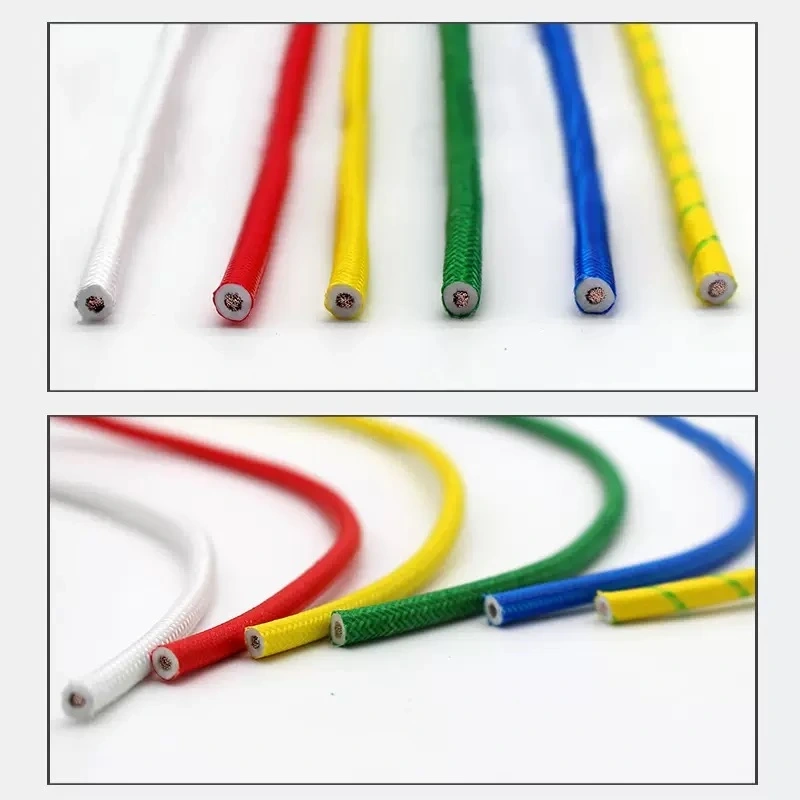
AGR 200°C High-Temperature Cable (Fiberglass and Silicone)
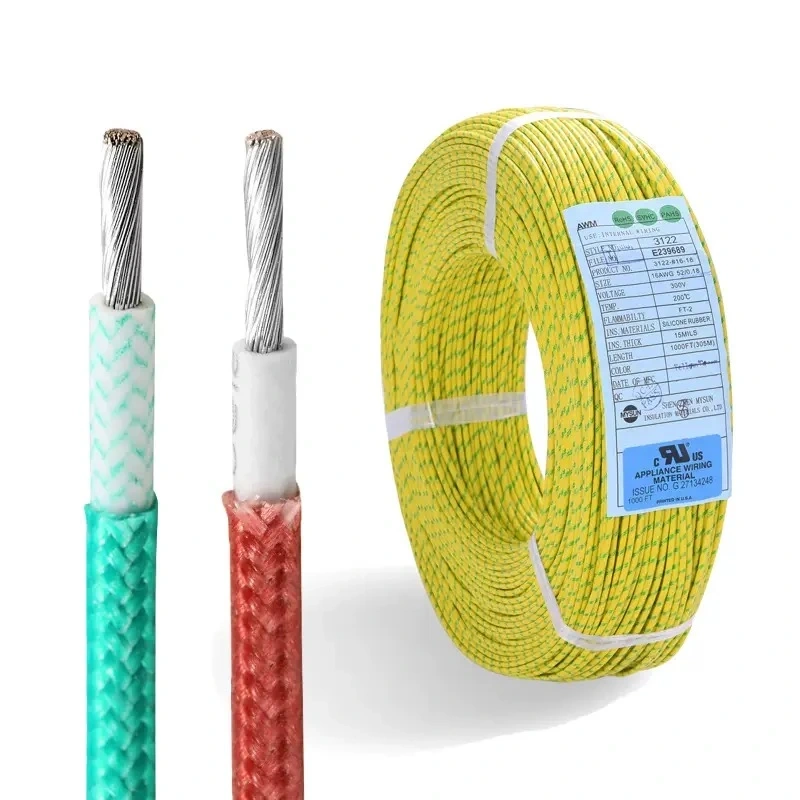
If you are looking for a heat-resistant cable that offers flexibility and durability for your projects, the AGR 200°C model is the perfect choice. This fiberglass and silicone cable is optimized for high-temperature applications in both industry and home, providing a reliable solution for the wiring of electrical appliances and lighting equipment. Its capacity to withstand temperatures of up to 200°C, along with its excellent resistance to thermal shock and improved mechanical strength, make it a high-performance silicone electrical cable. It is the ideal option for manufacturers and technicians who need a UL-approved cable that combines safety, efficiency, and a long service life in moderate to high-heat environments.
Overview
Main Applications
Features and Advantages
Technical Specifications
High-Temperature Cable Comparison
Overview
If you are looking for a heat-resistant cable that offers flexibility and durability for your projects, the AGR 200°C model is the perfect choice. This fiberglass and silicone cable is optimized for high-temperature applications in both industry and home, providing a reliable solution for the wiring of electrical appliances and lighting equipment. Its capacity to withstand temperatures of up to 200°C, along with its excellent resistance to thermal shock and improved mechanical strength, make it a high-performance silicone electrical cable. It is the ideal option for manufacturers and technicians who need a UL-approved cable that combines safety, efficiency, and a long service life in moderate to high-heat environments.
Main Applications
The AGR 200°C cable is widely used in various applications where temperature resistance and flexibility are crucial:
-
Internal Wiring of Household Appliances: Ideal for ovens, stoves, toasters, coffee makers, and other heat-generating appliances.
-
Electronic Equipment: Used in the internal wiring of luminaires, transformers, electric motors, and industrial control systems.
-
Heating Systems: Connection of heater elements in commercial and industrial applications that do not exceed 200°C.
-
High-Temperature Lighting: Wiring for halogen lamps, infrared lamps, and lighting systems in demanding environments.
-
Automotive Industry: Specific applications requiring heat resistance in the engine compartment or exhaust systems.
Features and Advantages
|
Feature |
Advantage |
|---|---|
|
Wide Temperature Range |
Operates from -60°C to +200°C, making it suitable for a wide variety of thermal environments, from extreme cold to elevated heat. |
|
Extruded Silicone Insulation |
Provides excellent flexibility, resistance to moisture, chemicals, and aging, ensuring a long service life. |
|
Fiberglass Braid |
Offers superior mechanical protection against abrasion and cutting, in addition to added heat resistance. |
|
Thermal Shock Resistance |
Maintains its integrity and performance even with sudden temperature changes, which is crucial in many applications. |
|
UL/cUL Approvals |
Complies with internationally recognized safety standards (UL file E101965), guaranteeing product quality and reliability. |
Technical Specifications
|
Characteristic |
Detail |
|---|---|
|
Type |
AGR |
|
Operating Temperature |
-60°C to +200°C |
|
Construction |
Copper conductor (various types), extruded silicone insulation, fiberglass braid |
|
Rated Voltage |
300V / 600V / 1000V (cUL 600V) |
|
Approvals |
UL 3122, 3513, 3645; cUL AWM I A/B |
|
Flame Resistance |
Horizontal / FT2 |
|
Color Coding |
Solid or stripes |
|
Surface Marking |
Yes |
|
AWG Sizes |
Wide range (e.g., 26 AWG to 4/0 AWG and MCMs) |
Dimensions and Weight Table (Typical Values)
|
AWG Size |
Nominal OD (in) |
Approx. Linear Weight (lbs/mft) (300V) |
Nominal OD (in) |
Approx. Linear Weight (lbs/mft) (600V) |
Nominal OD (in) |
Approx. Linear Weight (lbs/mft) (1000V) |
|---|---|---|---|---|---|---|
|
26 |
.059 |
2.8 |
- |
- |
.122 |
7.9 |
|
24 |
.067 |
3.9 |
- |
- |
.126 |
9.0 |
|
22 |
.075 |
5.8 |
- |
- |
.138 |
11.8 |
|
20 |
.083 |
8.8 |
.114 |
11.6 |
.154 |
16.3 |
|
18 |
.091 |
12.8 |
.122 |
15.8 |
.161 |
20.8 |
|
16 |
.102 |
18.1 |
.142 |
22.4 |
.169 |
26.2 |
|
14 |
- |
- |
.158 |
34.1 |
.189 |
39.0 |
|
12 |
- |
- |
.177 |
49.2 |
.201 |
53.2 |
|
10 |
- |
- |
.228 |
76.9 |
.228 |
76.9 |
|
8 |
- |
- |
.260 |
122 |
.288 |
129 |
|
6 |
- |
- |
.350 |
202 |
.350 |
202 |
|
4 |
- |
- |
.421 |
340 |
.421 |
340 |
|
2 |
- |
- |
.469 |
506 |
.469 |
506 |
|
1 |
- |
- |
.567 |
707 |
.567 |
707 |
|
1/0 |
- |
- |
.614 |
871 |
.614 |
871 |
|
2/0 |
- |
- |
.650 |
1,076 |
.650 |
1,076 |
|
3/0 |
- |
- |
.717 |
1,323 |
.717 |
1,323 |
|
4/0 |
- |
- |
.807 |
1,631 |
.776 |
1,609 |
|
250MCM |
- |
- |
.854 |
1,918 |
.854 |
1,918 |
|
300MCM |
- |
- |
.929 |
2,338 |
.929 |
2,338 |
|
350MCM |
- |
- |
.969 |
2,601 |
.969 |
2,601 |
|
400MCM |
- |
- |
1.008 |
3,004 |
1.008 |
3,004 |
|
500MCM |
- |
- |
- |
- |
1.110 |
3,721 |
|
600MCM |
- |
- |
- |
- |
1.232 |
4,505 |
|
700MCM |
- |
- |
- |
- |
1.307 |
5,207 |
|
750MCM |
- |
- |
- |
- |
1.346 |
5,596 |
Other AWG sizes available upon request.
High-Temperature Cable Comparison
To facilitate the choice and highlight the advantages of the AGR 200°C cable against other high-temperature options, we present the following comparison table:
|
Characteristic |
AGR Cable (200°C) |
BGR Cable (500°C) |
AGRP Cable (800°C) |
GN 500 Cable (1000°C) |
|---|---|---|---|---|
|
Max Temperature |
200°C |
500°C |
800°C |
1000°C |
|
Conductor |
Copper (various types) |
Bare Copper |
Braided Nickel-Plated Copper |
Pure Nickel |
|
Primary Insulation |
Silicone + Fiberglass |
Fiberglass + Mica |
Fiberglass + Mica |
Fiberglass + Mica |
|
Typical Applications |
Household appliances, electronic equipment, lighting |
Industrial ovens, heating systems, Oil & Gas |
Heat treatment furnaces, foundries, petrochemical |
Sintering furnaces, metallurgy, aerospace |
|
Key Advantage |
Flexibility, resistance to moisture and chemicals, wide temperature range |
Balance between performance and cost for 500°C |
Higher oxidation resistance and flexibility for 800°C |
Extreme oxidation resistance and stability for 1000°C |
This table helps users quickly understand the differences and select the most suitable cable according to their temperature and application requirements, reinforcing the position of the AGR 200°C in its specific niche.
FAQ
Can these cables be buried or placed in conduit?
-
Conduit: Yes, but applying the grouping factor. If there are more than three conductors in a conduit, their permitted ampacity must be reduced.
-
Buried: Generally, direct burial is not recommended. Thermal cables (TGGT/MG) use fiberglass braids that can absorb moisture from the soil. For underground applications, use sealed conduits and cables with XLPE insulation.
What safety certifications must high-temperature cables comply with?
Regulatory compliance is vital for industrial safety. Key certifications include:
-
UL (Underwriters Laboratories): E.g., UL 5196. Guarantees rigorous fire and voltage testing.
-
CSA (Canadian Standards Association): Requirement for North American markets.
-
CE and IEC: Global standards (e.g., IEC 60331) for fire resistance and conductor quality.
What is the best cable for the internal wiring of heat-generating household appliances?
The AGR-type cable (Silicone + Fiberglass) is the standard. It offers the flexibility of silicone (up to 200°C) with the mechanical protection of fiberglass. It is ideal for ovens and air fryers, where space is limited and heat is constant.