Fundamentals and Closed-Loop Thermal Control Architecture
In modern industrial processing, regulating thermal energy presents a dynamic challenge dictated by physical properties such as material thermal conductivity, mass inertia, and environmental heat dissipation. An industrial temperature controller is far more than a basic power switch; it functions as the continuous analytical core of a closed-loop control system. Its primary role is to maintain an exact, stable equilibrium between the power applied by heating elements and the thermal load demands of the process.
The operational sequence initiates when the controller receives a low-voltage analog electrical signal—typically quantified in millivolts or ohms change—from a temperature sensor embedded at the process destination. The instrument interprets this signal into clear temperature units and immediately runs a comparative analysis against the targeted user-defined Setpoint (SV). Based on the dynamic error margin between the actual Process Value (PV) and the desired Setpoint, the internal microprocessor processes advanced calculations to determine the precise percentage of energy required by the actuators, neutralizing settling times and eliminating heat fluctuations that ruin production repeatability.
Unlike primitive commercial systems relying on basic ON/OFF binary switching logic—which creates aggressive thermal cycling—industrial instrumentation requires predictive calculation. Proportional-Integral-Derivative (PID) control addresses this by partitioning power delivery over time. As the live temperature converges toward the target, the controller scales back the output duration. This mechanism neutralizes residual thermal inertia (overshoot), preventing structural degradation or chemical alterations in raw processing materials.
Critical Demands in Rigorous Manufacturing Environments
Precise closed-loop thermal regulation is mandatory across countless processing applications where a minimal variance of even one degree Celsius can compromise mechanical properties or induce plant structural risks. Within polymer processing sectors (including high-capacity extrusion, injection molding, and blow molding), controllers manage multiple distinct heat zones across the processing barrel. Maintaining a uniform, calibrated thermal gradient ensures polymers achieve correct fluid viscosity without enduring molecular degradation from excessive heat or inducing mechanical stress on the extrusion screw due to un-melted solid clusters.
In food processing and fast-paced packaging, these instruments regulate heat variables spanning automated shrink tunnels, vertical form-fill-seal jaws, and sterilization autoclaves. In these environments, the controller must respond instantly to thermal drops triggered by the continuous introduction of cold product batches onto the automated line. Furthermore, in metallurgic treating, chemical synthesis, and pharmaceutical processing, controllers orchestrate precise multi-stage heating and cooling profiles inside chemical reactors and heavy-duty industrial ovens. These workflows require rigid ramp-and-hold profiles to guarantee metal alloys or chemical products attain their intended crystalline and molecular structures safely.
Engineering Guide: Core Specifications for Temperature Controller Selection
Selecting the correct thermal controller configuration for an industrial automation panel demands an objective review of the processing environment and electrical infrastructure. The first consideration is cross-compatibility with field sensors. Factories typically host a combination of thermocouples (such as Type K, J, or S for high-temperature zones) and resistance temperature detectors (such as the RTD PT100 for unparalleled low-to-mid range accuracy). A professional-grade instrument must feature a software-configurable universal input terminal stage, allowing fast adaptations without requiring physical hardware modifications when factory needs evolve.
The second critical choice centers on the control output module, which must align completely with the deployed power switching hardware:
- Electromechanical Relay Output: Best suited for slow thermal systems with massive heat inertia (such as large industrial liquid reservoirs), where cycle times are prolonged. High-frequency switching will destroy mechanical contact points due to persistent electrical arcing.
- Logic Voltage Pulse Output (For SSR): The default configuration for high-performance industrial PID setups. It delivers a direct current voltage pulse (typically 0-12V) to trigger a Solid-State Relay (SSR). Lacking moving parts, the SSR safely modulates power to electrical resistances thousands of times per minute, delivering micro-precise temperature management and zero physical component wear.
- Proportional Analog Outputs (4-20 mA or 0-10 V): Crucial when processes rely on modulating actuators rather than direct electrical heating elements. This includes controlling motorized gas valves for combustion burners or modulating proportional steam positioners.
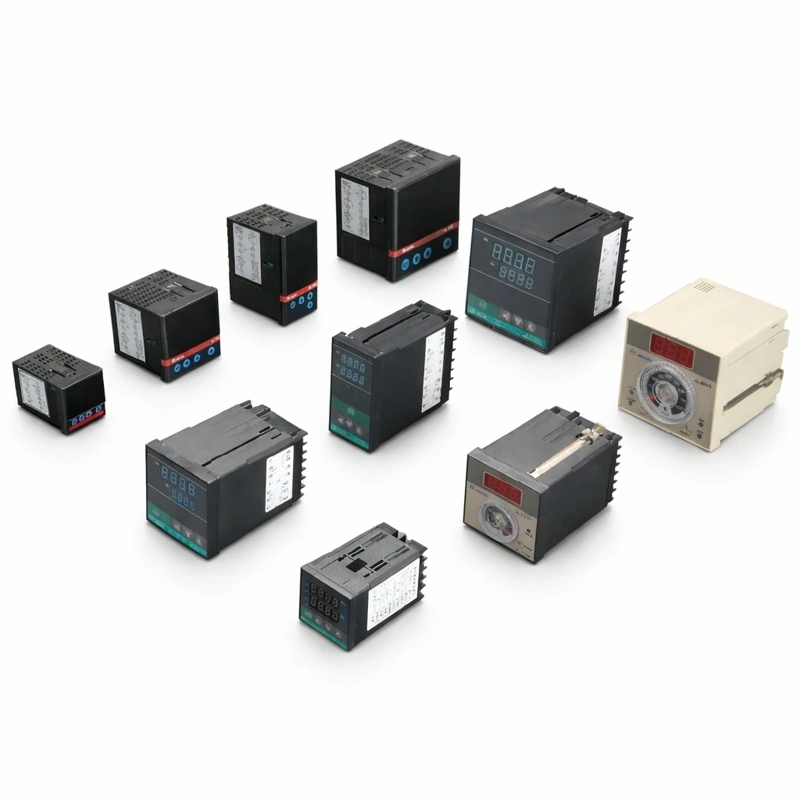
Lastly, engineering layouts must conform to international DIN panel cutout metrics. The industry relies on three standardized form factors: the highly compact square 1/16 DIN (48x48 mm), optimal for embedding directly into dense machine footprints; the vertical 1/8 DIN (48x96 mm), offering clear local text separation for floor operators; and the large-format 1/4 DIN (96x96 mm), preferred for centralized plant control consoles due to its superior long-distance legibility.
The Heatecx Specialized Solution Portfolio: X Series
Abiding strictly by our standardized engineering designation metrics, Heatecx's entire array of precision thermal regulation and monitoring instrumentation is developed under the X Series product umbrella. These units are built within ruggedized housings engineered to block heavy electromagnetic interference (EMI) while resisting airborne dust and high-temperature ambient conditions common to manufacturing facilities:
- X-C100 Series Controllers (Essential & Efficient Regulation): Built in a space-saving 1/16 DIN configuration, these units offer an ideal path for machinery manufacturers and localized control enclosures. They harness an adaptive PID control loop integrated with smart Autotuning routines. This enables the device to analyze the thermal feedback properties of the processing environment during its first activation cycle, calculating and locking its own gain constants automatically to simplify shop-floor commissioning.
- X-C900 Series Controllers (Advanced Connected Architecture): This tier is optimized for intricate industrial operations demanding rigorous parameter mapping and network integration. They feature high-luminescence dual-line LED screens to provide simultaneous visibility of PV and SV. Beyond hosting multiple configurable alarm output channels for over-temperature protection, they feature onboard RS485 serial communication using the open Modbus RTU protocol. This allows plants to daisy-chain numerous controllers into a unified digital network, routing critical data to SCADA control centers, centralized HMIs, or Distributed Control Systems (DCS).
The Heatecx Strategic Advantage: Applied Thermal Engineering
Recognizing that an instrument is only as reliable as the closed thermal loop it manages is what defines Heatecx's position in the industrial market. We do not just ship standalone components; we partner with your maintenance and engineering departments through the entire system design cycle. We audit the electrical wattage of your heating resistances, evaluate mass density profiles, and calculate dynamic response targets to construct the ideal control panel enclosure.
Our technical support specialists provide detailed guidance for programming multi-tier safety alarms—preventing critical failures such as element sheath melting—while fine-tuning PID coefficients under actual factory load conditions. Partnering with Heatecx grants your facility direct communication with seasoned industrial heat professionals, accelerating commission targets and securing maximum energy efficiency across your processing equipment.