Quartz Infrared Heating Elements
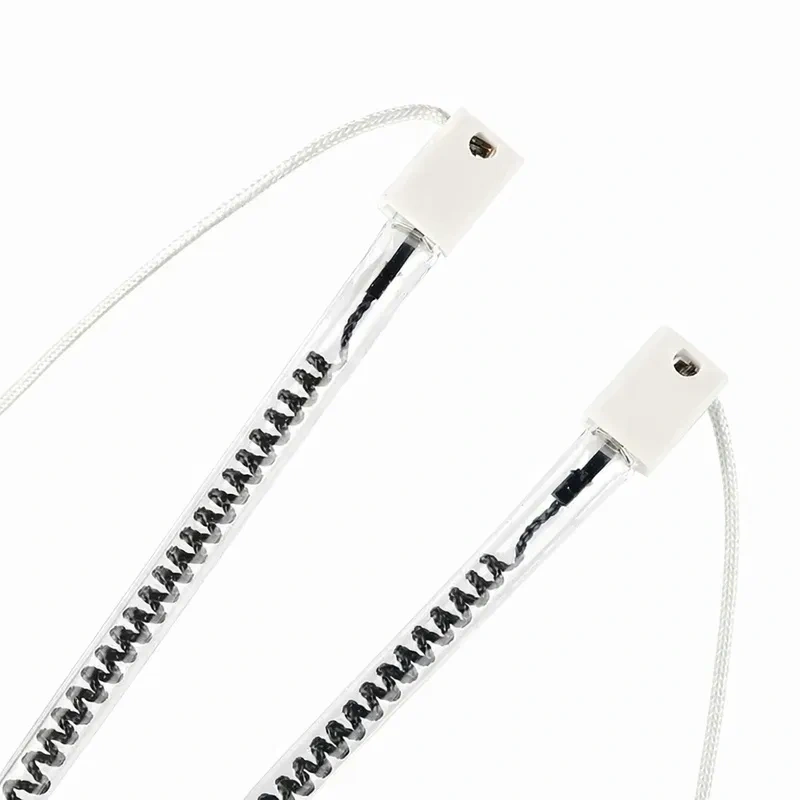
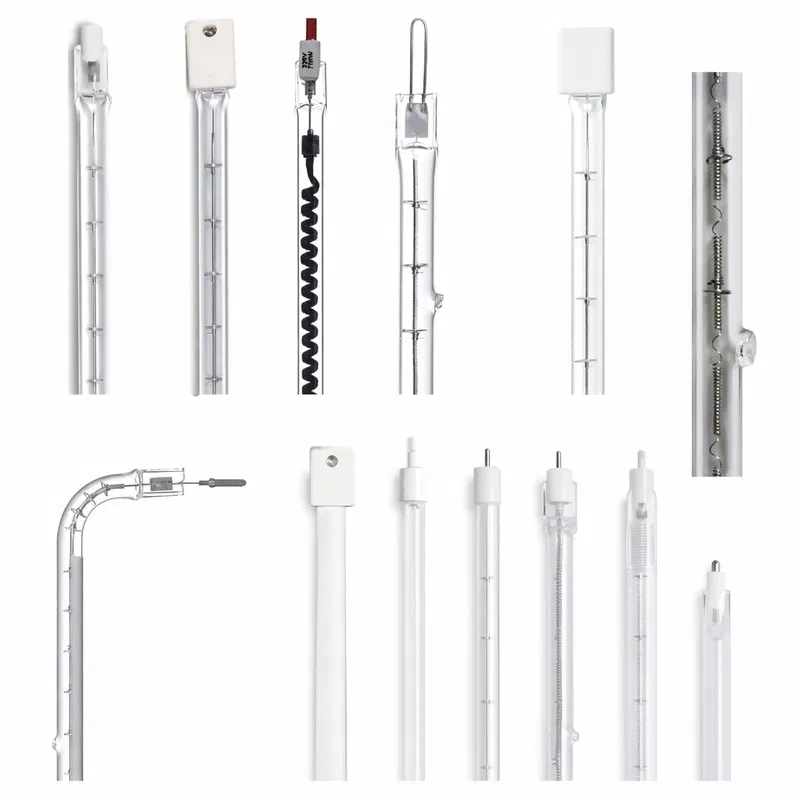
Quartz infrared heating elements are radiant heat sources built around a fused silica (quartz) tube that houses a resistive filament. Also referred to as quartz infrared emitters, quartz infrared lamps or quartz heaters, they transfer energy directly to the target material through electromagnetic radiation, with no need for a physical medium and minimal loss to the surrounding air. This category covers the formats we manufacture: single-tube quartz infrared lamps, double-tube quartz elements and carbon fiber quartz heaters, all built from high-purity quartz tubing.
As a radiant heating system, the quartz infrared heater differs from a metal tubular heater or convection heater in that it doesn't rely on an intermediate fluid: infrared energy travels in a straight line until it is absorbed by the product surface. This makes the quartz radiant emitter the reference solution for processes that demand localized, directional, fast-start heating.
Definition and how quartz infrared heating works
To understand what a quartz infrared heater is, it helps to start with its function: it's a heating element that converts electrical energy into infrared radiation via a resistive filament housed inside a clear or translucent quartz tube. How quartz infrared heating works comes down to a simple physical principle: electrical current passes through the filament, driving it to temperatures of several hundred to a few thousand degrees, and that thermal energy is emitted as electromagnetic waves that pass through the quartz — a material optically transparent to infrared — until absorbed by the surface of the target material.
The difference between quartz and ceramic heaters isn't in the radiation principle, which both share, but in thermal mass and response speed: quartz is a lightweight material that reaches operating temperature in seconds, while a ceramic emitter, with greater mass and thermal inertia, takes minutes to heat up and cool down. This difference directly determines which technology suits which process.
Among the advantages of quartz infrared tubes most valued by industry are near-instant start-up and shutdown, low weight and footprint compared with other technologies, the ability to direct radiation using built-in reflectors, no airflow or particulate generation, and a service life of thousands of hours with minimal maintenance.
Operating principle and wave technology
A quartz infrared heater is classified by the wavelength it emits, which determines its response speed, color temperature and how deeply it penetrates different materials:
|
Technology
|
Filament
|
Wavelength
|
Filament temperature
|
Response time
|
|
Short-wave (halogen)
|
Tungsten in halogen gas
|
0.76 – 1.4 µm
|
Up to ~2,200 °C
|
< 1 second
|
|
Medium-wave
|
Ni-Cr alloy
|
1.4 – 3.0 µm
|
~950 – 1,100 °C
|
30 – 60 seconds
|
|
Long-wave
|
Low-density Ni-Cr
|
3.0 – 10 µm
|
~650 – 800 °C
|
60 – 180 seconds
|
|
Carbon fiber
|
High-purity carbon fiber
|
2.0 – 10 µm
|
~800 – 900 °C
|
3 – 5 seconds
|
Short-wave quartz heaters penetrate deepest and are preferred where instant on/off response is required. Medium-wave elements offer the most common balance between penetration and surface absorption for plastics, textiles and water-based coatings. Long-wave infrared delivers gentler, more even heat distribution, useful for curing sensitive surfaces. The carbon fiber quartz heater combines an intermediate thermal response with lower energy draw, making it a preferred choice for comfort heating and compact equipment.
The comparison between medium-wave and short-wave quartz infrared is one of the most common technical decisions at the selection stage: short-wave offers higher power density and penetration, ideal for fast-cycle processes, while medium-wave is more efficient when the material absorbs better in that spectral range, as with water, plastics and textiles. In terms of the energy efficiency of quartz emitters, both technologies outperform convection systems by eliminating air preheating, though short-wave gains an added edge from its near-instant modulation capability. The maximum temperature of quartz infrared tubes in continuous operation sits between 750°C and 950°C depending on filament technology, a limit set by quartz's resistance to prolonged devitrification; above this range, ceramic or silicon carbide technologies are recommended instead.
Materials and construction
The quartz tube is manufactured from 99.9% SiO₂ fused silica, a material that combines optical transparency to infrared radiation with high resistance to thermal shock — it can go from room temperature to over 900 °C without cracking, a property borosilicate glass and other transparent ceramics cannot match. Tube ends are sealed with ceramic end caps and high-temperature cement that anchor the electrical terminals, maintaining a stable joint despite the differential thermal expansion between the quartz and the terminal metal.
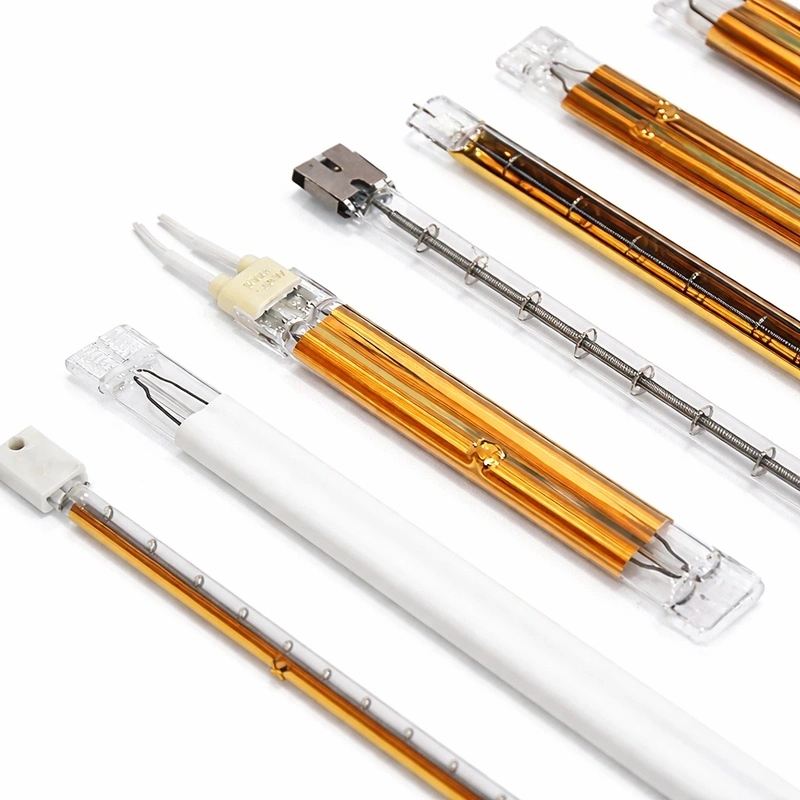
To maximize directional efficiency, quartz tubes can carry a reflective coating fired onto half their circumference: gold (up to 95% reflectivity), white ceramic (~70%) or ruby, depending on the cost/performance balance the application requires. The resistive filament is wound in a spiral inside the tube, centered by quartz spacers that prevent contact with the inner wall and avoid localized hot spots. Dimensional control of the coil — pitch, wire diameter and hot-zone length — determines how evenly the emitter's thermal profile is distributed along the full length of the tube.
General technical specifications
|
Parameter
|
Typical range
|
|
Tube material
|
Fused silica (quartz), 99.9% SiO₂
|
|
Power
|
100 W – 10,000 W depending on configuration
|
|
Operating voltage
|
110V, 220V, 380V, 440V, 480V
|
|
Tube diameter
|
8 – 20 mm (single/double tube format)
|
|
Tube finish
|
Clear, frosted, ruby, gold-reflector
|
|
Maximum continuous operating temperature
|
750 – 950 °C depending on technology
|
|
Connection type
|
Ceramic bipolar terminal, flexible high-temperature lead
|
|
Mounting orientation
|
Horizontal, vertical or angled, with no functional restriction
|
|
Nominal service life
|
5,000 – 10,000 hours continuous use
|
Energy efficiency and operating cost savings
One of the competitive advantages of a quartz infrared heater over conventional metal tubular heaters is its thermal response time. Since it reaches 100% output within seconds, a quartz emitter can be programmed to switch on only when the product is present in front of the heat source, eliminating preheating consumption and energy waste during line downtime. This near-instant on/off capability, combined with gold or ceramic reflectors that direct radiation toward the target, significantly reduces electrical consumption compared with central heating or contact-based systems — especially in processes with intermittent cycles.
Comparison with other industrial heating systems
In practice, the comparison quartz heater vs halogen heater causes some terminology confusion: "halogen" emitters are simply short-wave quartz heaters with a tungsten filament in a halogen gas atmosphere — not two distinct product families, but two names for the same technology. The more relevant engineering comparison is quartz infrared heater vs metal heater: against a classic metal tubular heater, the quartz emitter offers a much faster thermal response and superior directional efficiency thanks to reflectors, though the metal heater retains an edge in direct-contact or low-temperature immersion applications where radiation isn't required.
To determine the best infrared heater for plastics, thickness and color of the material matter most: thin or transparent plastics generally respond better to short-wave, while pigmented or thicker plastics absorb more efficiently at medium-wave, which penetrates more gradually and reduces the risk of surface overheating.
|
Criterion
|
Quartz
|
Ceramic infrared
|
Silicon carbide (SiC)
|
Metal tubular heater
|
|
Response time
|
Seconds
|
Minutes
|
Minutes
|
Minutes
|
|
Maximum temperature
|
~950 °C
|
~1,000 °C
|
~1,600 °C
|
~750 °C
|
|
Thermal uniformity
|
Medium-high
|
High
|
High
|
Medium
|
|
Weight and footprint
|
Low
|
Medium
|
Medium-high
|
Medium
|
|
Typical application
|
Fast drying and curing
|
Comfort and surface heating
|
High-temperature furnaces
|
Contact or immersion heating
|
Industrial applications
- Plastics thermoforming: quartz heaters for thermoforming are used to pre-heat sheets before vacuum or pressure forming, and to heat preforms in container blow molding.
- Coating drying and curing: quartz emitters for paint drying are common on industrial finishing and automotive refinishing lines, as well as for drying varnishes and inks at high throughput.
- Chemical and plating baths: quartz-sheathed immersion heaters, inert to corrosive and acidic solutions.
- Industrial comfort heating: zoned infrared panels in large-volume facilities, cutting energy use versus central heating.
- Textile and printing industries: contactless drying of inks, surface treatment fixation and heat-setting.
- Packaging and heat sealing: activation of heat-seal adhesives and shrink-film contraction.
- Pharmaceutical processes and cleanrooms: no airflow or particulate generation, suited to high-cleanliness environments.
- Mold pre-heating: in injection molding and reinforced composite processes, reducing cycle times.
- Food industry: infrared heaters for the food industry are used for surface drying, toasting, browning and contactless pasteurization, meeting the hygiene requirements of processing lines.
- Industrial ovens: quartz tubes for industrial ovens are integrated as pre-heating elements or fast-curing zones within tunnel ovens and continuous drying chambers.
Power control and regulation
Power management for a quartz infrared heating element is typically handled through solid-state relays (SSRs) combined with PID temperature controllers, allowing fine modulation of emitted radiation and avoiding the current spikes associated with mechanical switching. In multi-zone installations, each emitter or group of emitters can be controlled independently, enabling staged thermal profiles along a drying tunnel or continuous curing line.
Selection criteria
|
Process variable
|
Recommended technology
|
|
Very frequent on/off cycling
|
Short-wave (halogen)
|
|
Materials that absorb best in mid-band (plastics, water, textiles)
|
Medium-wave Ni-Cr
|
|
Curing delicate surfaces or large areas
|
Long-wave
|
|
Domestic or low thermal-profile use
|
Carbon fiber
|
|
Environments where cleaning is difficult or impact risk exists
|
White ceramic reflector
|
|
Maximum directional efficiency
|
Gold reflector
|
|
Installation in chemical baths or humid environments
|
Sealed tube with waterproof junction box
|
Custom manufacturing
We produce quartz infrared heating elements in custom lengths, wattages and voltages, with sealed junction boxes for chemical bath immersion, and provide guidance on selecting the optimal wave technology for a given material and production cycle. We also manufacture the quartz emitter in special geometries — curved tube, U-shaped tube or multi-filament configurations — to match the shape of the product being heated. See also our raw quartz tubing line for in-house emitter fabrication.
Purchasing, quotes and replacement parts
To buy a quartz infrared heater or request a quote for industrial quartz emitters, it's best to specify voltage, power, tube length and required wave technology in advance — for example, a 220V 1000W medium-wave quartz infrared tube — since these parameters directly affect manufacturing lead time and the price of quartz infrared tubes. As quartz infrared heater suppliers, we handle both full-equipment orders and requests for a quartz heater replacement part for packaging, thermoforming and drying lines, manufacturing custom quartz heaters when the original equipment's dimensions or connection point don't match a standard model. Contact us with your application and electrical specifications to receive a technical and commercial proposal.
Related categories
Ceramic Infrared Heaters · Silicon Carbide (SiC) Heating Elements · MoSi2 Heating Elements · Heating Blankets · Heating Plates and Disks · Raw material: High-temperature mica