Technical Foundations of Industrial Deburring
Deburring machines are critical industrial finishing systems engineered to mechanically remove burrs, sharp edges, and slag left on metal parts after thermal cutting (laser, plasma, oxy-fuel) or mechanical processing (punching, shearing, stamping). Deburring is not merely a cosmetic enhancement; it is a vital safety and quality control measure that protects operators from lacerations, ensures structural compliance with tight dimensional tolerances, and guarantees cross-linking adhesion for downstream coatings like powder painting or galvanizing.
The operational layout incorporates a high-friction conveyor belt that feeds flat or formed parts beneath modular work stations. These stations utilize wide abrasive belts to flatten heavy, vertical dross, alongside rotating or planetary vertical flap brushes that move transversely. This synchronous movement delivers uniform edge rounding along both the external perimeter and internal cutouts, effectively neutralizing sharp profiles on complex workpieces.
Process Dynamics and Contact Precision
Industrial deburring efficiency depends on precise penetration control and linear throughput. A key challenge in high-volume operations is compensating for brush wear. Advanced deburring platforms integrate automated tool-wear monitoring that micro-adjusts the height of the grinding heads. This maintains consistent working pressure, guaranteeing that perimetric burrs are eradicated without reducing nominal sheet thickness or destroying pre-existing surface protection, such as plastic masking on stainless steel or protective zinc coatings on galvanized steel.
Machine Types, Technologies, and Finishing Standards
1. Wide Belt Deburring Machines
Equipped with heavy-duty abrasive belts tensioned over a rubber contact roller. These units are custom-engineered for surface scaling, heavy slag removal, and flattening vertical burrs resulting from plasma or flame cutting. Their mechanical action is strictly directional.
2. Planetary / Rotary Brush Edge Rounding Machines
These systems deploy multiple vertical flap brushes that rotate on their own spindle while simultaneously revolving in an orbital, planetary path across the conveyor belt. This multidirectional impact ensures efficient edge rounding from every angle (360-degree breakdown), smoothing sharp edges inside and out.
3. Multi-Head Combined Systems (Belt + Brush)
The pinnacle of versatility for sheet metal fabricators. In a single automated pass, the leading module (wide abrasive belt) knocks down top-facing burrs, while the trailing modules (vertical or cross-belt brushes) smooth out the edges and deliver the final surface grain.
Finishing Standards and Technical Objectives
- Heavy Dross Removal: Stripping away stubborn laser oxide, plasma slag, or weld spatter using coarse ceramic or zirconia abrasive media.
- Edge Breaking & Radius Rounding: Modifying structural edges to precise radius specifications (typically ranging from 0.1 mm to 2.0 mm). This is critical for liquid and powder coatings, preventing coat pull-back caused by surface tension along sharp apexes.
- Surface Refinement & Graining: Removing material handling scratches to establish a pristine, uniform brushed pattern on stainless steel or aluminum sheets.
Technology Comparison Matrix
|
Technical Metric
|
Wide Belt Systems
|
Planetary Brush Systems
|
Combined Multi-Head Systems
|
|
Target Burr Type
|
Heavy vertical dross and slag
|
Sharp edges and inner cutouts
|
Complete burr envelope (Slag + Edges)
|
|
Workpiece Geometry
|
Flat, uniform parts
|
Complex flat shapes with holes
|
Flat, slightly formed, or louvered parts
|
|
Edge Treatment Action
|
Directional (Top face only)
|
Multidirectional (360° Rounding)
|
Total Processing (Removal + Radius)
|
|
Coating Protection
|
Low (Risk of stripping zinc/film)
|
High (Preserves protective masking)
|
Configurable via modular head isolation
|
|
Throughput Efficiency
|
High (Rapid linear feed rates)
|
Very High (All edges finished in 1 pass)
|
Maximum (Turnkey single-pass processing)
|
Specialized Industrial Applications
- Machinery Manufacturing & Structural Steelwork: Deburring laser-cut profiles to eliminate sharp edges, streamlining downstream assembly, fit-up, and manual welding workflows safely.
- Automotive & White Goods Production: Processing stamped structural brackets requiring strict edge radiuses prior to cathodic electrodeposition (KTL) coating, eliminating potential corrosion hotspots.
- Aerospace & Defense Components: Micro-deburring aerospace-grade aluminum and titanium alloys, where micro-burrs along component perimeters could act as stress concentrators, causing structural fatigue failure.
- Food Processing & Catering Equipment: Finishing stainless steel enclosures and hoppers to a flawless sanitary standard, eliminating sharp corners and micro-cavities where organic debris or bacterial bio-films could accumulate.
Process Stability & Troubleshooting
- Small Part Dislodgement: Small workpieces can drift or be thrown by intense brush pressure. Heatecx deburring systems prevent this by utilizing high-depression Vacuum Beds built directly into the conveyor system, or integrated magnetic tracks for ferrous sheets.
- Uneven Abrasive Consumption: Caused by feeding sheets exclusively through the center of the conveyor track. Heatecx control software tracks load distribution, prompting operators to alternate feeding paths to extend tool longevity.
- Inadequate Internal Cutout Rounding: Occurs when the conveyor feed rate is too fast or the brush grit is too fine. This is resolved by reducing conveyor line speed and increasing the RPM of the planetary brushing heads.
Why Choose Heatecx
At Heatecx, we engineer production-ready finishing infrastructure designed for structural longevity. Our industrial deburring machines and edge-rounding solutions offer peerless operational adaptation:
- Custom Modular Frame Layouts: Tailor your machine configuration (e.g., Belt-Brush-Brush or Belt-Belt) to precisely match your workshop's production requirements.
- High-Vacuum Conveyor Beds: Engineered with heavy-duty internal exhaust turbines to safely lock down parts as small as 20x20 mm without internal collisions.
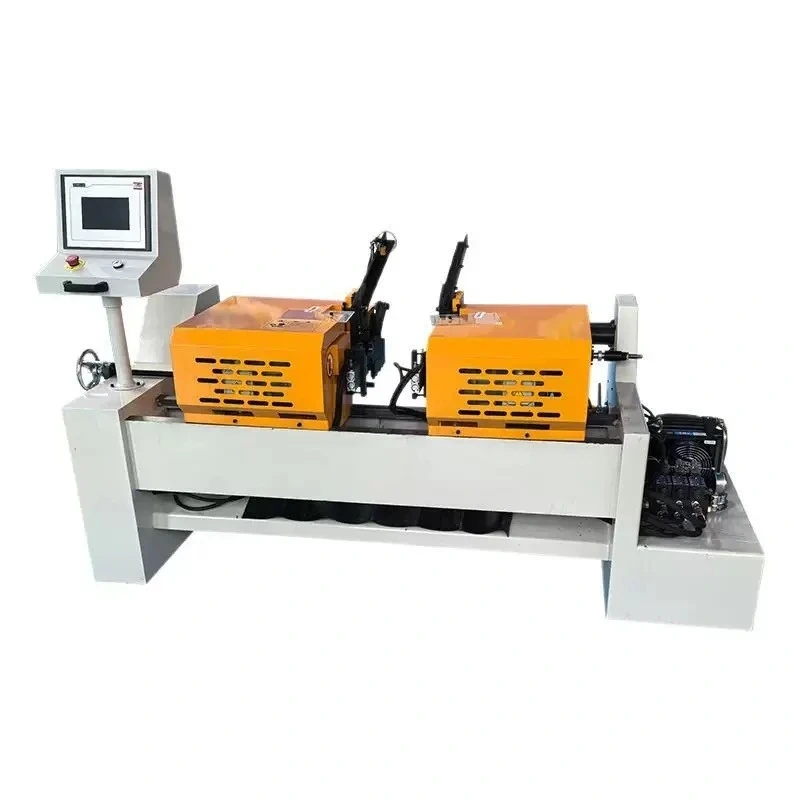
- Dynamic Smart Tool Compensation: Intuitive touchscreen HMI architecture monitors motor current draws to gauge actual tool wear, automatically adjusting head depth to secure unvarying finish metrics.