Digital Temperature Recorder/Logger – Heatecx Limited

Heatecx Limited

Digital Temperature Recorder/Logger

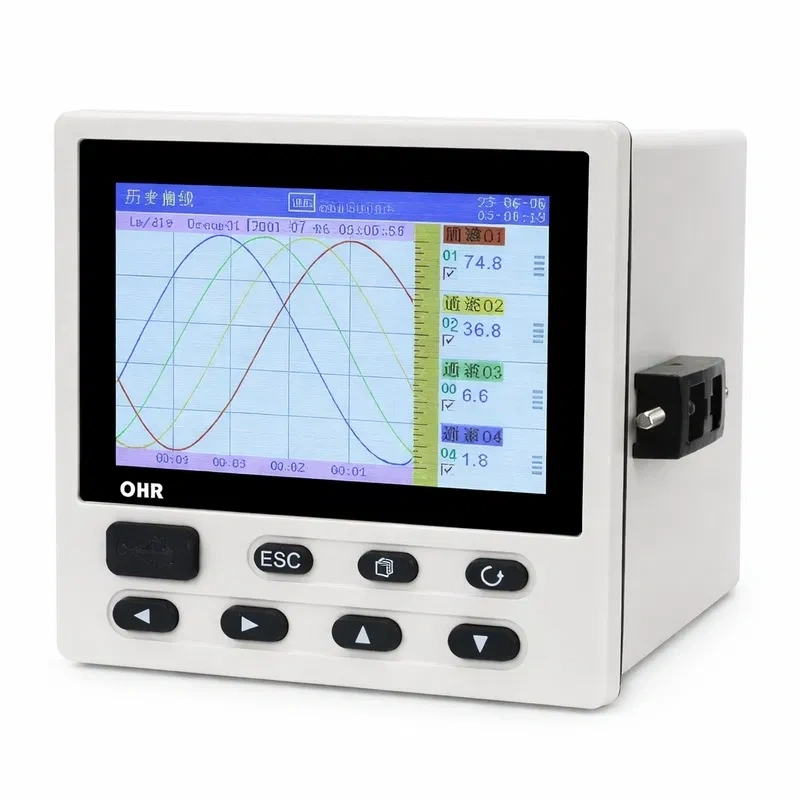
The SIN-R5000C Digital Temperature Recorder/Logger is an advanced paperless data logger designed for continuous monitoring and recording of data in demanding industrial environments. This digital temperature recorder eliminates the need for consumables like paper and pens, offering a modern and efficient solution for process data management. Equipped with a 7-inch TFT screen, the SIN-R5000C provides clear, real-time visualization of trends and measured values. Its ability to handle up to 12 analog input channels and a wide range of signals (current, voltage, thermocouples, RTD) makes it a highly versatile industrial measurement instrument, ideal for applications that demand precision and digital traceability.

The SIN-R5000C represents the cutting edge in industrial data loggers, combining an intuitive user interface with powerful logging and communication capabilities. As a digital temperature logger, it not only captures and stores critical data but also facilitates its analysis and export via its USB interface for U-disk. This paperless process recorder is fundamental for ensuring operational reliability and process optimization in industries where precise monitoring of temperature and other variables is vital. Its multiple output options (alarms, retransmission, 24V distribution) and communication options (RS485, Ethernet) allow for seamless integration with existing control and management systems, such as SCADA or DCS. The SIN-R5000C is the perfect choice for professionals seeking a reliable data logger, a multi-channel temperature recorder, and a digital monitoring solution with high storage capacity and easy access to historical data.

The SIN-R5000C Digital Temperature Recorder/Logger is an indispensable tool in a wide range of sectors and applications requiring accurate digital recording of temperature and other process variables. Its main applications include:

  • Food and Beverage Industry:​ Monitoring temperatures in cold rooms, cooking, pasteurization, sterilization, and storage processes, ensuring food quality, safety, and compliance with regulations like HACCP.

  • Pharmaceutical and Biotechnology Industry:​ Recording environmental conditions in laboratories, drug warehouses, clean rooms, and manufacturing processes to guarantee the integrity of temperature-sensitive products and comply with GMP (Good Manufacturing Practices).

  • Cold Storage and Supply Chain:​ Temperature control in refrigerated vehicles, warehouses, and distribution centers to maintain the cold chain for perishable and pharmaceutical products.

  • HVAC (Heating, Ventilation, and Air Conditioning) Systems:​ Monitoring temperature and humidity in commercial buildings, hospitals, and industrial facilities to optimize energy consumption and ensure environmental comfort.

  • Laboratories and Research Centers:​ Data recording in experiments, incubators, ovens, climate chambers, and other equipment, providing digital data for analysis and development.

  • Industrial Processes:​ Temperature control in furnaces, boilers, dryers, heat exchangers, and other processing equipment in industries such as chemical, petrochemical, metallurgical, and manufacturing.

  • Quality Control:​ Digital verification and documentation of temperature conditions at various production stages to ensure product conformity with quality standards and facilitate audits.

  • Energy Management:​ Monitoring the thermal efficiency of systems and equipment to identify energy-saving opportunities.

The SIN-R5000C Digital Temperature Recorder/Logger offers a combination of advanced features and significant advantages that position it as a leading paperless digital monitoring solution:

Key Features:

  • 7-inch TFT Screen:​ Provides a clear, high-resolution user interface for real-time visualization of data, trends, and configurations.

  • Multiple Input Channels:​ Supports 1 to 12 selectable analog channels, allowing simultaneous monitoring of multiple process points or variables.

  • Wide Signal Compatibility:​ Accepts a wide variety of input signals, including standard current (0-20mA, 4-20mA), voltage (0-5V, 1-5V, 0-20mV, -20-20mV, 0-100mV), thermocouples (S, B, K, T, E, J, R, N), and thermal heaters (Pt100, Cu50, Pt1000 customizable).

  • Versatile Output Functions:​ Includes 24V distribution output, up to 12 configurable alarms (220V 1A), and up to 6 channels of retransmission / RS485 communication / Ethernet communication output.

  • Wide Power Supply Range:​ Operates with a (85-264) VAC, 50/60Hz power supply, providing flexibility in various installations.

  • Configurable Sampling Periods:​ Offers nine sampling period options, from 1 second to 240 seconds, to adapt to different process dynamics.

  • Large Storage Capacity:​ Can store data for up to 24 days with 1-second sampling (example for 16 channels), ensuring a complete process history.

  • External Data Transfer:​ Incorporates a standard USB 2.0 interface for easy data transfer to a U-disk (USB flash drive), simplifying download and analysis.

  • Edit Function:​ Supports input of Chinese characters (4 characters) or 8 alphanumeric characters for easy configuration and labeling.

  • Robust Working Conditions:​ Designed to operate in a temperature range of -10 to 50°C and relative humidity of 10 to 90% RH (non-condensing).

  • High Measurement Accuracy:​ With an accuracy of 0.2% F.S, it guarantees reliable and exact measurements.

Advantages:

  • Elimination of Consumables:​ As a paperless recorder, it reduces operational costs and maintenance associated with chart paper and pens.

  • Simplified Data Management:​ Digital data transfer via USB facilitates archiving, searching, and analysis of large volumes of information.

  • Enhanced Visualization:​ The 7-inch TFT screen offers an intuitive graphical interface for clear, real-time monitoring.

  • Flexibility and Adaptability:​ Its wide compatibility with signal types and channels makes it suitable for a great variety of sensors and applications.

  • Advanced Integration:​ Communication options (RS485, Ethernet) and versatile outputs allow for smooth integration with automation and control systems.

  • Proactive Alerts:​ Configurable alarms allow for a quick response to deviations, minimizing risks and losses.

  • Space Saving:​ Its compact design and absence of paper contribute to less installation space and a cleaner work environment.

  • Digital Traceability:​ Provides a complete and secure digital record, essential for audits and regulatory compliance in the digital age.

Technical Characteristic

Specification

Product Name

SIN-R5000C

Display Method

7-inch TFT LCD Screen

Input Channels

1-12 analog channels (selectable)

Input Signals

Standard: 0-20mA, 4-20mA, 0-5V, 1-5V
Millivolts: 0-20mV, -20-20mV, 0-100mV
Thermocouple: S, B, K, T, E, J, R, N
Thermal Heater: Pt100, Cu50, Pt1000 (customizable)

Output Functions

24V distribution output, Max. 12 alarms (220V 1A)

Retransmission / Communication Output

Max. 6 channels of retransmission / RS485 Communication / Ethernet Communication output

Power Supply

(85-264) VAC, 50/60Hz

Sampling Period

1, 2, 4, 6, 15, 30, 60, 120, 240 seconds (nine options)

Storage Duration

1 second/point, can store 24 days (e.g., for 16 channels)

External Transfer

Standard USB 2.0 interface (for U-disk)

Edit Function

Supports input of Chinese characters (4 characters) or 8 alphanumeric characters

Working Environment

Temperature: -10~50°C; Relative Humidity: 10~90% RH (non-condensing)

External Dimensions

185mm × 154mm × 76mm

Cut-out Size

138mm × 138mm

Measurement Accuracy

0.2% F.S


To select the optimal configuration of the SIN-R5000C Digital Temperature Recorder/Logger, consider the following key points based on your specific application requirements. A suitable choice will ensure efficient process monitoring and effective data management:

  1. Number of Input Channels:​ Determine how many measurement points you need to monitor simultaneously. The SIN-R5000C offers configurations from 1 to 12 channels. Choose a model with enough channels to cover your current and future multi-channel data logging needs.

  2. Type of Input Signal:​ Identify the type of sensors you will use (thermocouples, RTD, current, or voltage signals). The SIN-R5000C is compatible with a wide range; ensure it is compatible with your existing instruments for seamless sensor integration.

  3. Accuracy Requirements:​ The accuracy of 0.2% F.S is standard for the SIN-R5000C, which is suitable for most industrial applications. If your application has extremely strict accuracy requirements, confirm that this level meets your high-precision measurement standards.

  4. Communication Options:​ If you need to integrate the recorder with a centralized control system (SCADA, DCS) or data management software, select the RS485 or Ethernet communication options. Consider the distance, number of devices on the network, and the need for remote data access.

  5. Output Functions:​ Evaluate the need for alarm outputs for process alerts or event control. If you need to retransmit the signal to other devices (PLCs, indicators), opt for the retransmission output channels. The 24V distribution output is useful for powering sensors.

  6. Sampling Period and Storage:​ Consider your process dynamics. For rapid changes, choose a short sampling period (e.g., 1 second). The storage capacity of 24 days (for 16 channels at 1s) is generous, but verify if it suits your long-term data logging needs.

  7. Installation Environment:​ Verify the external dimensions (185x154x76mm) and cut-out size (138x138mm) to ensure the recorder fits properly in your control panel or cabinet. Ensure that the environmental conditions (temperature, humidity) are within the equipment's operating limits.

By carefully considering these factors, you can select the optimal configuration of the SIN-R5000C for efficient, reliable, and paperless digital temperature monitoring in your specific application, ensuring superior data management and optimization of operational efficiency.

FAQ

Downloading data from a modern data logger is designed to eliminate manual errors. Depending on the model, there are three main methods:

  • Direct USB Connection:​ Many devices function as "Plug & Play" storage. When connected, they automatically generate a report in PDF or Excel without the need for proprietary software.

  • Wireless Connectivity (WiFi/Bluetooth):​ State-of-the-art loggers synchronize data to the cloud or mobile applications in real-time, allowing remote download from any office.

  • Reading Stations:​ Some industrial models require an interface base that transfers information via infrared sensors or metal contacts to the computer's USB port.

Ensure the logging interval is well configured before downloading to avoid excessively large files that hinder analysis in Excel.

Customers also viewed