Flat Resistance Wire – Heatecx Limited

Heatecx Limited

Flat Resistance Wire

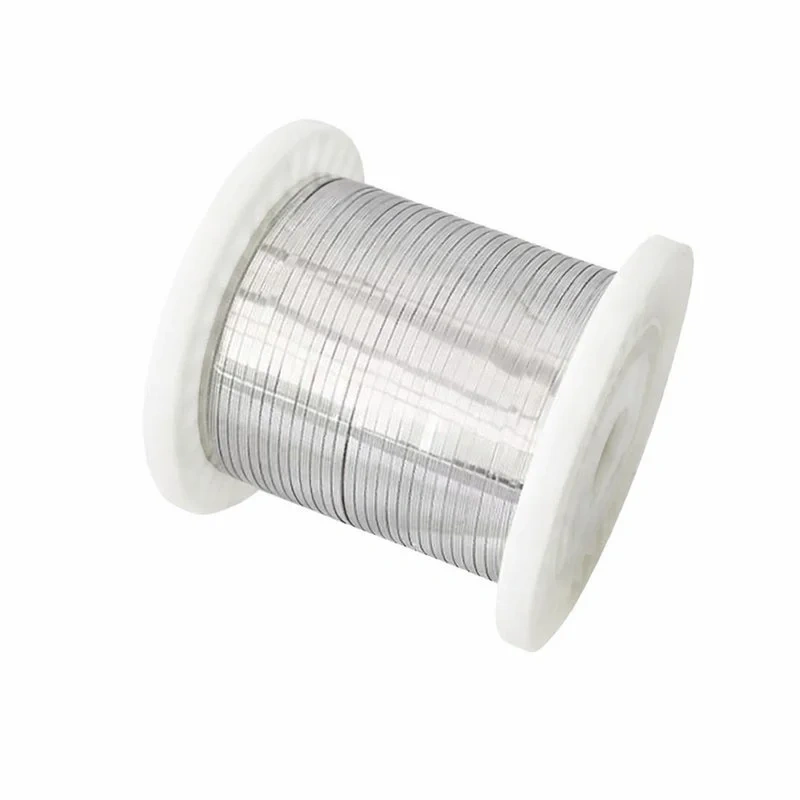
Flat resistance wire, also known as flat wire or resistive ribbon, is a specialized type of resistance wire manufactured from metallic alloys with high electrical resistivity. Unlike traditional round wire, its flat strip or ribbon design optimizes contact surface and heat dissipation, making it an ideal heater​ element for various industrial and commercial applications. This material is fundamental in the creation of precision heating elements, where uniform heat and durability are critical. The most common alloys include Nicromel (NiCr 80/20), Nickel-Chromium in various proportions, Iron-Chromium-Aluminum (FeCrAl), and Kanthal—each selected for their specific properties of temperature and corrosion resistance.

Our Nickel-Chromium alloy flat resistance wires are advanced engineering materials designed to deliver exceptional performance in high-temperature and mechanical stress environments. Thanks to their optimized composition, these resistance wires combine superior ductility, processability, and solderability, facilitating integration into a wide range of designs. They feature high and stable electrical resistance, excellent corrosion resistance, and notable surface oxidation resistance, ensuring a long service life and consistent performance. Their good winding capacity allows for efficient manufacturing and adaptability to diverse heater​ configurations.

The inherent properties of flat resistance wire distinguish it as a superior solution for heat generation:

  • High & Stable Electrical Resistance: Offers high and exceptionally stable electrical resistance across a wide temperature range, ensuring consistent heater​ performance and predictability—crucial for precision heating elements.

  • Excellent High-Temperature Resistance: Capable of operating effectively in environments up to 1300°C (depending on the specific alloy, such as Cr10Ni90), making it indispensable for industrial furnaces and extreme heat applications.

  • Superior Corrosion & Oxidation Resistance: The Nickel-Chromium composition provides robust protection against corrosion and surface oxidation, significantly extending the service life of the heater​ strip even in adverse conditions.

  • Good Ductility & Processability: Its malleability allows the flat wire to be easily formed, wound, and soldered, facilitating the manufacture of resistive ribbons with complex geometries and customized designs.

  • Efficient Heat Dissipation: The flat shape maximizes contact surface and heat transfer efficiency, resulting in faster and more uniform heating compared to round wires—ideal for plastic sealers.

  • Long Service Life: The combination of high temperature, corrosion, and oxidation resistance contributes to exceptional durability, reducing the need for frequent replacements and minimizing maintenance costs.

Flat resistance wire is a versatile and essential component in numerous sectors due to its ability to generate heat efficiently and controllably. Its applications span from high-demand industrial processes to everyday devices:

  • Plastic Sealing & Packaging: Serves as the core of plastic sealers and bag sealing machines, where precise and rapid heat is required to create airtight, durable seals. Its flat shape ensures uniform contact and efficient heat transfer for flawless bag sealing.

  • Industrial Furnaces: Used as heater​ elements in high-temperature industrial furnaces, heat treatment ovens, and drying equipment—where oxidation resistance and stability at extreme temperatures are crucial.

  • Shrink Tunnels & Heating Systems: Integrated into shrink tunnels and infrared heating systems for comfort and industrial processes, providing efficient radiant heat.

  • Appliances: Present in toasters, hair dryers, water heaters, and other devices requiring heat generation.

  • Automotive Industry: Used in heated seats, defogging mirrors, and temperature sensors.

  • Medical Equipment: Employed in sterilizers and heating devices for clinical applications.

  • Dynamic Braking Resistors: Used in dynamic braking applications to dissipate energy in the form of heat.

The following technical specifications correspond to our Nickel-Chromium alloys for flat resistance wire, highlighting key properties that ensure superior performance. Data is presented for different compositions, including Nicromel variants.

Property / Material

Cr10Ni90

Cr20Ni80

Cr30Ni70

Cr15Ni60

Cr20Ni35

Cr20Ni30

Cr30Ni70 (Revised)

Composition (%)


Nickel (Ni)

90

Balance

Balance

55.0–61.0

34.0–37.0

30.0–34.0

Balance

Chromium (Cr)

10

20.0–23.0

28.0–31.0

15.0–18.0

18.0–21.0

18.0–21.0

28.0–31.0

Iron (Fe)

≤1.0

≤1.0

Balance

Balance

Balance

≤1.0

Max. Temperature (°C)

1300

1200

1250

1150

1100

1100

1250

Melting Point (°C)

1400

1400

1380

1390

1390

1390

1380

Density (g/cm³)

8.7

8.4

8.1

8.2

7.9

7.9

8.1

Resistivity (μΩ·m, 20°C)

8.7

8.4

8.1

8.2

7.9

7.9

8.1

Elongation at Break (%)

≥20

≥20

≥20

≥20

≥20

≥20

≥20

Specific Heat (J/g·°C)

0.44

0.461

0.494

0.5

0.5

0.461

Thermal Conductivity (kJ/m·h·°C)

60.3

45.2

45.2

43.8

43.8

45.2

Linear Expansion Coefficient (x10⁻⁶ /°C, 20–1000°C)

18

17

17

19

19

19

17

Microstructure

Austenitic

Austenitic

Austenitic

Austenitic

Austenitic

Austenitic

Austenitic

Magnetism

Weak

Weak

Weak

Weak

Weak

Weak

Weak

Note: "Balance" in Nickel or Iron composition indicates the element constitutes the remaining percentage of the alloy after accounting for other major elements. The "Cr30Ni70 (Revised)" column clarifies data consistency from the original source, where "Cr30Ni70" appeared twice with slightly different property values.

Choosing the right flat resistance wire is fundamental to the success of any heating application. Beyond basic technical specifications, it is crucial to consider factors that directly impact the performance, efficiency, and service life of the heater​ strip:

  • Operating Environment: Evaluate environmental conditions—such as corrosive atmospheres, humidity, or vibrations—to select an alloy with appropriate resistance. For example, in highly oxidizing environments, alloys with higher chromium content or aluminum additions (e.g., FeCrAl) may offer superior protection.

  • Heating/Cooling Cycles: The frequency and severity of thermal cycles can affect material fatigue. Alloys with good microstructural stability and low thermal expansion coefficients are preferable for applications with frequent cycles, such as plastic sealers.

  • Heater Element Design: The geometry of the flat wire (width, thickness) must be optimized to achieve the desired heating power and uniform heat distribution. Proper design can improve energy efficiency and extend the life of heater​ elements.

  • Compatibility with Adjacent Materials: Ensure the resistance wire is compatible with insulating and structural materials it will contact to avoid chemical reactions or premature degradation.

  • Regulations & Standards: Compliance with industry-specific safety and performance regulations (e.g., for industrial furnaces or bag sealing equipment) is imperative to guarantee reliability and product acceptance.

FAQ

Calculating the required resistance for a heater​ element is key to its efficiency. It is based on the available power (W) and voltage (V), using Ohm’s Law and Joule’s Law. For a resistance wire or resistive ribbon:

Key Formulas:

  • Power (P) = V² / R

  • Resistance (R) = V² / P

  • R = ρ * (L / A) (where ρ = material resistivity, L = length, A = cross-sectional area)

Steps:

  1. Determine the required Power (P) and Voltage (V) for your application (e.g., plastic sealer, industrial furnace).

  2. Calculate Resistance (R) using R = V² / P.

  3. Select the material (e.g., Nicromel (NiCr 80/20), Kanthal, Iron-Chromium-Aluminum (FeCrAl)) and its dimensions (flat wire, resistance wire) to achieve the calculated resistance—considering resistivity (ρ) and operating temperature.

Customers also viewed