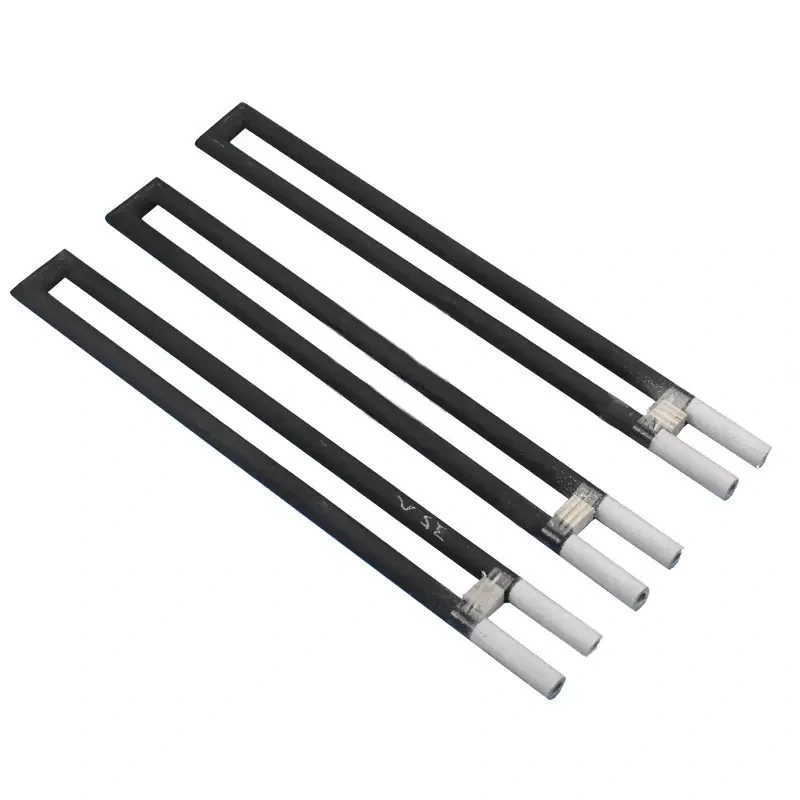
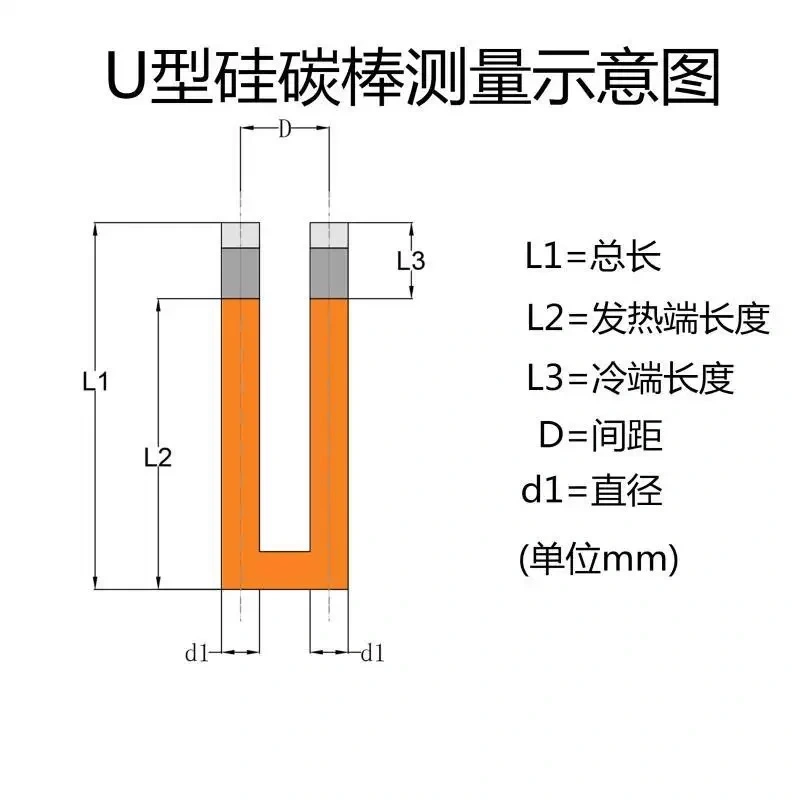
Silicon Carbide (SiC) GDC/U Type Heater
Experience the durability and efficiency of the SiC GDC/U Heating Element, a robust solution for 1500°C heating applications. Its silicon carbide composition provides superior oxidation and thermal shock resistance, making it indispensable in heat treatment furnaces and metallurgical processes. The U-shaped configuration allows for uniform heat distribution and easy integration into various furnace architectures. Invest in the reliability of the SiC GDC/U to optimize your high-temperature processes and reduce maintenance costs.
The Silicon Carbide (SiC) GDC / U Type Heater is designed to deliver exceptional performance in resistance furnaces with controlled atmospheres. Its advanced manufacturing ensures a nominal surface temperature of 1500°C, making it ideal for industrial processes requiring rigorous thermal control and unbreakable stability. This type of SiC heater is the perfect choice for applications where environmental purity and temperature precision are crucial, ensuring consistent results and long equipment life. Optimized for high-temperature industrial heating, the U-shaped SiC element minimizes contamination and maximizes energy efficiency.
-
Resistance furnaces with controlled atmosphere: Ideal for processes requiring a specific, contaminant-free thermal environment.
-
Metal heat treatment: For hardening, annealing, and other processes demanding high temperatures and precision.
-
Ceramic and glass industry: Heating of materials to elevated temperatures in controlled environments.
-
Research and development laboratories: For tests and experiments simulating extreme temperature conditions.
-
Sintering processes: Where constant and uniform temperature is required for material compaction.
Features:
-
Nominal surface temperature of 1500°C: Capable of operating in extreme heat environments.
-
Design optimized for controlled atmosphere furnaces: Minimizes interaction with the process environment.
-
Manufactured with Silicon Carbide (SiC): High oxidation and thermal shock resistance.
-
Long service life: Superior durability in high-temperature conditions.
-
High energy efficiency: Effective conversion of electrical energy into heat.
Advantages:
-
Consistent and precise results: Maintains the desired temperature with high stability.
-
Reduced operational costs: Less need for replacement and maintenance.
-
Application versatility: Suitable for a wide range of high-temperature industrial processes.
-
Improved product quality: Uniform heating that prevents defects in processed materials.
-
Safe operation: Robust materials that ensure reliable performance.
|
Parameter |
Value |
|---|---|
|
Heater Type |
GDC / U Type Silicon Carbide |
|
Nominal Surface Temperature |
1500°C |
|
Size Annotation Method |
GDCd/l/m x 2 x E |
|
Material |
Silicon Carbide (SiC) |
|
Shape |
U-shaped |
-
Furnace Preparation: Ensure the furnace is clean and free of debris. Verify that the mounting holes are aligned and of the correct size for the heater.
-
Careful Handling: Handle SiC heaters with care to avoid impacts or fractures. Use gloves to prevent contamination.
-
Heater Insertion: Insert the GDC/U heater into the furnace, ensuring the terminals are correctly oriented towards the electrical connections.
-
Electrical Connection: Make the electrical connections securely, using suitable high-temperature terminals. Ensure there are no loose connections that could cause electrical arcing.
-
Initial Test: Before full-load operation, perform a gradual heating test to verify correct operation and temperature uniformity.
FAQ
What is the average service life of a SiC heater operating at 1500°C?
The service life of a Silicon Carbide (SiC) heater operating at its maximum nominal temperature of 1500°C typically ranges between 2,000 and 5,000 hours of continuous operation. This range critically depends on the surface load (W/cm²) and the furnace atmosphere.
Factors Influencing Longevity: At 1500°C, the SiC material is near its thermal operating limit. To maximize durability, it is vital to maintain a low surface load (generally between 3-8 W/cm²).
Impact of Thermal Cycling: Intermittent use (frequent on/off cycles) significantly reduces service life due to mechanical stress from thermal expansion. Continuous operation is preferred to achieve the heater's maximum performance.