Terminal Block | Ceramic Block for Temperature Sensors
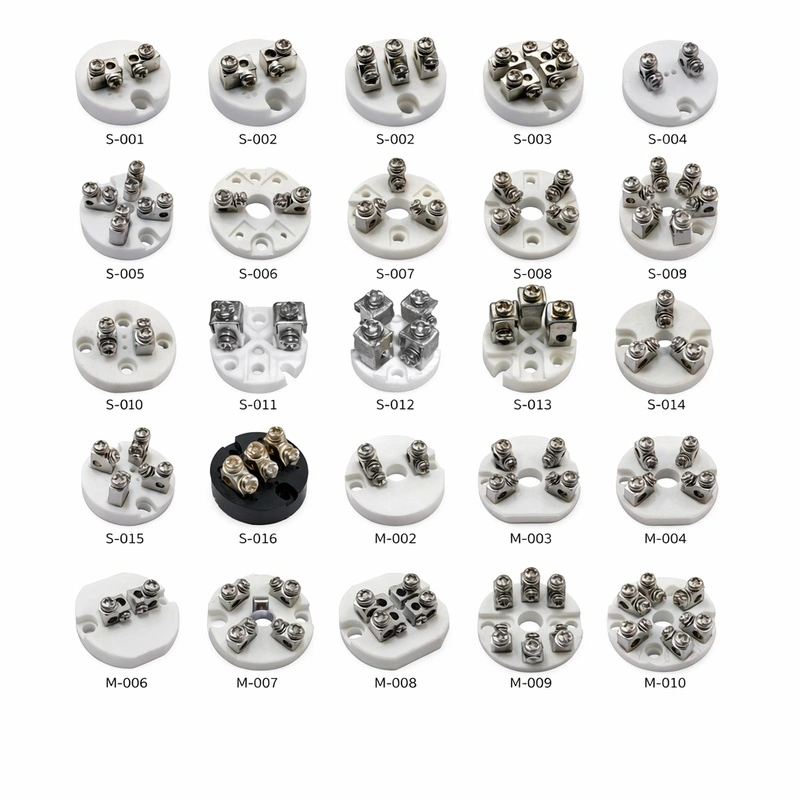
The terminal block, also known as ceramic block or connection socket, is a critical component designed to facilitate safe and stable electrical interconnection between sensor elements (RTD or thermocouples) and extension or transmission cables. These blocks are typically installed inside the sensor connection head, acting as the junction point where millivolt (thermocouples) or resistance (RTD) signals are transferred to the monitoring system. Manufactured with high-quality insulating materials such as technical ceramic or bakelite, these thermocouple accessories are designed to withstand extreme thermal conditions and provide superior electrical insulation, preventing short circuits or interference that could compromise measurement accuracy.
The construction of a ceramic terminal block is generally based on porcelain, steatite, or high-density alumina, materials selected for their exceptional thermal shock resistance and their ability to maintain constant dielectric properties even at temperatures exceeding 1000 °C. On the other hand, the bakelite terminal block is a robust and economical alternative for moderate temperature applications, offering excellent mechanical strength and insulation in standard industrial environments. These blocks feature metallic terminals (nickel-plated brass, stainless steel, or specific alloys) and clamping screws that ensure a firm, low-resistance contact. Their modular design allows for 2, 3, 4, or even 6-pole configurations, adapting to single, dual, or multi-wire RTD sensors.
Terminal blocks are indispensable accessories in practically any industrial temperature measurement system. Their main applications include:
-
Assembly of Industrial Sensors: Used as the connection core in the manufacture of J, K, T, E, R, S, and B type thermocouples, as well as Pt100 and Pt1000 RTD sensors.
-
Furnaces and Thermal Processes: Due to their high heat resistance, ceramic blocks are ideal for connections inside industrial furnaces, drying ovens, and heat treatment equipment.
-
Chemical and Petrochemical Industry: Installed inside connection heads to protect electrical junctions in processes involving corrosive fluids or elevated temperatures.
-
Plastics Machinery: Used in extruders and injection molding machines where a reliable connection resistant to constant vibration is required.
-
Industrial Heating Systems: Connection of electric heaters and control sensors in boilers and heat exchange systems.
-
Test Laboratories: Facilitate the quick and safe exchange of sensors in test benches and calibration equipment.
Main Features:
-
High-Resistance Materials: Body manufactured from technical ceramic (steatite/porcelain) or high-density bakelite.
-
Superior Contact Terminals: Screws and connection plates in nickel-plated brass or stainless steel to prevent oxidation and ensure optimal conductivity.
-
Multi-Pole Design: Available in 2, 3, 4, and 6-terminal configurations for single or duplex sensors.
-
Extreme Thermal Resistance: Ceramic models withstand continuous operating temperatures of up to 800 °C - 1000 °C, while bakelite models are ideal up to 150 °C - 200 °C.
-
Dielectric Insulation: High dielectric strength to prevent current leakage or interference in low-level (mV) signals.
Advantages:
-
Signal Stability: Provide a firm mechanical connection that minimizes contact resistance, crucial for the accuracy of RTDs and thermocouples.
-
Durability in Harsh Environments: Resistant to chemical corrosion, thermal shock, and heat aging.
-
Mounting Versatility: Standardized dimensions that allow installation in most connection heads (KNE, NAA, DAN, etc.).
-
Electrical Safety: The terminal design prevents accidental contact and short circuits between poles.
-
Easy Maintenance: Allow for quick disconnection and replacement of the sensor without the need for complex special tools.
|
Specification |
Ceramic Terminal Block |
Bakelite Terminal Block |
|---|---|---|
|
Body Material |
Porcelain / Steatite / Alumina |
Bakelite (Phenolic Resin) |
|
Maximum Temperature |
800 °C - 1200 °C (depending on grade) |
150 °C - 200 °C |
|
Number of Poles |
2, 3, 4, 6 terminals |
2, 3, 4 terminals |
|
Terminal Material |
Nickel-Plated Brass / Stainless Steel |
Brass / Zinc-Plated Steel |
|
Insulation Voltage |
> 600 V AC |
> 400 V AC |
|
Contact Resistance |
< 0.01 Ω |
< 0.02 Ω |
|
Standard Diameter |
33mm, 40mm, 45mm, 54mm |
33mm, 40mm |
|
Center Distance |
19mm, 27mm, 33mm, 40mm |
33mm, 40mm |
|
Color |
White / Cream |
Black / Brown |
|
Model |
Material |
Poles |
Diameter (mm) |
Recommended Application |
|---|---|---|---|---|
|
S0077-2P |
Ceramic |
2 |
33 / 40 |
Simple thermocouples (J, K, T). |
|
S0077-3P |
Ceramic |
3 |
40 / 45 |
3-wire Pt100 RTD sensors. |
|
S0077-4P |
Ceramic |
4 |
45 / 54 |
Dual thermocouples or 4-wire RTDs. |
|
S0077-6P |
Ceramic |
6 |
54 |
High-complexity duplex sensors. |
|
B-BAQ-2P |
Bakelite |
2 |
33 |
Low-temperature, economical connections. |
|
B-BAQ-3P |
Bakelite |
3 |
40 |
Standard RTD in non-aggressive environments. |
|
TC-MINI |
Ceramic |
2 |
20 / 25 |
Miniature heads and tight spaces. |
|
TC-HIGH-TEMP |
Alumina |
2 / 4 |
45 |
Foundry and high-temperature processes (>1000°C). |
FAQ
What is a terminal block (or ceramic block)?
A terminal block, also known as a ceramic block or connection socket, is a high-engineering insulating component designed to perform the electrical interconnection between a temperature sensor (such as a thermocouple or a Pt100 RTD) and the instrumentation wiring.
This device is typically installed inside the connection head and acts as the core of the sensor, allowing for stable and safe signal transfer. Ceramic terminal blocks are preferred in the industry for their exceptional resistance to extreme heat (up to 1000 °C) and their high dielectric strength, which prevents short circuits and interference. On the other hand, bakelite blocks offer a robust and economical solution for moderate temperature applications, always guaranteeing a firm mechanical fixation for the conductors.