Paper Chart Temperature Recorder – Heatecx Limited

Heatecx Limited

Paper Chart Temperature Recorder

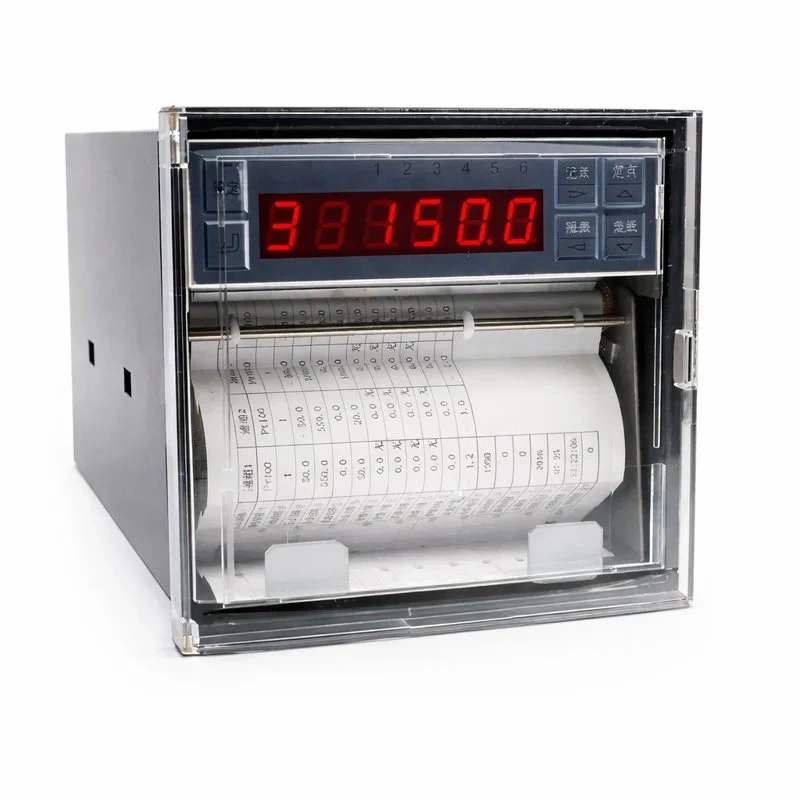
The MIK-R1000 Paper Chart Temperature Recorder is a high-precision industrial measurement instrument designed for continuous monitoring and recording of temperature and other process variables. This industrial data recorder uses a paper printing system to provide a physical, unalterable record of measurements, making it an ideal solution for applications requiring traceability and regulatory compliance. The MIK-R1000 is a versatile temperature chart recorder, capable of accepting a wide range of input signals, including standard current, voltage, RTD (Thermal Resistor), and thermocouples, ensuring its adaptability to various environments and sensors. Its robust design and intuitive interface position it as an essential tool for process control and data security in multiple sectors.

The MIK-R1000 is an advanced monitoring solution that combines the reliability of paper recording with the precision of digital technology. This paper temperature recorder not only captures and stores critical data but also presents it clearly and legibly, facilitating analysis and decision-making. It is fundamental equipment for ensuring industrial reliability and automation in environments where precise temperature monitoring is crucial. Its ability to handle up to 8 selectable input channels and offer communication options like RS232C and RS485 (customizable) makes it a flexible and powerful data logging instrument. Additionally, its 4-20mA analog output (customizable) allows for integration with external control systems, improving operational efficiency and responsiveness to deviations. The MIK-R1000 is the perfect choice for professionals seeking a reliable temperature recorder and process chart recorder with tangible data history.

The MIK-R1000 Paper Chart Temperature Recorder is an indispensable tool in a wide variety of sectors and applications where precise temperature control and recording are critical. Its main applications include:

  • Food and Beverage Industry:​ Monitoring temperatures in cold rooms, cooking, pasteurization, and storage processes to ensure product quality and safety. Crucial for HACCP compliance.

  • Pharmaceutical and Biotechnology Industry:​ Recording environmental conditions in laboratories, drug warehouses, and manufacturing processes to guarantee the integrity of temperature-sensitive products.

  • Cold Storage and Supply Chain:​ Temperature control in refrigerated vehicles, warehouses, and distribution centers to maintain the cold chain and prevent spoilage of perishable goods.

  • HVAC Systems (Heating, Ventilation, and Air Conditioning):​ Monitoring temperature and humidity in commercial and industrial buildings to optimize energy consumption and ensure environmental comfort.

  • Laboratories and Research Centers:​ Data recording in experiments, incubators, ovens, and climate chambers, providing documented evidence for research and development.

  • Industrial Processes:​ Temperature control in furnaces, boilers, dryers, and other processing equipment in industries such as chemical, petrochemical, and metallurgical.

  • Quality Control:​ Verification and documentation of temperature conditions at various production stages to ensure product conformity with quality standards.

  • Agriculture and Floriculture:​ Monitoring of greenhouses and storage facilities to optimize growing and conservation conditions for crops and flowers.

The MIK-R1000 Paper Chart Temperature Recorder offers a combination of advanced features and significant advantages that distinguish it in the industrial instrumentation market:

Key Features:

  • Multiple Input Channels:​ Supports 1 to 8 selectable input channels, allowing simultaneous monitoring of multiple points or variables. Accepts standard current, voltage, RTD, and thermocouple signals.

  • High Accuracy:​ With an accuracy of ±0.2% FS, it guarantees reliable and exact measurements, essential for critical process control.

  • Paper Recording:​ Provides a physical, continuous record of data, offering tangible, unalterable evidence for audits and regulatory compliance.

  • Digital LED Display:​ Facilitates clear, real-time visualization of measured data, improving operational supervision.

  • Fast Sampling Rate:​ A sampling cycle of 0.6 seconds ensures agile and precise capture of variable changes.

  • Communication Options:​ RS232C or RS485 communication interface (customizable) for integration with SCADA, DCS, or other data control and management systems.

  • Analog Outputs:​ Two 4-20mA analog outputs (customizable) for retransmitting signals to other devices or control systems.

  • Alarm Relay Outputs:​ Options for 2, 4, or 6 relay outputs for activating visual or audible alarms, or for controlling external devices if preset limits are exceeded.

  • Compact Design:​ Dimensions of 144mm x 144mm x 200mm and a cutout size of 138mm x 138mm, facilitating installation in control panels.

Advantages:

  • Documented Traceability:​ The paper record provides irrefutable proof of process conditions, crucial for quality and audits.

  • Operational Reliability:​ Its robust construction and measurement accuracy ensure consistent and durable performance in demanding industrial environments.

  • Versatility:​ The ability to accept multiple signal types and channels makes it adaptable to a wide range of applications and sensors.

  • Easy Integration:​ Communication options and analog outputs facilitate its incorporation into existing automation systems.

  • Early Warning:​ The alarm outputs allow for a quick response to deviations, minimizing risks and losses.

  • Ease of Use:​ The LED display and clear interface simplify daily configuration and monitoring.

  • Cost-Effectiveness:​ Offers a complete recording and monitoring solution with an excellent balance of features and price.

Technical Characteristic

Specification

Product Model

MIK-R1000

Product Name

Paper Chart Recorder

Input Signal

Standard Current, Voltage, RTD (Thermal Resistor), Thermocouple

Sampling Cycle

0.6 seconds

Communication

RS232C or RS485 (customizable)

Analog Output

2 channels, 4-20mA (customizable)

Number of Channels

1-8 channels (selectable)

Display Mode

Digital LED Display

Accuracy Level

±0.2% FS

Power Supply

220V, 50Hz

Input Impedance

>10MΩ (250Ω for current measurement)

Power Consumption

<30VA

External Dimensions

144mm × 144mm × 200mm

Cutout Size

138mm × 138mm

Alarm Relay Outputs

0, 2, 4, or 6 channels (selectable)

Communication Options

None, RS-232, RS-485 (selectable)

Analog Output Options

None, 1 channel, 2 channels (selectable)

Distribution Output Options

None, 1 channel, 2 channels (selectable)

Power Supply Options

AC220V, DC24V (selectable)


To select the appropriate model of the MIK-R1000 Paper Chart Temperature Recorder, consider the following key points based on your specific application requirements:

  1. Number of Input Channels:​ Determine how many measurement points you need to monitor simultaneously. The MIK-R1000 offers configurations from 1 to 8 channels. Choose a model with enough channels to cover your current and future needs.

  2. Type of Input Signal:​ Identify the type of sensors you will use (thermocouples, RTDs, current or voltage signals). The MIK-R1000 is compatible with a wide range, but it is important to confirm compatibility with your existing instruments.

  3. Accuracy Requirements:​ The accuracy of ±0.2% FS is standard for the MIK-R1000, which is suitable for most industrial applications. If your application has extremely strict accuracy requirements, ensure this level meets your standards.

  4. Communication Options:​ If you need to integrate the recorder with a centralized control system (SCADA, DCS) or data management software, select the RS232C or RS485 communication options. Consider the distance and number of devices on the network to choose the appropriate protocol.

  5. Analog Outputs:​ If you need to retransmit the temperature signal to other devices, such as PLC controllers or remote indicators, opt for the model with 1 or 2 4-20mA analog outputs.

  6. Alarm Relay Outputs:​ Assess the need for alarms and event control. Choose the number of relay outputs (2, 4, or 6) that suits your requirements for activating visual/audible alarms or controlling external equipment if limits are exceeded.

  7. Power Supply:​ Select the power supply option compatible with your electrical infrastructure: AC220V or DC24V.

  8. Installation Space:​ Verify the external dimensions (144mm x 144mm x 200mm) and the cutout size (138mm x 138mm) to ensure the recorder fits properly in your control panel or cabinet.

By carefully considering these factors, you can select the optimal MIK-R1000 configuration for efficient and reliable temperature monitoring in your specific application.

FAQ

Calibrating a circular temperature recorder is an essential process to ensure measurement accuracy and data reliability in any industrial application. To calibrate a circular chart recorder or temperature recorder, it is recommended to follow these steps:

  1. Preparation:​ Ensure the recorder is clean, functioning correctly, and has the chart paper installed. Verify that the writing arm moves freely.

  2. Reference Points:​ Use a certified reference thermometer or a temperature calibrator to establish at least three temperature points (low, medium, high) within the recorder's operating range.

  3. Simultaneous Measurement:​ Place the recorder's sensor and the reference equipment's sensor in the same environment (e.g., a controlled temperature bath) and wait for both to stabilize.

  4. Comparison and Adjustment:​ Record the readings from both devices and compare the values. If there is a significant deviation, adjust the recorder's calibration mechanism (usually screws or potentiometers), making small adjustments and verifying the reading after each one.

  5. Verification and Documentation:​ Once adjusted, repeat the measurements at the reference points to confirm the recorder measures within tolerances. Finally, document all calibration data, including readings, date, reference equipment, and the responsible person, which is crucial for metrological traceability and quality audits. Periodic calibration ensures accuracy and prolongs equipment life.

Customers also viewed