Thermocouple Extension Cables
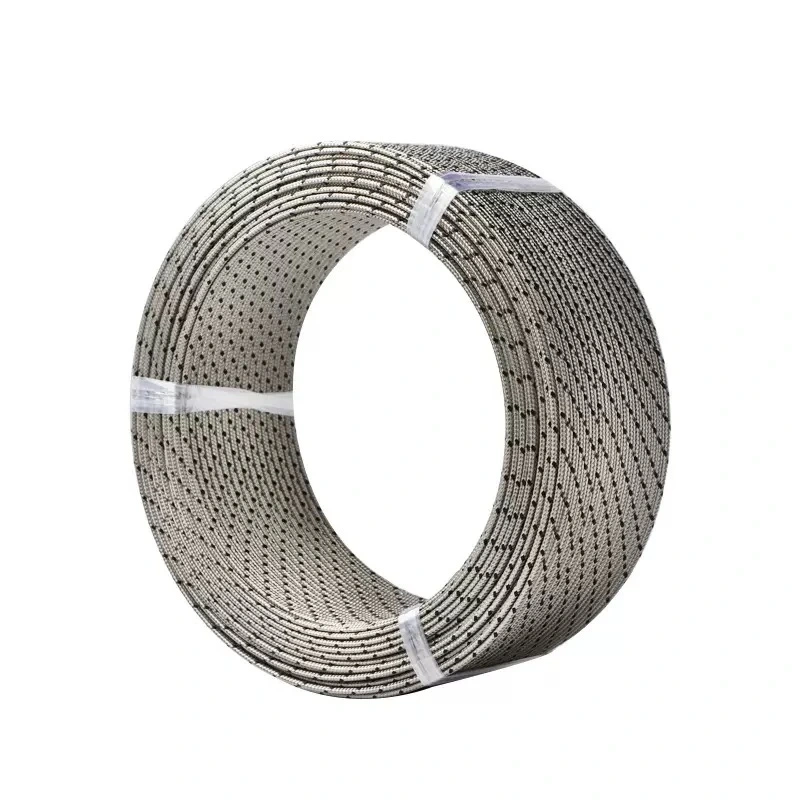
Thermocouple extension cables are critical components in any temperature measurement system requiring precision and reliability. Specifically designed to transmit the delicate temperature signals generated by thermocouples from the measurement point to the control or recording instrument, these compensated conductors ensure that signal integrity is maintained without degradation. Their primary function is to extend the thermocouple connection without introducing additional errors due to dissimilar metal junctions, a phenomenon known as the thermoelectric effect. This is achieved through the use of metal alloys that replicate the thermoelectric characteristics of the original thermocouple, guaranteeing effective temperature compensation throughout the entire measurement chain. They are indispensable in industrial and laboratory environments where precise temperature measurement is fundamental for process control, operational safety, and product quality.
Product Description
Applications
Technical Specifications
Models and Sizes
Product Description
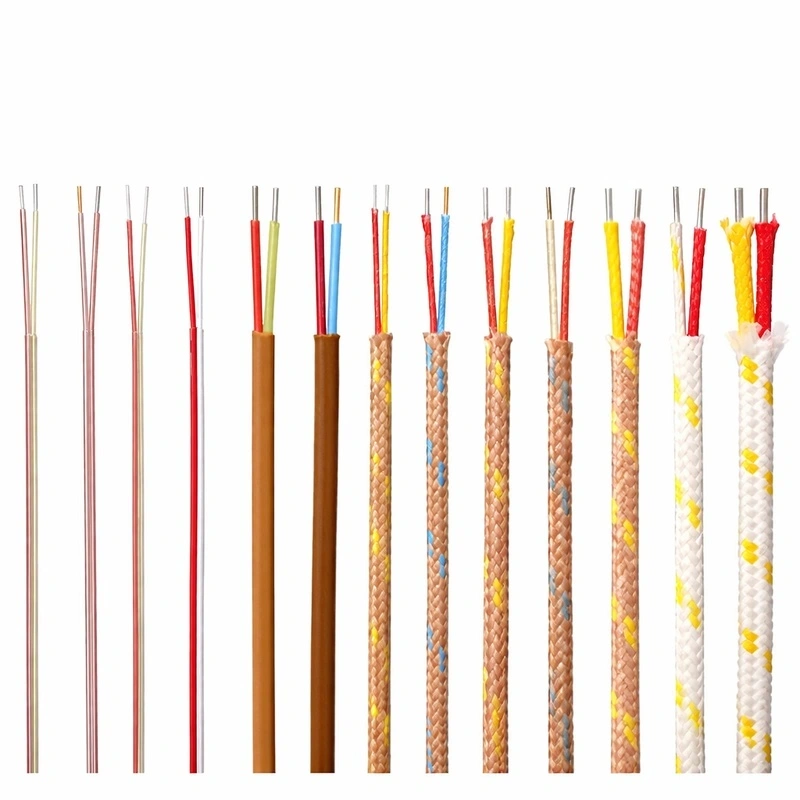
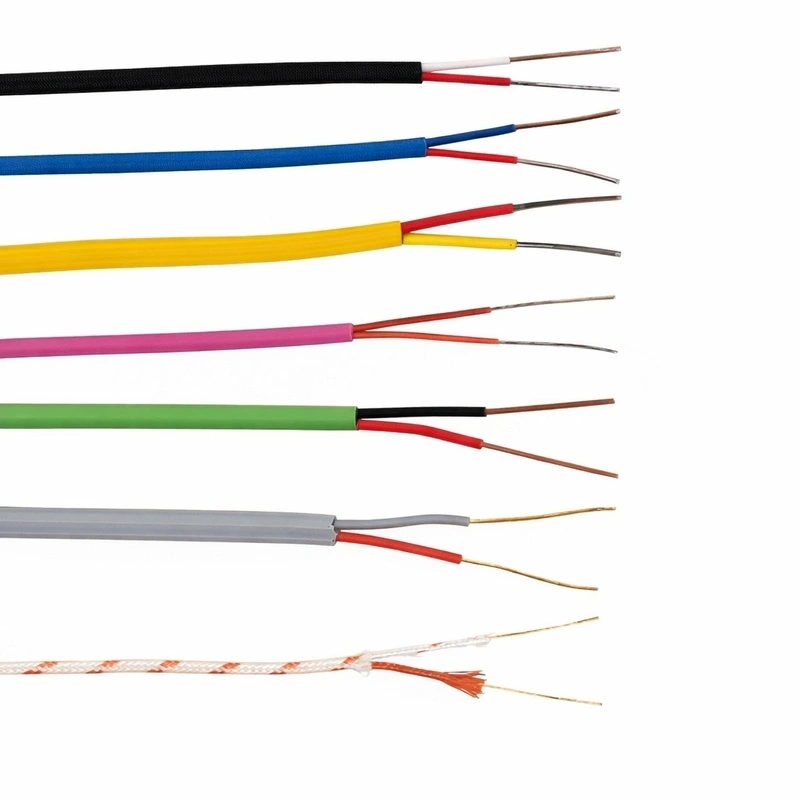
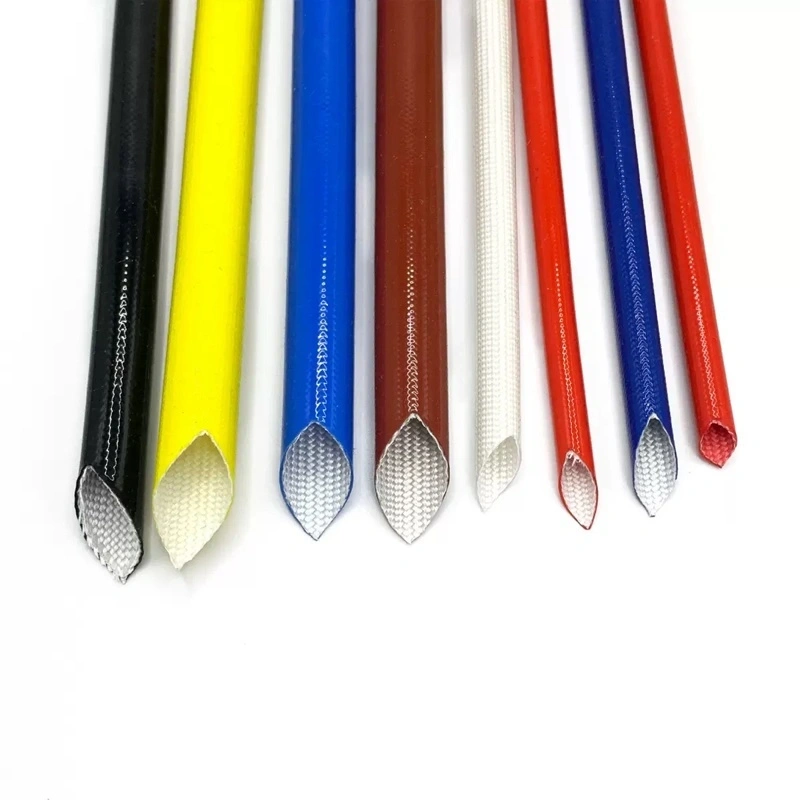
These cables are constructed with high-quality materials that offer heat resistance, moisture resistance, and durability under adverse conditions. The cable insulation, which can be PTFE, fiberglass, or PVC, along with appropriate shielding, protects the signal from electromagnetic interference and ensures stable performance. They comply with international color-coding standards for easy identification of thermocouple types (K, J, T, E, R, S), simplifying installation and reducing the risk of errors. Choosing the correct extension cable is vital to avoid signal loss and ensure temperature data is accurate, which in turn optimizes the efficiency and reliability of the temperature monitoring system.
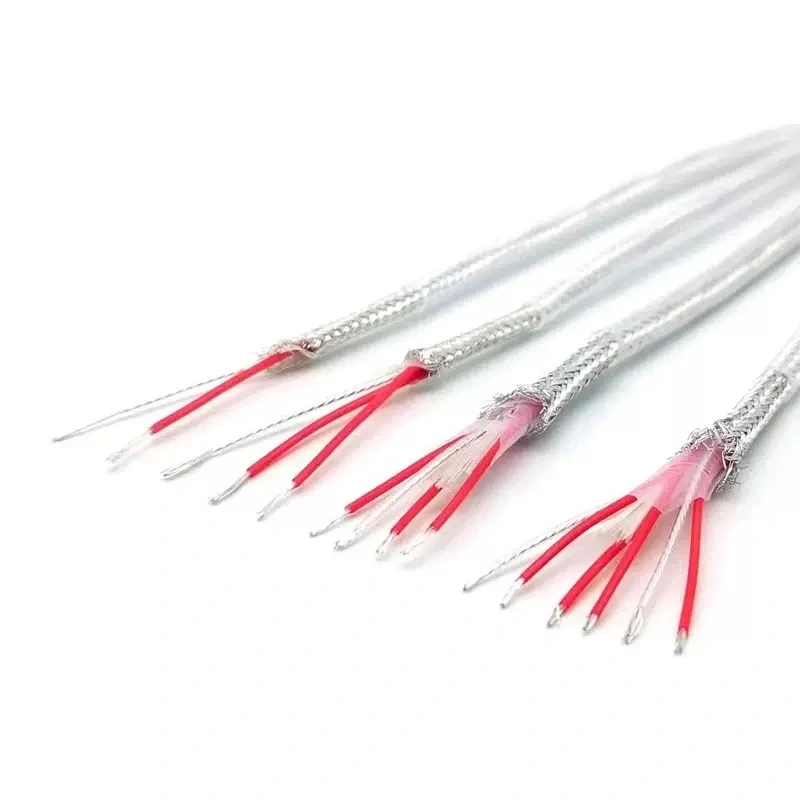
The selection of suitable thermocouple extension cables is crucial for the optimal performance of temperature control systems. Our cables are designed to offer superior temperature signal transmission, minimizing signal drift and ensuring consistent readings. Manufactured with high-purity compensated materials, such as Chromel/Alumel alloys for Type K thermocouples or Iron/Constantan for Type J thermocouples, they guarantee unmatched measurement accuracy. The robust construction of these instrumentation cables includes insulation options of Teflon (PTFE), high-temperature fiberglass, and rugged PVC, adapting to various environmental conditions and operating temperature ranges. Furthermore, they incorporate advanced shielding to protect against electrical noise and radio frequency interference (RFI), making them ideal for demanding industrial applications.
Our extension cables not only meet but often exceed industry standards in abrasion resistance, chemical resistance, and flexibility. Identification is straightforward thanks to standardized color codes that facilitate correct connection and avoid costly field errors. Whether for temperature sensors, industrial thermocouples, or data acquisition systems, these cables are the ideal solution for maintaining signal integrity over long distances. With an optimized cable diameter and a temperature capacity of up to 200°C (for standard Teflon/PC versions), and options for higher thermal resistance, our products are ready to integrate into any thermocouple circuit, offering a fast response and exceptional reading precision. Trust our high-quality thermocouple extension cables for your temperature monitoring and control needs.

Applications
Thermocouple extension cables are versatile and essential components in a wide range of industries and applications where precise temperature measurement is critical. Their ability to reliably transmit thermocouple signals makes them indispensable in:
-
Metallurgical and Steel Industry: For temperature monitoring in foundry furnaces, heat treatment processes, rolling, and forging, where extreme temperatures are common and precision is vital for product quality.
-
Chemical and Petrochemical Industry: In reactors, distillation columns, pipelines, and storage tanks, for process control involving corrosive or flammable substances, ensuring operational safety and efficiency.
-
Power Generation: In thermal, nuclear, and combined-cycle power plants for supervising temperatures in turbines, boilers, generators, and exhaust systems, contributing to performance optimization and failure prevention.
-
Food and Pharmaceutical Industry: In cooking, sterilization, pasteurization, and storage processes, where strict temperature control is fundamental for food safety, product quality, and regulatory compliance.
-
Plastics and Rubber Manufacturing: For temperature monitoring in extruders, injection molds, and presses, guaranteeing material consistency and final product quality.
-
Research and Development Laboratories: In material testing, climatic chambers, laboratory furnaces, and thermal analysis equipment, where high-precision temperature measurement is required for experimentation and result validation.
-
HVAC and Refrigeration Systems: For temperature control in heating, ventilation, air conditioning, and industrial refrigeration systems, optimizing energy consumption and maintaining desired environmental conditions.
-
Automotive and Aerospace: In engine test benches, exhaust systems, and critical components, for thermal data acquisition under extreme operating conditions.
These cables are fundamental for industrial instrumentation, automation systems, and any environment that depends on exact and continuous temperature monitoring. Their robust design and the variety of insulation and shielding materials available allow for adaptation to hostile environments, guaranteeing reliable signal transmission even under the most demanding conditions.
Technical Specifications
Our thermocouple extension cables are designed and manufactured under strict quality standards to guarantee optimal performance and precise temperature measurement in a variety of industrial and laboratory environments. Below are the technical specifications in a table format for easy consultation:
|
Characteristic |
Specification |
|---|---|
|
Compensated Conductor Material |
Specific alloys such as Chromel/Alumel (Type K), Iron/Constantan (Type J), Copper/Constantan (Type T), and others for Types E, R, S. |
|
Cable Insulation |
Options: Teflon (PTFE), Fiberglass, High-Strength Fiberglass, Silicon Dioxide, NT Ceramic, PVC, and Silicone. |
|
Insulation Temperature Range |
- Teflon (PTFE): up to 260°C |
|
Shielding |
Metal braid and foil shielding options for protection against EMI and RFI. |
|
Conductor Diameter |
Available configurations: 2 * 0.127mm, 2 * 0.254mm, 2 * 0.511mm, 2 * 0.800mm. |
|
Operating Temperature Range |
From 200°C (standard Teflon/PC) up to 1350°C (ceramic insulation). |
|
Color Codes |
Compliance with international standards (ANSI, IEC, JIS) for easy identification. |
|
Packaging |
305-meter rolls (305M). |
|
Additional Processing |
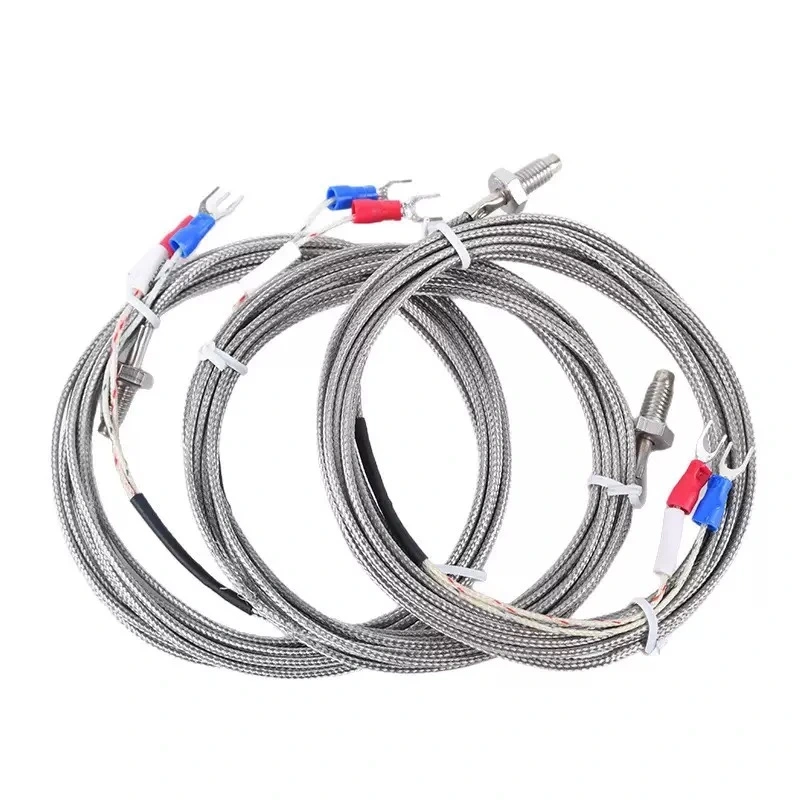
Availability of connectors, solder points, and spooling. |
Models and Sizes
Models and Sizes
The following table details the available thermocouple extension cable models, their size specifications, insulation materials, color coding for positive and negative poles, and the maximum temperature resistance of the insulating layer. This information is crucial for the proper selection of the cable according to the thermocouple type and the environmental conditions of the application. For other specifications, please contact our sales team.
|
Model |
Thermocouple Type |
Conductor Diameter |
Insulation Material |
Positive/Negative Pole Color |
Max. Insulation Temp. |
Length per Roll |
|---|---|---|---|---|---|---|
|
TT-K-36 |
K |
2 * 0.127mm |
Double layer of Teflon |
Yellow Positive/Red Negative |
260°C |
305M |
|
TT-K-30 |
K |
2 * 0.254mm |
Double layer of Teflon |
Yellow Positive/Red Negative |
260°C |
305M |
|
TT-K-24 |
K |
2 * 0.511mm |
Double layer of Teflon |
Yellow Positive/Red Negative |
260°C |
305M |
|
TT-J-36 |
J |
2 * 0.127mm |
Double layer of Teflon |
White Positive/Red Negative |
260°C |
305M |
|
TT-J-30 |
J |
2 * 0.254mm |
Double layer of Teflon |
White Positive/Red Negative |
260°C |
305M |
|
TT-J-24 |
J |
2 * 0.511mm |
Double layer of Teflon |
White Positive/Red Negative |
260°C |
305M |
|
TT-T-36 |
T |
2 * 0.127mm |
Double layer of Teflon |
Blue Positive/Red Negative |
260°C |
305M |
|
TT-T-30 |
T |
2 * 0.254mm |
Double layer of Teflon |
Blue Positive/Red Negative |
260°C |
305M |
|
TT-T-24 |
T |
2 * 0.511mm |
Double layer of Teflon |
Blue Positive/Red Negative |
260°C |
305M |
|
GG-K-36 |
K |
2 * 0.127mm |
Fiberglass |
Yellow Positive/Red Negative |
482°C |
305M |
|
GG-K-30 |
K |
2 * 0.254mm |
Fiberglass |
Yellow Positive/Red Negative |
482°C |
305M |
|
GG-K-24 |
K |
2 * 0.511mm |
Fiberglass |
Yellow Positive/Red Negative |
482°C |
305M |
|
GG-J-36 |
J |
2 * 0.127mm |
Fiberglass |
White Positive/Red Negative |
482°C |
305M |
|
GG-J-30 |
J |
2 * 0.254mm |
Fiberglass |
White Positive/Red Negative |
482°C |
305M |
|
GG-J-24 |
J |
2 * 0.511mm |
Fiberglass |
White Positive/Red Negative |
482°C |
305M |
|
GG-T-36 |
T |
2 * 0.127mm |
Fiberglass |
Blue Positive/Red Negative |
482°C |
305M |
|
GG-T-30 |
T |
2 * 0.254mm |
Fiberglass |
Blue Positive/Red Negative |
482°C |
305M |
|
GG-T-24 |
T |
2 * 0.511mm |
Fiberglass |
Blue Positive/Red Negative |
482°C |
305M |
|
HH-K-24 |
K |
2 * 0.511mm |
High-Temp Fiberglass |
Yellow Positive/Red Negative |
704°C |
305M |
|
XS-K-24 |
K |
2 * 0.511mm |
Silicon Dioxide |
Yellow Positive/Red Negative |
870°C |
305M |
|
XC4-K-24 |
K |
2 * 0.511mm |
NT Ceramic |
- |
1350°C |
305M |
|
20# |
E |
2 * 0.800mm |
- |
Purple Positive/Red Negative |
- |
- |
FAQ
What is the difference between thermocouple-grade cable and extension cable?
Thermocouple-grade cable (commonly identified with the letter "X" after the type, such as KX) is used to manufacture the probe or actual sensor; it possesses very strict precision specifications for the measurement point. Conversely, extension-grade cable (identified as EX or JX) is designed exclusively to connect the sensor to the measuring instrument (pyrometer or controller). The main advantage of the extension cable is its lower cost over long runs, maintaining the integrity of the millivolt signal without introducing thermal errors, as long as the original thermocouple alloy type is respected.
How to choose the right insulation: PTFE vs. Fiberglass?
The choice depends directly on the operating environment and temperature range:
|
Key Characteristic |
PTFE (Teflon) Insulation |
Fiberglass Insulation |
|---|---|---|
|
Maximum Temperature |
Up to 260°C |
Up to 482°C (or 704°C in high-resistance versions) |
|
Moisture Resistance |
Excellent. Repels water and other liquids, ideal for humid environments. |
Low. It is a porous material that can absorb moisture if not treated. |
|
Chemical Resistance |
Excellent. Inert to most acids, bases, and solvents. |
Moderate. Can be attacked by certain strong acids and alkalis. |
|
Flexibility |
Very Good. The cable is flexible and easy to install in tight spaces. |
Good. Less flexible than PTFE and can become brittle over time at high temperatures. |
|
Abrasion Resistance |
Good. Offers a smooth surface resistant to wear. |
Moderate. Fibers can fray with friction if they do not have a protective jacket. |
|
Main Application |
Food, pharmaceutical, chemical, and laboratory industries. |
Industrial furnaces, foundries, heat treatment, and exhaust systems. |
Conclusion for the user: If your priority is resistance to chemicals and moisture at moderate temperatures, choose PTFE. If you need to withstand extreme heat above 260°C, Fiberglass is the only viable and suitable option.
What do the acronyms SLE mean in thermocouple cables?
The acronym SLE stands for Special Limits of Error. A cable with SLE certification is manufactured with higher purity metal alloys, which guarantees superior accuracy. While a standard cable has an acceptable margin of error, the SLE cable reduces that margin to approximately half. It is the critical choice for processes where high-precision temperature control is vital for final product quality or to comply with international safety regulations.