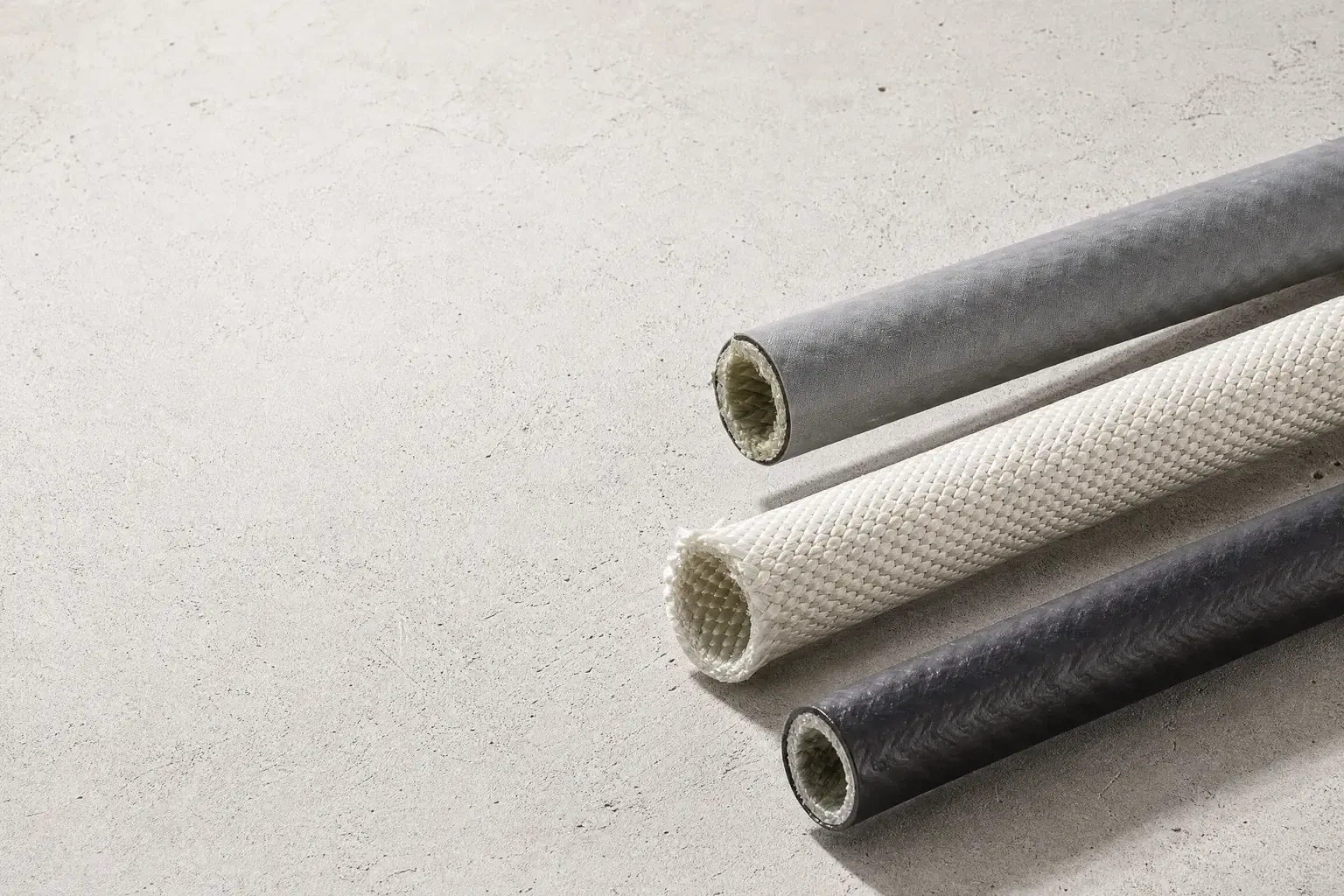
Behind every electric motor, every industrial furnace, and every control panel run miles of wiring that no one ever sees, protected by a layer of woven sleeving that rarely gets a second thought until something goes wrong. High-temperature sleeving — that tubular, woven sheath slid over a cable before the final connections are made — is one of those quiet materials that lets wiring survive next to a tubular heater, inside a motor vibrating sixteen hours a day, or inches from molten metal in a foundry. It isn’t a cosmetic detail or a minor line item on a bill of materials: it’s the difference between an electrical system that runs safely for years and one that turns into a short-circuit or fire risk. At Heatecx we manufacture three lines of high-temperature sleeving — fiberglass, silica fiber, and silicone with fiberglass — and each one answers a different profile of industrial demand. Understanding where each one fits isn’t an academic exercise; it’s what separates a correct technical specification from an avoidable warranty cost.
Fiberglass: the industry standard for general-purpose thermal and electrical protection
By sheer volume of use, fiberglass sleeving is the most widespread type in the electrical and electronics industry, and that popularity isn’t accidental: it combines solid thermal resistance (400°C continuous, with the ability to withstand instantaneous peaks up to 600°C) with a dielectric strength range of 500V to 1500V that covers the vast majority of low- and medium-voltage circuits found in both industrial and consumer equipment. Manufactured from alkali-free fiberglass braided or woven into tube form and given thermal treatment, this sleeving strikes a balance between cost, availability across an extremely wide range of diameters (from 0.5mm to 60mm), and performance that makes it the default choice whenever there isn’t an extreme thermal, chemical, or environmental condition that justifies a more specialized material.
In the automotive industry, fiberglass sleeving protects the wiring of engines, exhaust systems, and electrical components exposed to elevated temperatures under the hood or near the drivetrain; in a vehicle or in heavy machinery, space is tight and wiring harnesses share that space with constant heat sources, so the combination of routing flexibility and thermal resistance makes this sleeving the standard choice for harness manufacturers and assembly shops. In household and commercial appliances — ovens, stoves, water heaters, industrial irons, and commercial kitchen equipment — it fulfills the same role: insulating internal wiring from the appliance’s own hot surfaces, where the on-off cycling generates constant thermal fluctuations that a conventional plastic insulator wouldn’t tolerate. The high-power lighting industry, in both industrial luminaires and stage and studio lighting systems, relies on this sleeving to protect the conductors feeding high-power discharge and LED fixtures, where heat generated by the driver or ballast itself can far exceed what a standard cable can withstand without extra protection.
Industrial machinery in general — processing lines, medium-temperature furnaces, dryers, extruders, and packaging equipment — uses fiberglass extensively in the control and power wiring that runs across the machine’s chassis, often in long runs that pass near motors, auxiliary heating elements, or points of friction against metal structure. In power electronics, transformers, and electrical distribution systems, this sleeving insulates components that dissipate heat continuously during normal operation, a use case that demands both the thermal resistance and the 1500V dielectric capacity needed to prevent arcing between adjacent conductors. Heating, ventilation, and air conditioning (HVAC) systems also depend on it to protect wiring inside heating units, boilers, and hot-air ducts, where the sleeving coexists with moderate but sustained process temperatures across long periods of continuous operation. Finally, in aerospace and defense applications requiring a lightweight material with proven reliability under severe vibration and thermal cycling, fiberglass remains a standard specification for wiring harnesses in non-critical systems.
Silica fiber: the solution for extreme temperature and chemically aggressive environments
When operating temperature exceeds what conventional fiberglass can sustain, silica fiber — with a SiO2 content above 96% — steps in as the reference material for truly extreme conditions. It runs continuously at 1000°C and resists instantaneous peaks up to 1400°C, with a softening point near 1700°C, which places it in an entirely different category from fiberglass: this isn’t an incremental upgrade but a material designed for scenarios where any other insulating textile would simply degrade or fail outright. Its inorganic nature means it doesn’t burn, doesn’t release toxic gases under extreme heat, and resists most acids and alkalis without losing structural integrity — a combination of properties that makes it indispensable in sectors where extreme heat coexists with aggressive chemical exposure.
The metallurgical and foundry industry is perhaps the clearest example of this need: in plants that process molten metal, wiring near melting furnaces, ladles, and pouring lines faces both intense thermal radiation and the risk of metal splash at temperatures that would instantly overwhelm conventional fiberglass. Silica fiber, thanks to its resistance to 1400°C peaks, acts as an effective barrier at these critical points, protecting instrumentation and control wiring that has to keep operating despite the process’s proximity. In industrial heat-treatment furnaces, annealing, sintering, and in energy applications like high-pressure boilers and thermal generation systems, this sleeving protects the wiring of temperature sensors, thermocouples, and actuators working permanently near the hottest zones of the process, where an insulation failure represents not just a replacement cost but the risk of an unplanned plant shutdown.
The aerospace sector turns to silica fiber in applications where wiring has to reliably survive extreme temperatures — zones near exhaust systems, jet engine components, or sections exposed to atmospheric friction — and where the material’s light weight, combined with its chemical stability, offers an advantage over heavier metallic alternatives. In industrial welding processes, silica fiber sleeving protects hydraulic hoses and wiring near the weld point against sparks and splatter, a use that extends naturally to the glass industry, where melting furnaces maintain constantly elevated process temperatures across production cycles that can run for days or weeks without interruption. It’s also used as a resin reinforcement in the manufacture of high thermal-resistance composites, taking advantage of its dimensional stability under extreme heat to provide structural support to composite materials that will later face their own demanding service conditions.
Silicone with fiberglass: flexibility, hermetic sealing, and reinforced dielectric protection
The third sleeving line we manufacture combines an inner layer of silicone with an outer fiberglass jacket, and its purpose isn’t to compete with silica fiber on extreme thermal resistance — it’s to solve a different problem: the need for superior flexibility, hermetic sealing against moisture and oils, and reinforced dielectric capacity that in some models reaches up to 7000V, well above what uncoated fiberglass offers. Operating in a typical range of -50°C to 200°C, this sleeving isn’t intended for the extreme temperatures of a foundry or an industrial furnace, but for environments where the combination of constant movement, exposure to liquids, and the need for robust electrical insulation makes neither standard fiberglass nor silica fiber the optimal choice.
In electric motors of every kind — from heavy industrial motors to precision motors in medical and instrumentation equipment — this sleeving protects internal wiring that must flex continuously with rotor vibration and the mechanical movement of the assembly, something that bare fiberglass’s relative rigidity doesn’t handle as well over time. Its resistance to water and oils makes it the natural specification for equipment operating in frequent wash-down environments, food processing lines, agricultural machinery, and industrial equipment subject to regular pressure cleaning, where moisture that would penetrate uncoated fiberglass is completely blocked by the hermetic silicone layer. In tight spaces with multiple bends and irregular geometries — compact control panels, densely wired electrical cabinets, portable equipment — its notable flexibility eases installation where rigid fiberglass would resist bending without fatiguing the weave.
Shipbuilding is another sector where this variant finds a natural use: in vessel galleys, deck electrical systems, and equipment exposed to the constant salt humidity of the marine environment, the combined resistance to corrosion, moisture, and vibration — inherent to any vessel underway — makes silicone-coated sleeving a better fit than standard fiberglass, which lacks the hermetic protection that environment requires. In specialized lighting systems and electrical heating equipment requiring both moderate thermal protection and elevated dielectric capacity to prevent arcing in high-voltage configurations, this sleeving combines both properties in a single product, avoiding the need for additional insulation layers that would complicate the wiring design.
How to choose between the three types by application
The decision doesn’t hinge on a single variable but on the combination of process temperature, chemical or environmental exposure, and the circuit’s dielectric requirement. As a general rule, fiberglass covers the vast majority of industrial and consumer applications operating below 400°C without severe chemical exposure, making it the best cost-to-performance option for general wiring harnesses, appliances, lighting, and mid-range process machinery. Silica fiber is reserved for scenarios where sustained temperature exceeds that threshold or where the environment includes exposure to acids, alkalis, or molten-metal splash — situations typical of foundries, industrial furnaces, aerospace, and welding, where no other insulating textile would reliably survive. The silicone-coated variant, for its part, doesn’t compete on thermal resistance but instead solves needs around flexibility, moisture and oil sealing, and reinforced dielectric capacity, making it the natural choice for motors, wash-down environments, marine applications, and dense wiring spaces where constant handling and movement are the dominant demand, not extreme heat.
Application case
A manufacturer of heat-treatment furnaces for the metallurgical industry needed to specify wiring insulation for three distinct zones of its production line: control wiring in the external electrical panel, power wiring running across the furnace chassis to the heating elements, and instrumentation wiring for thermocouples located inches from the heating chamber. Rather than specifying a single sleeving type for the entire line — a common mistake that often translates into overspending or premature failures depending on the section — the project used standard fiberglass for the external control panel, where ambient temperature stays moderate; silica fiber for the instrumentation run next to the heating chamber, where thermal radiation and occasional peaks far exceed 400°C; and silicone-coated sleeving for the power run crossing a constant-vibration zone near the forced-circulation fan motor. The result was an insulation system optimized zone by zone, without overspecifying costly material where it wasn’t needed or underspecifying protection where the thermal or mechanical risk demanded it.
FAQ
Can I combine all three sleeving types in the same machine or installation? Yes, and this is in fact the recommended practice in complex industrial installations. Each wiring run has its own thermal, chemical, and mechanical demand depending on its proximity to heat sources, environmental exposure, or movement, so specifying sleeve type zone by zone — rather than a single material for the whole installation — tends to be both safer and more cost-efficient.
Does silica fiber completely replace fiberglass in high-temperature applications? Not necessarily. Silica fiber is superior in extreme thermal resistance, but it costs more and doesn’t always offer additional benefits in applications that already work correctly below 400°C. The choice should be based on the actual temperature at the installation point, not on an excessive safety margin that inflates the specification unnecessarily.
Which sleeving type is recommended for equipment with frequent maintenance and disassembly? The silicone-coated variant is usually the best fit in these cases, thanks to its superior flexibility, which eases repeated disassembly and reinstallation without the material suffering fatigue or property loss — something that happens more readily with rigid fiberglass under constant handling.
Related links
- High-temperature sleeving — full category with all 4 available sleeve types
- High-temperature cables
- Mica
- Ceramic Insulators
- Heating Element Sealants
- Heating cables
- Heat Tracing