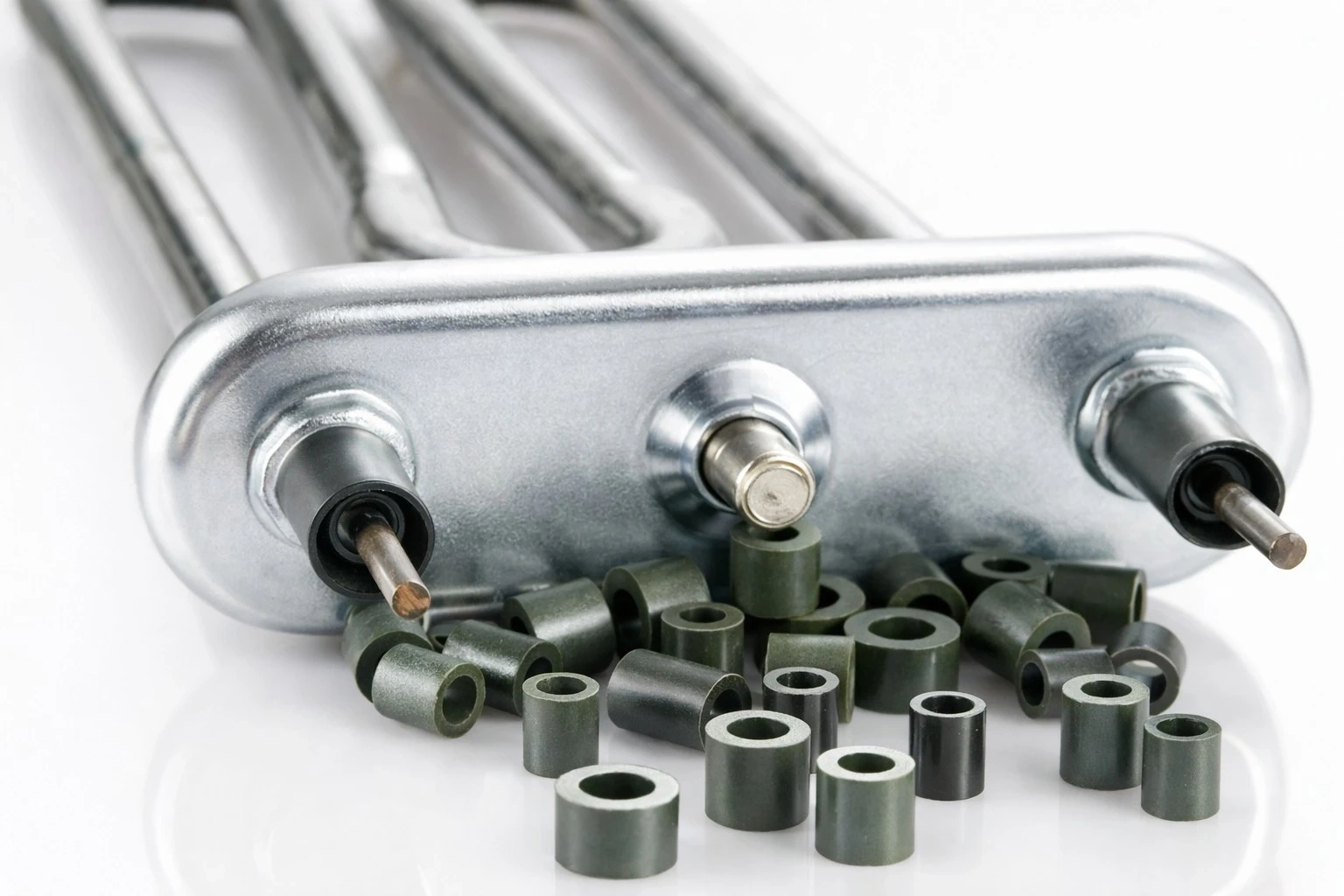
Buying a tubular heater bending machine is not the same as buying a generic tube bender. A hollow pipe tolerates radius or force errors that a sheathed heating element does not: inside the metal sheath sits a Nichrome filament suspended in compacted Magnesium Oxide powder, and a poorly chosen — or poorly operated — bender cracks that insulation, shifts the resistance wire, or creates micro-fractures that only surface once the end customer reports a field failure.
Picking the right machine is, in practice, a capex decision that determines your scrap rate, your delivery speed, and how complex a geometry you can offer your customers. Below is the process mechanics and the criteria that should actually drive the decision, before you start comparing catalogs and spec sheets.
Technical fundamentals: what physically happens to the tube when it’s bent
When a tubular heater is bent, the outer wall of the curve stretches (tension) while the inner wall compresses, and the material between the two faces tends to thin out. Two phenomena determine whether the bend is acceptable or the part ends up damaged:
Wall thinning. As a rough engineering rule, the percentage of wall thinning on the outer fiber of the curve depends on the ratio between the bend radius (R) and the tube’s outer diameter (D): the lower the R/D ratio, the greater the thinning. With R/D ratios below 2, the risk that the outer wall loses critical thickness — and with it mechanical and dielectric strength — increases non-linearly.
Minimum bend radius. That’s why the industry practice sets the minimum inside bend radius at at least 2 times the tube’s outer diameter (2×D) for sheathed heating elements, compared to more aggressive ratios (1×D or less) that an unfilled hollow tube can tolerate. Forcing a tighter radius doesn’t just thin the wall: it unevenly compresses the MgO powder on the inside of the curve, creating lower-density dielectric zones that become starting points for premature electrical failure.
Section ovalization. A round tube tends to ovalize in the bend zone if the machine doesn’t apply internal support (a mandrel) or adequate counter-pressure. Excessive ovalization reduces the effective thermal cross-section and, in applications where the bent tube must fit into a machined bore or sleeve, can directly prevent assembly.
These three phenomena — thinning, minimum radius, and ovalization — are the technical reason a “generic” bender for hydraulic or structural tubing isn’t interchangeable with a machine specifically designed for electric heating elements.
1. Production volume and automation level
The first filter is simple: how many bent parts do you need per shift?
- Low to medium volume, standard shapes (U, W): a semi-automatic or pneumatic benchtop bender with quick-change modular dies is usually the most cost-effective choice. It’s the typical equipment for a thermal maintenance shop or a plant that doesn’t yet justify fully automating this step.
- High volume, repetitive or complex shapes: a multi-axis CNC bending center pays for itself faster than it appears, because it eliminates operator variability — the leading cause of scrap at this stage of the process — and because changeover time (die or program change) is a fraction of what a manual machine requires.
A common mistake is buying a high-end CNC machine for a volume that doesn’t need it, or the opposite: forcing a manual bender to sustain an industrial production pace, which drives up scrap rates and prematurely wears out dies.
2. Part geometry: diameter, length, and shape complexity
Not every bending machine covers the same dimensional range or curve type:
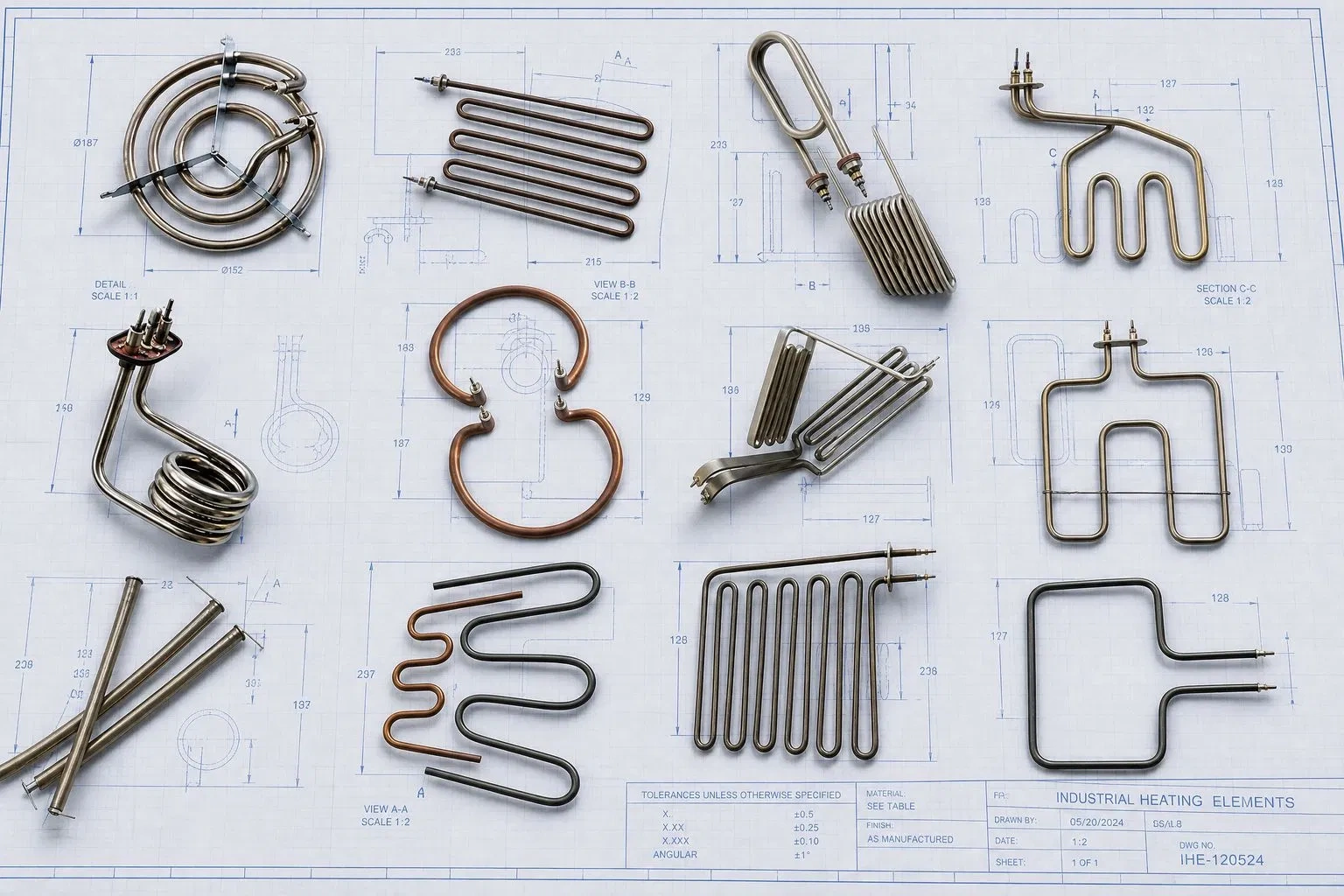
- Single-end bending (U, L shapes): single-head machines, ideal when the tube is long (over 3000 mm), the diameter is considerable, or the part configuration prevents using a double-head machine.
- Simultaneous double-end bending: double-head benders, typically sized for standard diameters up to 16 mm and lengths up to 2000 mm, which maximize output when the part needs symmetrical bends on both sides with precise distance and angles.
- Spirals, coils, and full circles: these require a mandrel system with pitch control — motors around 2 kW are common on this type of equipment — quite different from a conventional U/W bender, since the shaft must rotate in sync with the tube’s longitudinal feed.
- Compact helical coils (hot runner): a niche case — flat or microtubular heaters for injection nozzles — that needs a stepper-motor-driven mandrel shaft rather than a general-purpose bender.
- Flat heating elements: the optimal bend radius for a flat tube differs from that of a round tube, so a circular-section bender isn’t interchangeable with a flat-section one; the specific risk here is cross-section deformation, not just wall thinning.
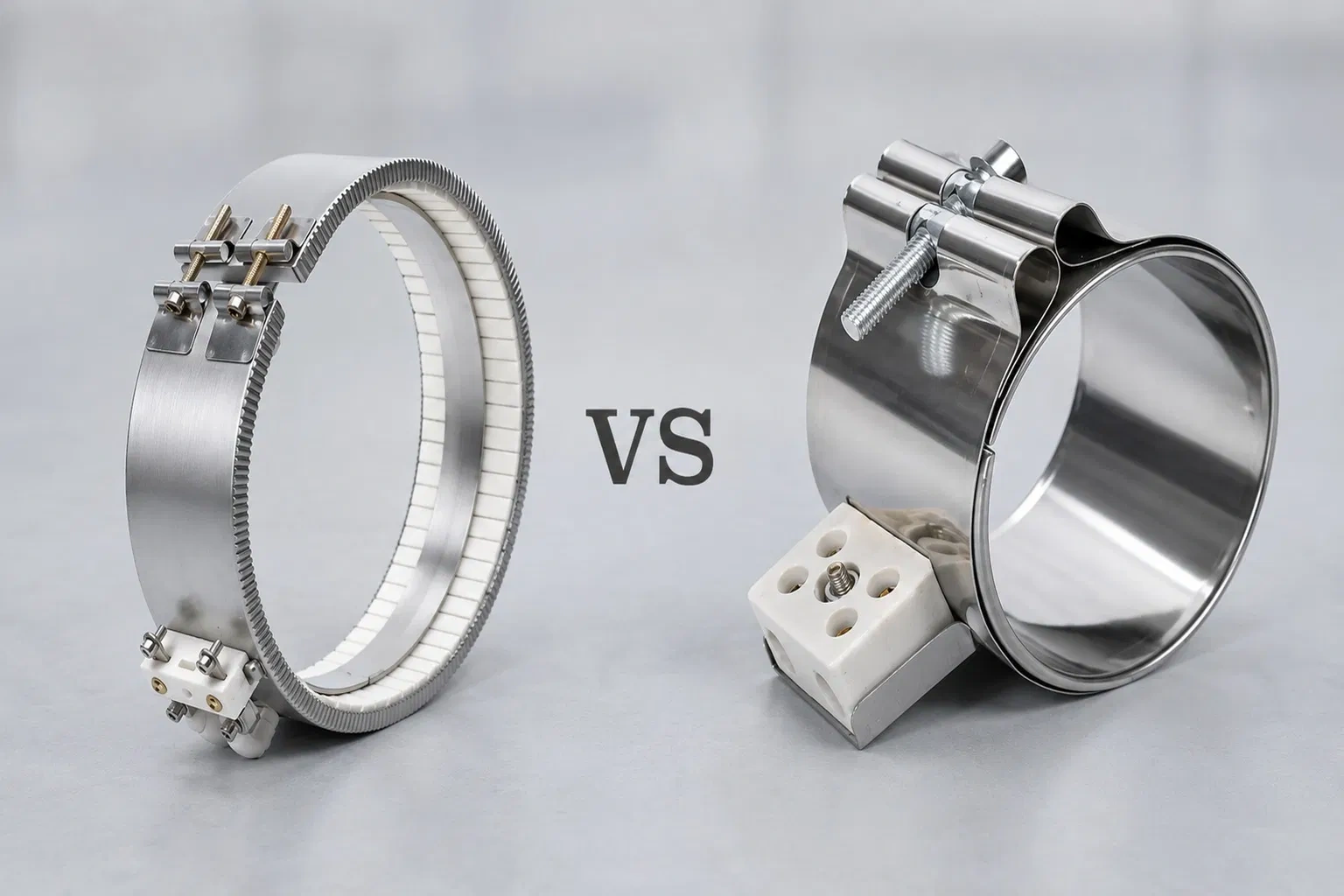
- Clamp or band heater housings: here the process isn’t bending a filled tube, but profiling and curving metal sheet before it houses the ceramic core; it requires an edge-forming/fluting machine plus a circular strip roller, not a traditional tube bender.
Before requesting quotes, define precisely the diameter, length, and angle range your product catalog actually needs — buying more dimensional range than you need rarely translates into useful flexibility, and it does raise the cost of the machine and the die inventory you have to maintain.
3. Sheath material and alloy: the springback factor
Every sheath alloy — Incoloy 800/840, 304/316 stainless steel, copper — has a different modulus of elasticity and yield strength, which translates into different springback behavior once bending pressure is released.
As a general engineering reference — not a specification for any specific batch, which should always be validated with testing — austenitic stainless steel alloys tend to require moderate over-bend angles, while nickel-iron-chromium superalloys like Incoloy, with a higher yield strength, tend to need more pronounced over-bend compensation to reach the same final angle. Copper, being more ductile, behaves more predictably but is more sensitive to surface marking from die pressure.
If the machine doesn’t let you set a material-specific over-bend angle, you’ll end up systematically out of spec. This matters even more if your plant works with multiple alloys for different customers: ask whether the equipment can save springback “recipes” by material in the PLC controller, so you don’t rely on the operator recalibrating by hand at every batch change.
4. Integration with your existing line
A bending machine doesn’t operate in isolation. Before deciding, review:
- Upstream: if the tube arrives work-hardened from earlier rolling or swaging steps, you likely need an annealing step before bending. Annealing restores ductility to cold-worked metal, which directly lowers the risk of micro-fractures and makes springback behavior more predictable.
- Downstream: after bending, the only reliable way to confirm the internal insulation is still intact is a high-voltage Hi-Pot test. If your line skips that step, even the most precise bender in the world won’t protect you from shipping parts with hidden defects.
Treating the bender as part of a work cell — not a standalone machine — avoids bottlenecks and rejections that surface too late, often after the part is already in the customer’s hands.
5. Budget and real return on investment
The cost of a bending machine isn’t measured by list price alone. The variable that matters most for ROI is the scrap rate:
| Bending method | Typical scrap from wire breakage or insulation loss |
| Manual or generic tube bender (not designed for heating elements) | 8% – 12% |
| Dedicated semi-automatic bender, precision dies | 2% – 4% |
| Automated CNC center with dynamic force control | < 0.5% |
With expensive alloys like Incoloy, that scrap differential translates directly into the investment’s break-even point — often much sooner than a simple purchase-price comparison would suggest. On top of that, there’s the indirect cost of scrap caught late: if a part fails Hi-Pot after already going through finishing, marking, and terminal assembly, the real cost of the reject is far higher than the raw material alone.
Applications by industry
| Industry | Typical geometry required | Specific consideration |
| Industrial fryers and cooking equipment | Multiple U/W shapes, high repeatability | High volume, tight dimensional tolerance for tank assembly |
| Boilers and circulation heaters | Large-diameter coils, spirals | Wide radii, long lengths, single-end bending |
| Plastics injection (hot runner) | Compact helical coils | Small diameter, constant coil pitch, tight thermal tolerance |
| Industrial immersion heaters | Simple to medium U shapes, corrosion-resistant alloys | Incoloy or stainless steel depending on process fluid |
| Textile ovens and dryers | Flat or clamp heating elements | Sheet profiling instead of filled-tube bending |
| White-goods appliances | Standard U/W shapes, high volume | CNC automation nearly mandatory given production scale |
Application case
A manufacturer of immersion heaters for chemical process tanks was using a generic tube bender adapted from another production line. The scrap rate from micro-fractures caught in Hi-Pot testing hovered around 10%, concentrated in Incoloy 800 parts with tight radii. After switching to a single-head bender with programmable per-alloy springback recipes, and adding a pre-bend annealing step for tubes arriving with more work-hardening from the reducing stage, scrap dropped below 1% within one quarter — without changing tube or resistance-wire suppliers.
Quick model comparison by use case
| Need | Recommended bender type |
| Standard U/W shapes, medium volume | Semi-automatic benchtop bender, interchangeable dies |
| Long tubes (>3000 mm) or single-end bending | Single-head bender (HTD-2A type) |
| Symmetrical double-end bending, high volume | Double-head bender, up to 16 mm diameter and 2000 mm length (HTD-2B type) |
| Spirals, coils, full circles | Pitch-controlled mandrel bender, ~2 kW motor (HT-B5 type) |
| Complex 3D geometries, maximum repeatability | Multi-axis 3-axis CNC center (HTD-1 type) |
| Flat heating elements | Flat-section bender (HT-B4 type) |
| Helical coils for hot runner | Dedicated microtubular spiral bender with stepper-driven mandrel (HTD-3 type) |
| Clamp/band heater housings | Edge-forming machine + circular strip roller (HT-B6 type) |
Common mistakes when choosing a bending machine
- Buying on list price alone without calculating the real cost of scrap with your alloy.
- Choosing generic tube-bending equipment instead of one designed specifically for sheathed heating elements.
- Skipping pre-bend annealing when the tube arrives work-hardened from prior steps.
- Omitting the post-bend Hi-Pot test, assuming that “if it bent cleanly, it’s fine.”
- Over-specifying automation level for a volume that doesn’t justify it.
- Forcing bend radii tighter than 2×D to save space, without validating the impact on MgO density.
- Not checking whether the machine can save per-alloy springback recipes when the plant works with several materials.
Frequently asked questions
What’s the recommended minimum radius for bending a tubular heating element? As a general rule, the inside bend radius should not be smaller than 2 times the tube’s outer diameter. Tighter radii increase the risk of excessive wall thinning and uneven MgO compaction.
Can the same machine bend different diameters and alloys? Yes, provided it has interchangeable die sets and a controller that lets you save different configurations (diameter, over-bend angle) as independent recipes.
Is annealing mandatory before bending? Not in every case, but it’s highly recommended when the tube arrives work-hardened from earlier rolling or reducing steps, since it lowers the risk of micro-fractures.
How do you confirm the bend didn’t damage the internal insulation? With a post-bend high-voltage Hi-Pot test, which confirms the MgO’s dielectric strength stays within expected values.
Conclusion
The right bending machine is the one that matches your volume, your dimensional range, your alloys, and your ability to integrate it into the rest of the line — not necessarily the most automated or the cheapest one. At Heatecx we manufacture both the machinery and the raw materials that pass through it (MgO, resistance wire, tubing, sealants), which lets us recommend the configuration that actually lowers your scrap rate, not just the one that appears first in the catalog. Browse our full line of heater bending machines or contact us to evaluate your specific case.