When an electric hotplate fails or a kitchen equipment project calls for replacement cooktop discs, the decision isn’t just “what diameter do I need” — it’s which heating disc variant performs best for that specific use case, and what to do when something starts to fail. This guide covers both fronts for our Cast Iron Electric Cooktop Heating Discs: how to choose between the Standard disc and the Fast (Red Dot) disc, and how to diagnose and resolve the most common issues that show up in home kitchens, commercial kitchens, and catering equipment.
Standard Disc vs. Fast Disc (Red Dot): Which One to Choose
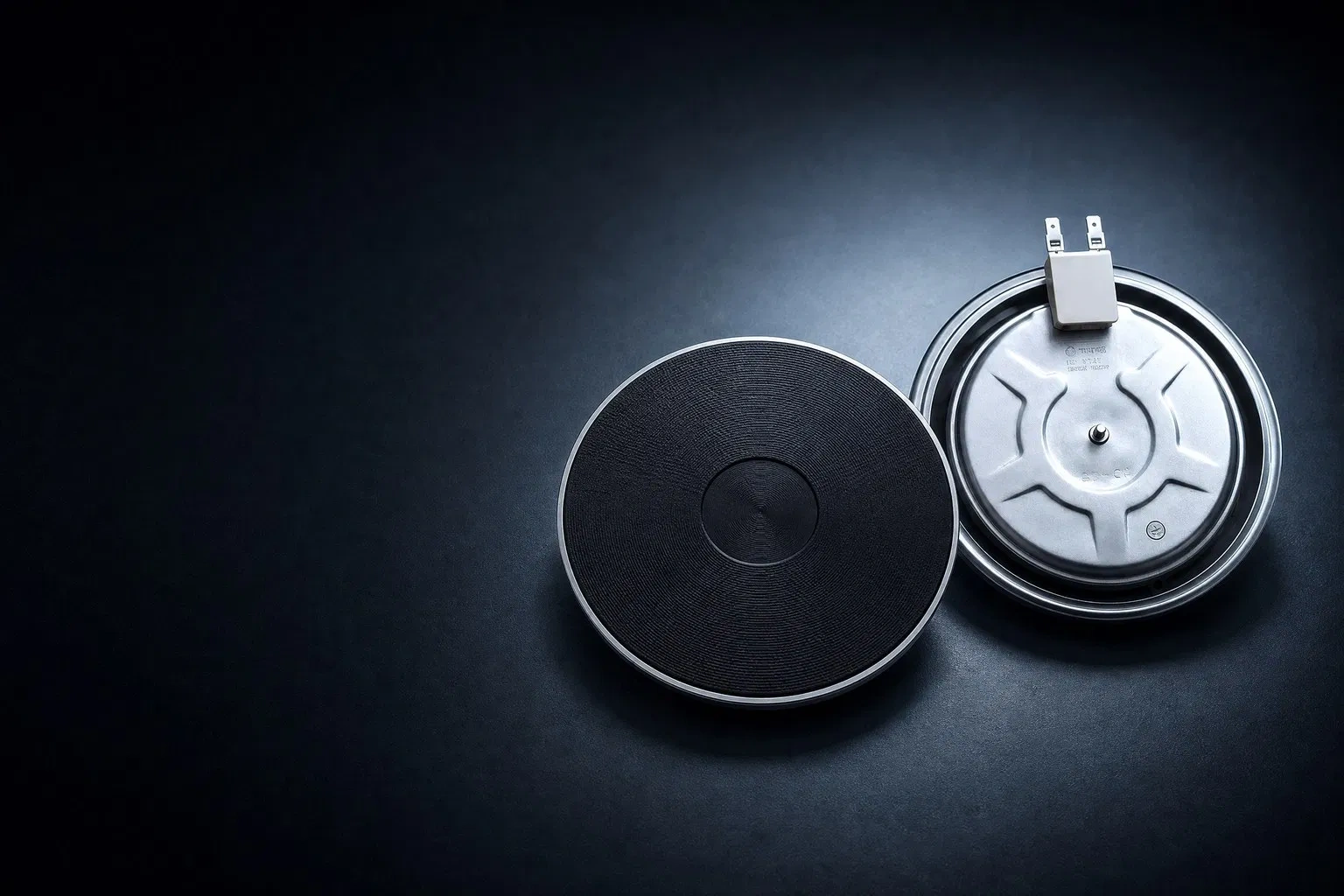
Both variants share the same principle: a spiral-embedded heating element under a high-density cast iron surface. The difference lies in the Red Dot’s built-in thermal protector, and that difference determines the right use case.
Standard Disc
- Lower unit cost and simpler construction, with fewer components that can fail.
- Suitable for home use or moderate-intensity commercial use, with on-off cycles controlled by an external thermostat.
- Recommended when the equipment already has its own temperature control system and only the heating element needs replacing.
Fast Disc (Red Dot)
- Built-in thermal protector that automatically cuts power before critical temperatures are reached, protecting both the disc and the stove’s electrical system.
- Faster heat-up, making it preferable in commercial kitchens and catering equipment where recovery time between uses is critical.
- The safer choice for intensive use, multiple operators, or environments where external temperature control can be inconsistent.
Rule of thumb: for low-frequency home use with reliable external temperature control, the Standard disc is sufficient and more economical. For commercial, high-turnover use, or if a previous disc has experienced an overheating incident, Red Dot is the right choice.
How to Choose the Right Disc for a Replacement
A common mistake is buying based on “approximate diameter” without checking the rest of the variables. Before requesting a quote, confirm:
- Exact diameter of the stove socket, measured with the old disc removed, not estimated by eye over the installed disc.
- Height and profile of the heating element, since two discs with the same diameter can have different mounting heights.
- Power and voltage compatible with the available electrical installation (single-phase or three-phase), avoiding both over- and under-sizing.
- Connection type and terminals, so the existing wiring fits without additional modifications.
- Expected frequency of use, which is ultimately what determines whether Standard or Red Dot is the right call, per the criteria above.
At Heatecx we manufacture to custom specifications when standard dimensions don’t match the client’s equipment, so an exact replacement is possible even for discontinued stove brands or models.
Applications in Demanding Environments: Marine and Industrial
Cast iron cooktop discs aren’t limited to home kitchens. Their rugged construction and stable thermal mass make them a common solution in two particularly demanding environments: cooking equipment aboard ships and high-volume industrial kitchens.
Marine Galleys and Maritime Catering Equipment
On commercial vessels, fishing boats, and industrial ships, kitchen equipment faces conditions that don’t exist on land: constant vibration, salt humidity, limited space, and electrical systems that don’t always offer the same stability as a shore-based installation. Cast iron cooktop discs suit this context well for several reasons:
- Mechanical resistance to vibration and motion: the solid cast iron construction tolerates a vessel’s constant movement without the internal heating element coming loose or getting damaged, something that can happen with lighter or poorly secured heating elements.
- Compatibility with stainless steel enclosures: these discs are commonly integrated into stainless steel electric hotplates, a standard in marine kitchen equipment for its resistance to corrosion in a salt environment.
- Compact profile: as a rigid body with a defined diameter, it fits easily into single or multi-burner cooktops designed for tight spaces, typical of galley or cabin kitchens.
- Built-in thermal protection (Red Dot): in an environment where human oversight can be intermittent due to watch shifts or navigation conditions, the Red Dot disc’s automatic temperature cutoff adds a relevant layer of safety.
This combination — compact resistive discs mounted in stainless steel enclosures, with multiple independently powered zones — is common in electric hotplates designed specifically for marine, industrial, and intensive commercial use, where each disc has its own independent temperature control.
Industrial and Institutional Kitchens
In high-volume kitchens — hospitals, institutional dining halls, food processing plants, catering lines for large-scale events — the selection criteria shift: it’s less about resistance to a salt environment and more about tolerance to prolonged, back-to-back use cycles, often across 12- to 16-hour continuous shifts.
In this context, the factors that matter most are:
- Fast thermal recovery between uses, which favors the Red Dot variant over the Standard one when cooking volume is high.
- Temperature uniformity across units on the same line, critical when multiple discs run in parallel and need to perform consistently to avoid creating bottlenecks in food prep.
- Compatibility with centralized control systems, when the kitchen has control panels managing several cooking zones simultaneously.
- Tolerance to frequent cleaning, since food-safety regulations in institutional kitchens require more frequent cleaning cycles than a home setting, which makes it critical to follow the protocol of letting the disc cool before cleaning.
| Environment | Main Consideration | Recommended Variant |
| Home kitchen | Occasional use, good external control | Standard |
| Restaurant / commercial kitchen | Thermal recovery between dishes | Red Dot |
| Vessels (marine) | Vibration, salt corrosion, limited space | Red Dot in stainless steel enclosure |
| Industrial / institutional kitchen | Long, continuous cycles, multiple parallel units | Red Dot |
| Catering / food trucks | Portability, frequent on-off cycling | Standard or Red Dot depending on volume |
Troubleshooting: Common Problems and How to Fix Them
1. The disc doesn’t heat, or heats intermittently
Root cause: the internal heating element has degraded, or there’s a break in the circuit — often from thermal fatigue after prolonged use cycles, or from loose electrical connections at the terminals.
Fix: check the power supply and terminal condition first before assuming an internal failure. If the heating element itself is damaged, there’s no practical repair: the embedded nature of the resistive element means full disc replacement is the only viable option.
2. Uneven heating, cold spots, or zones that take longer to heat
Root cause: displaced or deformed rear thermal insulation, or uneven wear of the internal spiral element after years of use.
Fix: confirm the equipment’s rear insulation is correctly installed and hasn’t shifted. If the problem persists with insulation in good condition, uneven internal element wear has no field fix and requires disc replacement.
3. The Red Dot disc shuts off on its own or cuts power early
Root cause: this is almost always the thermal protector working as designed, not a failure. It indicates the disc is reaching temperatures above the safe range.
Fix: check whether the equipment’s external temperature control is miscalibrated, or whether the disc is being run at higher power than specified. Repeated cutoffs under normal use conditions do warrant inspection, since they can indicate a failing thermal protector or a power density that isn’t right for the application.
4. Visible cracks or fissures on the disc surface
Root cause: thermal shock, typically from cold water or damp cloths contacting the hot disc, or from an abrupt cooling cycle.
Fix: there’s no safe repair for a cracked cast iron body; it must be replaced before the crack compromises the disc’s electrical integrity. Prevention is the only effective strategy: let the disc cool naturally before cleaning it.
5. Sparking, electrical noise, or a burning smell at the terminals
Root cause: oxidation or loosening of electrical connections, creating contact resistance and localized heating at the connection point.
Fix: this needs immediate attention for electrical safety. Cut power, inspect, and tighten or replace the terminals. If the issue originates in the disc itself rather than the external wiring, it’s time to replace it.
6. Short service life or repeated failures in a short period
Root cause: almost always a mismatch between the disc variant and actual usage — a Standard disc in a high-turnover environment that needed Red Dot — or an installation issue (poor rear insulation, repeated thermal shock cycles).
Fix: before replacing with the same model a second or third time, check whether the actual usage pattern matches the installed variant and adjust the selection per the criteria above.
Preventive Maintenance
- Periodic visual inspection for cracks, deformation, or unusual discoloration on the surface.
- Check the tightness of electrical connection terminals.
- Clean only when the disc is cold, avoiding cold water or damp cloths on a hot surface.
- Periodically confirm the temperature control system is calibrated for the specific thermal mass of the installed disc.
Application Cases
Commercial Cooking Line Upgrade
A catering equipment manufacturer needed to replace obsolete electric hotplates in an industrial kitchen line with higher-efficiency, longer-lasting components. The solution used high-density Red Dot discs, sized to match the installation footprint of the original hotplates, allowing a direct swap without modifying the equipment chassis. The result was reduced initial heat-up time and greater thermal consistency across units on the same production line.
Kitchen Equipment for Commercial Vessels
A marine kitchen equipment manufacturer needed heating discs to integrate into stainless steel electric hotplates for the galleys of fishing vessels and cargo ships. The main requirement was resistance to continuous vibration and salt humidity exposure, along with a low-maintenance profile given the limited access to technical service at sea. The solution used compact-diameter Red Dot discs, integrated into two- and four-burner hotplates depending on vessel size. The result was a reduction in vibration-related failures compared to the lighter heating elements used previously.
Frequently Asked Questions
Can I replace a Standard disc with a Red Dot disc on the same equipment? Yes, as long as mounting dimensions and power are compatible. It’s actually a recommended upgrade if the equipment is used more frequently than originally intended.
How long does an electric cooktop disc last under normal use? It depends directly on the usage pattern and the care taken during installation and cleaning. A correctly selected disc, installed with proper insulation and without exposure to thermal shock, achieves a considerably longer service life than one that’s mismatched for its application.
What if my stove doesn’t match any standard measurement? We offer custom manufacturing in geometry, power, and voltage. Contact us with the exact socket measurements and available electrical specification.
Cast Iron Electric Cooktop Heating Discs are part of our Heating Plates and Disks line. We also manufacture cast iron grates for gas stoves as a complementary support component for cooking equipment.