When people picture an industrial heating element, they usually think of the resistance wire, the MgO powder or the metal sheath. Yet a surprising share of the heating equipment and thermal processes running in a plant every day depends on a far less visible component: a technical fiberglass fabric coated with silicone or PTFE, or a Teflon tape placed exactly where heat, friction or product sticking would otherwise put production at risk. High-temperature fabrics and technical tapes are not a minor accessory. In many cases they are the body of the heater itself, the barrier that protects a sealing bar, or the surface a product rides on through an oven. In this article we walk through Heatecx’s High Temperature Tapes and Fabrics category from a practical angle: how each material is used in manufacturing and in operation, which engineering decisions sit behind each reference, and how to avoid the most common mistakes when selecting and processing them.
Why a fabric is an engineered component, not just cloth
A technical high-temperature fabric is best understood as the sum of two decisions: which textile substrate acts as the skeleton, and which coating gives it its function. The substrate, normally high-strength alkali-free fiberglass, provides dimensional stability, tensile strength and the ability to withstand heat without deforming. The coating, whether vulcanized silicone rubber or a PTFE dispersion, determines whether the material will be flexible, non-stick, electrically insulating or resistant to particular chemicals. That split explains why two fabrics that look identical at a glance can behave completely differently on a packaging machine, in a vulcanizing press or in a curing oven, and why correct selection starts with understanding what the material will be asked to do rather than with the temperature figure printed on a datasheet.
Vulcanized silicone fiberglass cloth: one cured face, one semi-cured face
Heatecx’s Vulcanized Silicone Fiberglass Cloth is perhaps the best example of a fabric designed on purpose for a manufacturing process. It is made from alkali-free fiberglass cloth impregnated and coated with organic silicone rubber by calendering or dipping, with one decisive twist: one face is supplied with the silicone already vulcanized, meaning cured and stable, while the other remains semi-cured, in a still “live” state. That semi-cured face is what later allows a permanent bond with other materials once heat and pressure are applied, so the silicone of the cloth and that of a second sheet fuse together and encapsulate whatever lies between them.
That property makes the cloth the base material of flexible silicone heaters and heating pads. The resistance wire or heating foil is placed between two sheets, with the semi-cured face of each one turned toward the element, and the assembly is hot-vulcanized into a single integral piece that is flexible and electrically well insulated. The product’s datasheet gives a continuous operating range of −20 °C to 280 °C, a dielectric constant of 3 to 3.2 and a dielectric breakdown strength of 10 to 50 kV/mm, and the material is halogen-free, RoHS-compliant, oil-resistant, waterproof and flame-retardant, meaning it does not spread flame. It is supplied in standard iron-red, in thicknesses of 0.3, 0.5, 0.75, 1.0, 1.6 and 2.0 mm, in widths from 100 to 600 mm and in lengths from 10 to 100 m, which lets you build anything from small heating pads to larger blankets without wasting material.
The vulcanization process deserves a detailed explanation because it is where final quality is won or lost. According to the method published by Heatecx, the sheets are cut to size and the first one is laid with its semi-cured face up; the heating elements are arranged on it and the second sheet goes on top with its semi-cured face down. When joining the two sheets it is better not to press them together all at once but to do it gradually and evenly, because that is how trapped air bubbles and folds are avoided. The assembly then goes into a hydraulic press with temperature and pressure control, and a foamed silicone pad is placed between the press surfaces and the heater, whose job is to cushion and spread the pressure evenly: without it the pressure arrives unevenly and the product does not form properly. The reference parameters are 165 °C for 3 minutes, with the pressure calibrated so that, after compression, a slight overflow of silicone is visible on both sides of the assembly, which is the visual sign that the silicone has flowed enough to fully encapsulate the internal elements. After the cycle the assembly is allowed to cool before handling to preserve dimensional stability. Heatecx notes that this procedure comes from its own tests and that every real case may need adjustments, so the values should be treated as a starting point and not a closed recipe.
Anyone manufacturing these parts should also know the finished product: the Flexible Silicone Heater and the other solutions grouped in the Heating Blankets category, which show where this type of construction ends up: heating of drums, tanks and pipes, among other uses. For other vulcanizing needs in heater manufacturing, such as sealing element ends or overmolding rubber, the Vulcanizing Machines category covers the equipment available at Heatecx.
Industrial PTFE and silicone fabrics: the non-stick, low-friction family
The second reference in the category, Industrial PTFE and Silicone Fabrics, answers a different problem: keeping product or molten material from sticking to a hot surface, or protecting that surface from wear. All of them start from a high-tenacity fiberglass substrate coated with PTFE dispersions or vulcanized silicone rubber, and they come in several variants that are worth telling apart clearly.
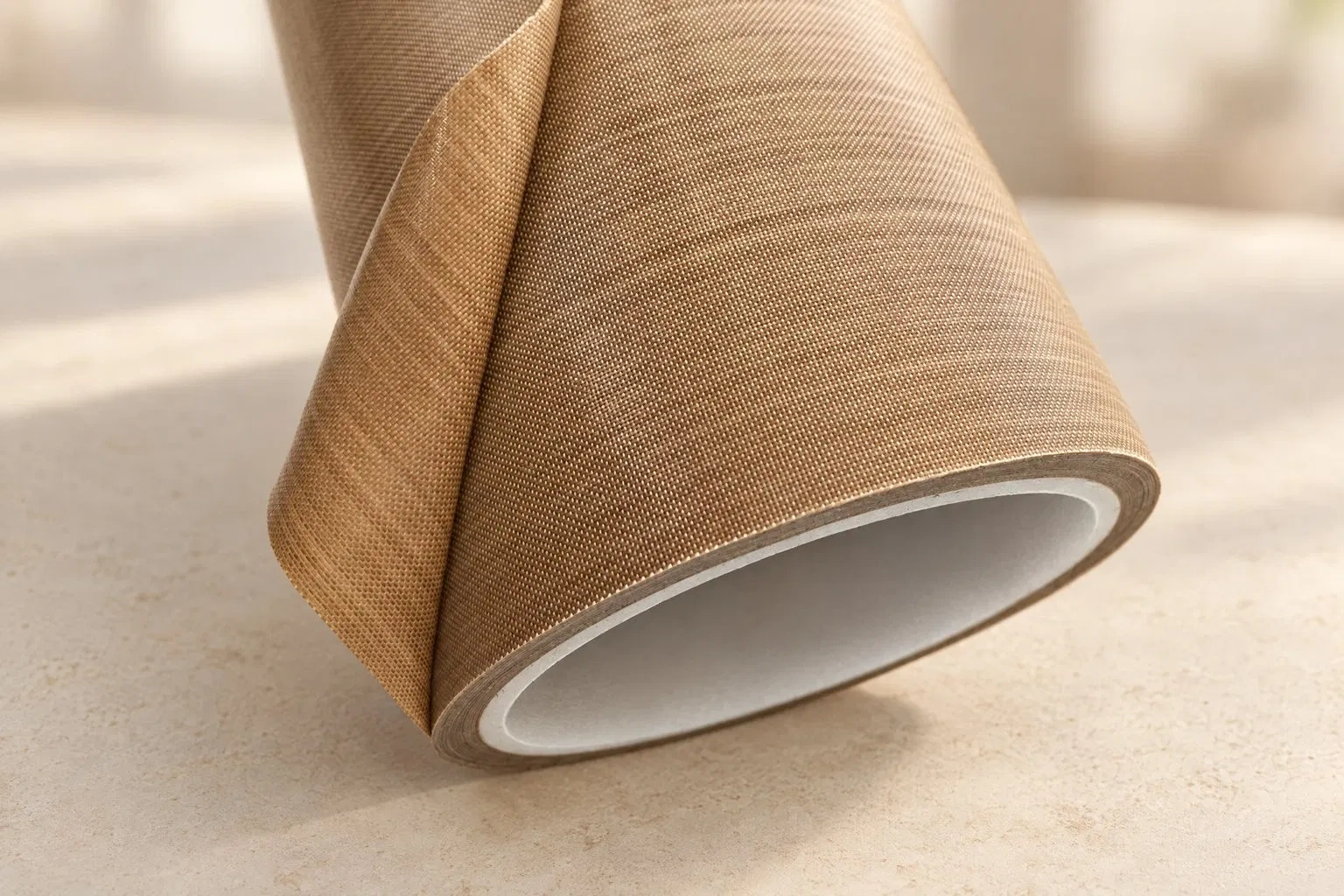
PTFE-coated fiberglass fabric has a smooth, non-porous surface with a friction coefficient of 0.05 to 0.10, and runs continuously between −73 and +260 °C with peaks up to 300 °C, with a dielectric strength of 15 to 25 kV/mm and a tensile strength of 1,000 to 3,000 N/5 cm depending on thickness. It is supplied in 0.13, 0.18 and 0.25 mm, in formats of 1 × 1 m, 1 × 100 m and 1 × 1,000 m. There is also a version with a high-performance silicone adhesive on one face and an easy-release liner, which makes it simple to install the lining directly on sealing bars or platens, with adhesion to steel above 30 N/25 mm. The silicone fabrics, in single- or double-sided versions and in thicknesses of 0.5, 0.7 and 0.9 mm, give up some release performance in exchange for much greater flexibility and resistance to weathering, ozone and UV radiation, with a continuous range of −60 to +200 °C; the double-sided version is meant to maximize abrasion resistance and service life. The range is rounded out by an oil-resistant blue fabric, 0.25 mm, useful in environments with hydrocarbons or hydraulic fluids at high temperature, and a copper-colored fabric, 0.20 and 0.35 mm, used for printed-circuit-board lamination and composite curing, where thermal management and antistatic properties matter.
In practice these fabrics show up in very specific places. On high-speed packaging machines they cover the sealing bars and jaws so that each seal comes out clean and free of packaging residue. In curing, drying and cooking ovens they work as conveyor belting in the textile, printing and food sectors. On presses and molds they protect the platens so polymers and resins do not stick, which makes cleaning easier and extends equipment life, and in the automotive and petrochemical sectors they allow gaskets to be made and components to be protected in oily environments. Heatecx states that many of its PTFE and silicone fabrics are designed to meet food-contact regulations such as FDA, although it recommends always verifying the specific certification of the reference you intend to use in a food application.
There is also an interesting link between the first two references: Teflon cloth itself is used in the vulcanization of flexible heaters as a non-stick barrier between the semi-cured silicone and the press platens, so that the final finish is clean and professional. It is a clear example of how the same category solves, within a single production line, both the structural material and the auxiliary material.
Industrial PTFE tapes: precision where fabric cannot reach
When the problem is not covering a large surface but protecting, insulating or spacing with precision, the Industrial PTFE (Teflon) Tapes come into play. The range is organized by function. The Teflon mesh tape, 530 mm wide in 8 m rolls, has an open structure that lets air and liquids pass while carrying material at high temperature, which is why it is used in cooking, freezing, drying, UV curing and shrink tunnels. The pure Teflon film tape, available in thicknesses of 0.06, 0.08, 0.13, 0.18 and 0.25 mm at 10 mm wide and 10 m long, offers the highest purity and high-performance electrical insulation, and is used in electronics and aerospace, for precision masking during soldering and for protecting sensitive components. The PTFE-coated sealing tape, 0.20 mm and 15 × 750 mm, is made specifically for heat-sealing machines, where it protects the heating bars and keeps packaging material from sticking. The antistatic Teflon tape, in 0.13, 0.18 and 0.25 mm, dissipates electrostatic charge and is used in semiconductor manufacturing, printing and electronics assembly, and the spacer tape, 30 mm wide and 0.08 or 0.13 mm thick, is used to create precise gaps and reduce wear between moving parts.
Heatecx also allows thicknesses, widths and roll lengths to be customized, supplies the tapes with or without high-temperature silicone adhesive backing depending on whether a permanent or temporary fixing is needed, and offers PTFE grades with additives such as fiberglass for greater mechanical strength or carbon for conductivity and antistatic properties. That flexibility matters because, on real machinery, the right tape is usually the one that fits exactly the width of a sealing bar or a guide, not the one in the standard catalog.
Technical comparison of the catalog references
Before getting into selection criteria it helps to have, in one place, exactly what each reference offers. The tables below collect the data published on Heatecx’s product datasheets; temperature ranges are those stated on each datasheet, which is why they do not match one another in every case.
| Reference | Substrate and coating | Continuous range (per datasheet) | Thicknesses | Format | Main function |
| Vulcanized silicone fiberglass cloth (semi-cured) | Alkali-free fiberglass + organic silicone; one cured face, one semi-cured face | −20 to 280 °C | 0.3 / 0.5 / 0.75 / 1.0 / 1.6 / 2.0 mm | Widths 100–600 mm; lengths 10–100 m | Base for flexible heaters and heating pads |
| PTFE-coated fiberglass fabric | Fiberglass + PTFE | −73 to +260 °C (300 °C peak) | 0.13 / 0.18 / 0.25 mm | 1 × 1 m, 1 × 100 m, 1 × 1,000 m | Release, sealing, conveyor belting |
| Adhesive PTFE fabric | Fiberglass + PTFE + silicone adhesive with liner | Fabric: −73 to +260 °C; adhesive: −50 to +200 °C | 0.13 / 0.18 / 0.25 mm | 1 × 1 m, 1 × 100 m, 1 × 1,000 m | Lining installed directly on bars and platens |
| Silicone fabric (single or double sided) | Fiberglass + vulcanized silicone rubber | −60 to +200 °C | 0.5 / 0.7 / 0.9 mm | 1 × 1 m | Gaskets, covers, flexible and outdoor uses |
| Oil-resistant blue fabric | Specialized PTFE | −73 to +260 °C | 0.25 mm | 1 × 1 m | Hydrocarbon and hydraulic-fluid environments |
| Copper-colored fabric | Specialized PTFE | −73 to +260 °C | 0.20 / 0.35 mm | 1 × 1 m | PCB lamination and composite curing |
Tapes are defined more by their dimensions and function than by a temperature range, so they are compared differently:
| PTFE tape | Standard dimensions | Function | Typical sectors |
| Teflon mesh | 530 mm wide × 8 m | Carries material while letting air and liquids pass | Cooking, freezing, drying, UV curing, shrink tunnels |
| Pure Teflon film | 0.06 / 0.08 / 0.13 / 0.18 / 0.25 mm × 10 mm × 10 m | Maximum purity and electrical insulation | Electronics, aerospace, soldering masking |
| PTFE-coated sealing | 0.20 mm × 15 mm × 750 mm | Protects heating bars and prevents sticking | Heat-sealing and packaging machines |
| Antistatic | 0.13 / 0.18 / 0.25 mm × 10 mm × 10 m | Dissipates electrostatic charge (ESD) | Semiconductors, printing, electronics assembly |
| Spacer | 0.08 / 0.13 mm × 30 mm × 10 m | Creates precise gaps and reduces wear | Guides, sliders, machinery assembly |
Finally, a property comparison of the three fabric families shows why they are not interchangeable:
| Property | PTFE fabric | Silicone fabric (industrial range) | Semi-cured vulcanized silicone |
| Continuous temperature | −73 to +260 °C | −60 to +200 °C | −20 to 280 °C |
| Release | Excellent (friction 0.05–0.10) | Good, lower than PTFE | Not its function |
| Flexibility | Medium-low | High | High (easy to cut and process) |
| Dielectric strength | 15–25 kV/mm | Not stated on datasheet | 10–50 kV/mm; dielectric constant 3–3.2 |
| Chemical resistance | Exceptional | Good (oils, greases) | Oil- and chemical-corrosion resistant |
| Weathering, ozone, UV | Good | Excellent | Waterproof |
| Bonding by vulcanization | No | No | Yes, through the semi-cured face |
As a complement, the category includes materials from other families for higher temperatures: mica tape, with indicative values of 500 to 600 °C as an electrical insulator, and silica-fiber sleeves rated up to 1,000 °C. They are not substitutes for coated fabrics, but the answer when an organic or fluorinated coating is no longer viable.
Application scope: where each material works
Heatecx’s product datasheets describe a very wide range of sectors, and it helps to organize them by function rather than by industry, because the same material shows up in very different sectors for the same technical reason. The table below summarizes the fields the datasheets cite along with the reference that fits best.
| Sector | Typical application | Fitting reference | Determining property |
| Packaging | Sealing bars and jaws on high-speed machines | PTFE fabric (with or without adhesive), PTFE sealing tape | Release and thermal stability |
| Food | Cooking, drying and freezing belts | PTFE fabric, mesh tape | Food contact (verify certification) and airflow |
| Textile and printing | Belts in curing, drying and printing ovens; UV curing | PTFE fabric, mesh tape | Continuous thermal resistance and release |
| Electronics and semiconductors | PCB lamination, soldering masking, static control | Copper-colored fabric, pure film tape, antistatic tape | Thermal management, insulation and ESD dissipation |
| Aerospace | Thermal and electrical insulation under fluctuating temperatures | Vulcanized silicone, PTFE film tape | Dielectric and thermal stability |
| New energy vehicles | Protection and insulation in batteries, thermal management and high-voltage wiring | Vulcanized silicone | Electrical insulation and flame retardancy |
| Chemical and petroleum | Insulation of equipment and pipes with corrosive substances; oily environments | Vulcanized silicone, oil-resistant blue fabric | Chemical and oil resistance |
| Power generation | Insulation in generators, transformers and high-power components | Vulcanized silicone | Dielectric strength |
| Industrial machinery | Wiring protection; guides and sliders | Vulcanized silicone, spacer tape | Mechanical strength and low friction |
| Aquaculture | Heating and insulation in temperature control | Vulcanized silicone (heating pads) | Waterproofing and insulation |
| Construction | Flame-retardant and insulating material in specific uses | Vulcanized silicone | Does not spread flame |
| Pressing and molding | Protection of platens and molds against polymers and resins | PTFE fabric | Release and ease of cleaning |
| Flexible heater manufacturing | Heater structure and auxiliary barrier in the press | Vulcanized silicone + Teflon cloth | Bonding by vulcanization and clean release |
Read by columns, the table makes two things clear. First, sectors that prioritize process cleanliness, such as packaging, food and textile, cluster around PTFE. Second, sectors that prioritize insulation, fire safety and flexibility, such as power, electric mobility or aquaculture, cluster around vulcanized silicone. In-between sectors, such as electronics, use both families depending on the process stage.
Choosing between silicone, PTFE and tape: four questions
The practical choice between these materials comes down to answering four questions in order. The first is whether the material will be in contact with a sticky, molten or food product; if so and release is critical, PTFE is the logical option, because it has the lowest friction coefficient and the greatest chemical inertness, although it is stiffer in exchange. The second is whether the component moves, bends or is exposed to the weather; in that case silicone wins, thanks to its elasticity and resistance to ozone and UV radiation. The third is whether the main function is electrical insulation in a part that will be integrated or vulcanized, as in heating pads, and then the route is the semi-cured vulcanized silicone cloth. The fourth is whether you are protecting a small area with a specific geometry, and there a tape, thanks to its controlled width and thickness, is usually more efficient than cutting a fabric.
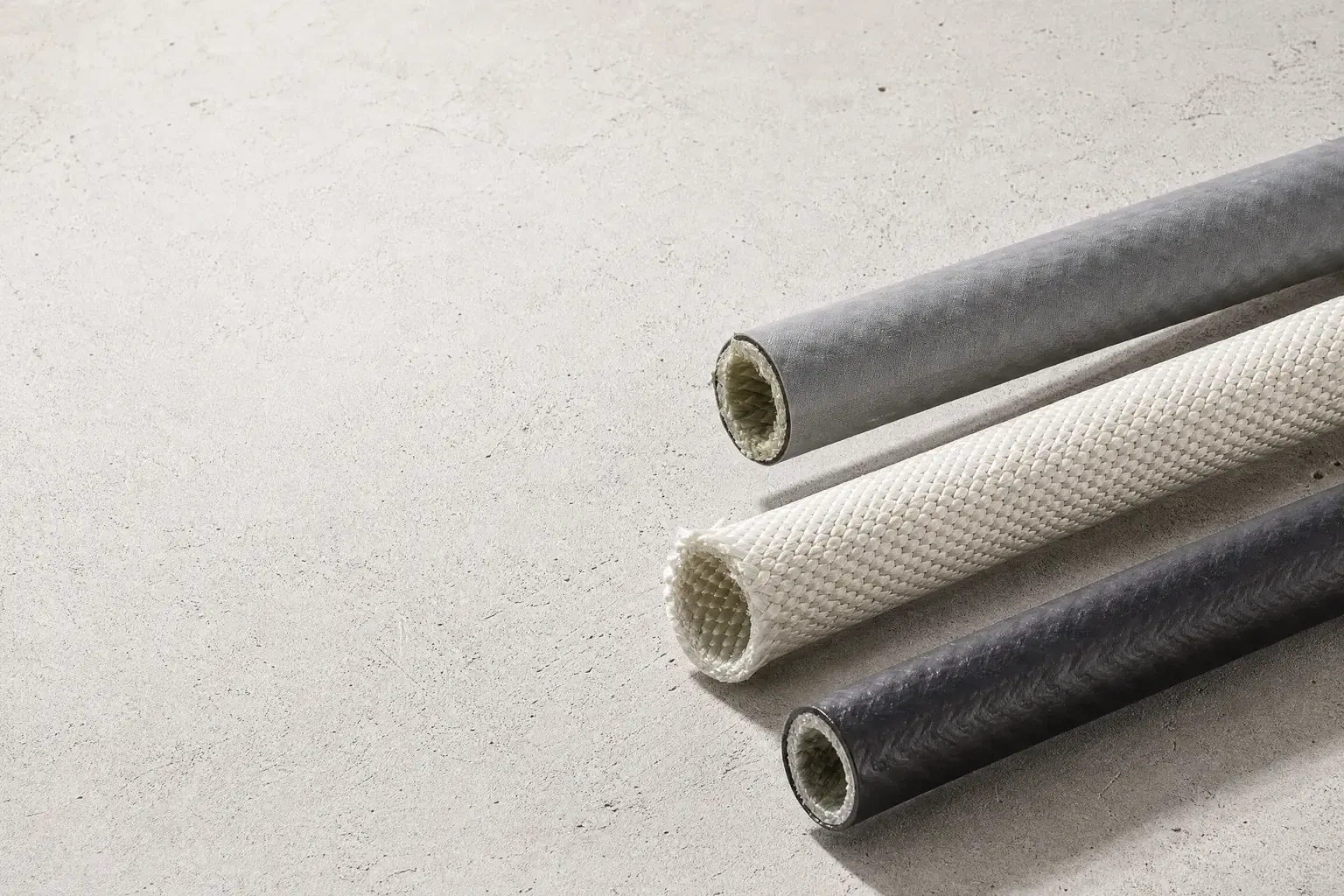
One important nuance is temperature. Continuous and peak ratings vary by the specific product: the semi-cured vulcanized silicone cloth is rated at −20 to 280 °C, the silicone fabric in the industrial range at −60 to +200 °C, and PTFE at −73 to +260 °C. So rather than memorizing a generic figure, it is better to compare the sustained service temperature of the application against the datasheet of the exact reference, and to leave a margin for short peaks. When the working temperature exceeds what these organic or fluorinated coatings can handle, the answer lies in materials such as Phlogopite Mica Tape for electrical insulation, or the silica-fiber sleeves in the High-Temperature Sleeving category, which protect cables and hoses from radiant heat.
Troubleshooting defects in flexible heater vulcanization
The most common defects when manufacturing flexible silicone heaters can almost always be traced to a specific step in the method of use. The table below is a practical reading of that method: the causes are the most likely ones according to the procedure described by Heatecx, and do not replace a specific analysis of your line.
| Symptom | Most likely cause | Correction |
| Air bubbles or folds inside the part | Both sheets joined all at once | Join gradually and evenly, applying progressive pressure |
| Poorly formed part or weak insulation zones | Uneven pressure from a missing cushioning pad | Place a foamed silicone pad between the press and the assembly |
| Silicone stuck to the press platens | No non-stick barrier | Interpose Teflon cloth between the assembly and the platens |
| No silicone overflow visible at the edges | Pressure too low for the silicone to flow and encapsulate | Recalibrate pressure until a slight overflow appears on both sides |
| Weak adhesion or delamination | Semi-cured face misoriented or incomplete cycle | Check that both semi-cured faces point toward the elements and keep 165 °C for 3 minutes as a reference |
| Distortion when removing the part | Handling before it has fully cooled | Let it cool completely before handling |
Maintenance and service life of PTFE
The investment in PTFE fabrics and tapes is justified by their durability, but that durability depends largely on how they are cared for. Their low surface energy means most contaminants do not bond chemically, so routine cleaning with microfiber cloths, soft sponges or nylon-bristle brushes, warm water and a neutral-pH detergent is usually enough, followed by a thorough rinse and air drying or a clean dry cloth. What should always be avoided are metal scouring pads, steel wool and any abrasive tool, because a deep scratch can expose the fiberglass and compromise the release. Periodic surface inspection is just as important: a rough or tacky feel when you run a finger or a test material over the surface usually points to coating wear or buildup of residue, and cuts, tears or frayed edges, especially on mesh tapes and at the tension points of turning rollers, can spread quickly under load. When not in use, rolls should be stored in a cool, dry place away from direct sunlight and heat sources, lying flat or hanging, to keep the core from deforming and the edges from being crushed.
Common selection and usage mistakes
Besides process defects, there is a set of selection mistakes that repeat and can almost always be avoided by reading the datasheet carefully.
| Common mistake | Consequence | How to avoid it |
| Choosing by peak temperature instead of continuous temperature | Premature coating degradation | Compare the sustained service temperature against the datasheet and leave a margin for peaks |
| Using PTFE where there is constant flexing or movement | Excess stiffness and risk of damage at flex points | Choose silicone or a woven sleeve |
| Using silicone where release is critical | Residue buildup and cleaning stoppages | Choose PTFE |
| Assuming food-contact suitability | Regulatory non-compliance | Verify the specific certification of the reference |
| Cleaning with metal scouring pads or abrasive tools | Exposed fiberglass and loss of release | Use microfiber, soft sponges or nylon brushes |
| Ordering a tape without checking the bar or guide width | Parts that do not fit and waste | Request a custom width |
| Storing rolls near heat sources or on end | Core deformation and crushed edges | Store flat or hanging, in a cool, dry place |
A representative scenario: bubbles on a heating-pad line
Picture a shop that makes silicone heating pads for temperature-control systems in aquaculture, one of the uses cited on the vulcanized cloth’s own datasheet. After setting up a new line, the shop finds that a share of the parts come out with air bubbles and delamination spots around the wires. Reviewing the process, it turns out the sheets were being joined all at once, the press was running without a foamed silicone pad, and pressure was being set by eye. After correcting the procedure (joining the sheets gradually, adding the cushioning pad, using Teflon cloth as a non-stick barrier on the platens, and calibrating pressure until a slight silicone overflow appears on both sides of the assembly at 165 °C for 3 minutes) the reject rate drops noticeably. This is an illustrative scenario, not a specific customer’s case, but it reflects the most common process errors described in the method of use and shows why the behavior of the semi-cured material and correct pressure distribution matter as much as the quality of the fabric.
Industry trends shaping the use of technical fabrics and tapes
What follows are general observations about the sector, not Heatecx data, and they are best read as context for deciding which materials to keep in your portfolio.
The first trend is electrification and thermal management. The vulcanized cloth’s own datasheet cites new energy vehicles as a field of use, in batteries, thermal management systems and high-voltage wiring, and it is reasonable to expect materials with good dielectric insulation, flame retardancy and halogen-free composition to gain weight in that type of design. The second is customization and integration: it is increasingly common for customers to ask for die-cut, sewn or heat-sealed parts with specific geometry, perforations or reinforcements instead of just buying rolls, and custom cutting and fabrication capability becomes part of the value proposition. The third is the demand for traceability and lot-to-lot consistency, especially where a thickness variation affects sealing or insulation, and in the food sector, where contact certification must be demonstrable per reference. The fourth is static control in electronics and semiconductors, where antistatic tapes and carbon-filled PTFE grades answer a growing need to protect sensitive components. The fifth is preventive maintenance: treating PTFE as a consumable that is inspected and cleaned on a protocol, rather than a material replaced when it fails, reduces downtime and extends service life.
There is also a regulatory trend that deserves specific attention: scrutiny of fluoropolymers within the European debate on PFAS substances. The PFAS restriction proposal being processed by the European Chemicals Agency (ECHA) was submitted in 2023 with the aim of taking effect in 2026 or 2027, according to an update from Plastics Engineering. According to Nordmann, in March 2026 a second consultation opened focused on socio-economic analysis and the availability of alternatives, with a deadline of 25 May 2026; ECHA’s final opinion would follow and only then a legislative proposal from the European Commission. In other words, there is no general ban on PTFE in force, and the final outcome remains open. Part of the industry argues that fluoropolymers, being high-molecular-weight, stable and mainly used in closed systems, should be treated differently from other PFAS, although that source is a distributor with commercial interests in the sector and reflects only one side of the debate. For a manufacturer that exports to the European Union, the practical takeaway is to follow the process, ask customers whether they have specific requirements, and be clear about which applications could be solved with silicone if needed. Because the status of this process changes frequently, it is worth checking it against official sources before making decisions.
Fabrics and tapes within the Heatecx raw-materials ecosystem
These three references are part of a broader range of raw materials for heater manufacturing, and their value grows when they are chosen together with the other components of the same construction. Heatecx manufactures and supplies these materials directly from Shenzhen, offers custom cutting and fabrication (thicknesses, widths, lengths, perforations and specific shapes) and provides technical guidance to pick the right substrate and coating based on temperature, chemical environment and expected service life. For projects that need developments outside standard sizes, the Heatecx engineering team can evaluate the solution case by case.
Frequently asked questions
What does it mean for a silicone fabric to be “semi-cured,” and what is it for? It means one of its faces is fully vulcanized and the other is kept partially cured. When heat and pressure are applied, the semi-cured face melts and bonds permanently to other components, such as resistance wires or a second silicone sheet, which makes it possible to build integrated, durable flexible heaters.
How do I know if the vulcanization pressure is right? The definitive visual sign is a slight overflow of silicone at the edges of the assembly after the cycle at 165 °C, which confirms that the silicone has flowed enough to encapsulate the internal elements and eliminate air bubbles. The parameters come from Heatecx’s own tests and may need adjusting for your equipment.
PTFE fabric or silicone fabric? PTFE stands out for near-total release and chemical inertness, but it is stiffer. Silicone offers greater flexibility and better weathering and UV resistance, though with a less non-stick surface. The decision depends on whether the application prioritizes release or flexibility.
When should I use a tape and when a PTFE fabric? PTFE-coated fiberglass fabrics are used when you need dimensional stability and mechanical strength over large areas, such as conveyor belts or press linings. Pure PTFE film tapes are preferred when flexibility, dielectric insulation and maximum purity come first, often in precision or wrapping applications.
Can I order a size or thickness that is not in the catalog? Yes. Heatecx can make specific thicknesses and widths, adjust adhesive type and thickness, supply perforated or custom-cut fabrics and offer PTFE variants with additives. The best approach is to send a drawing or sample and describe the working temperature and environment.
How does semi-cured vulcanized silicone cloth differ from an industrial silicone fabric? The semi-cured vulcanized cloth is designed to bond to other components during hot vulcanization, thanks to its semi-cured face, and its main application is manufacturing flexible heaters and heating pads. The industrial PTFE and silicone fabric range is aimed at lining, protection, gaskets and belting, where release, flexibility or weather resistance matter most.
Is PTFE banned in the European Union? There is no general ban on PTFE in force. According to the sources consulted through May 2026, the EU PFAS restriction proposal was still under evaluation with a final decision pending, so the prudent step is to check the current status in official sources and ask the customer whether they have specific requirements.