In industrial heating element manufacturing, magnesium oxide (MgO) keeps showing up as the reference dielectric material: high dielectric strength, excellent thermal conductivity for a ceramic insulator, chemical stability at extreme temperatures, and a coefficient of thermal expansion that is reasonably compatible with sheath metals. Yet when you compare what’s inside a cartridge heater to what’s inside an MI (Mineral Insulated) cable, it quickly becomes clear that “MgO” alone is not a complete specification. The same chemical compound shows up in two radically different physical forms — the rigid ceramic core combined with compacted powder in cartridge heaters, and crushable beads (prefused ceramic pellets with holes drilled through them) in MI cable — and that difference in form is what drives the entire manufacturing process, the achievable tolerances, the final dielectric behavior, and ultimately which application each technology is suited for.
The ceramic core and MgO powder in a cartridge heater
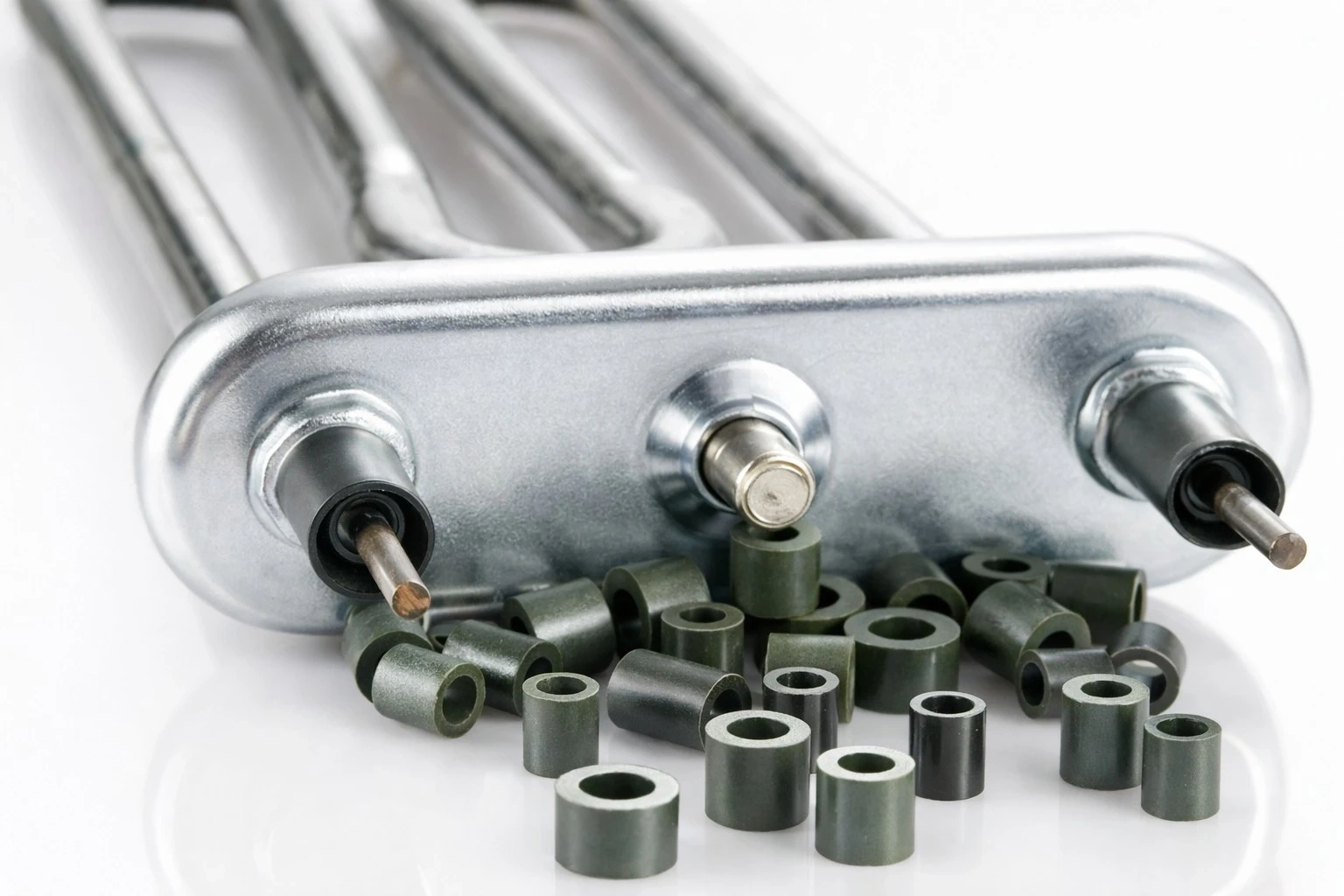
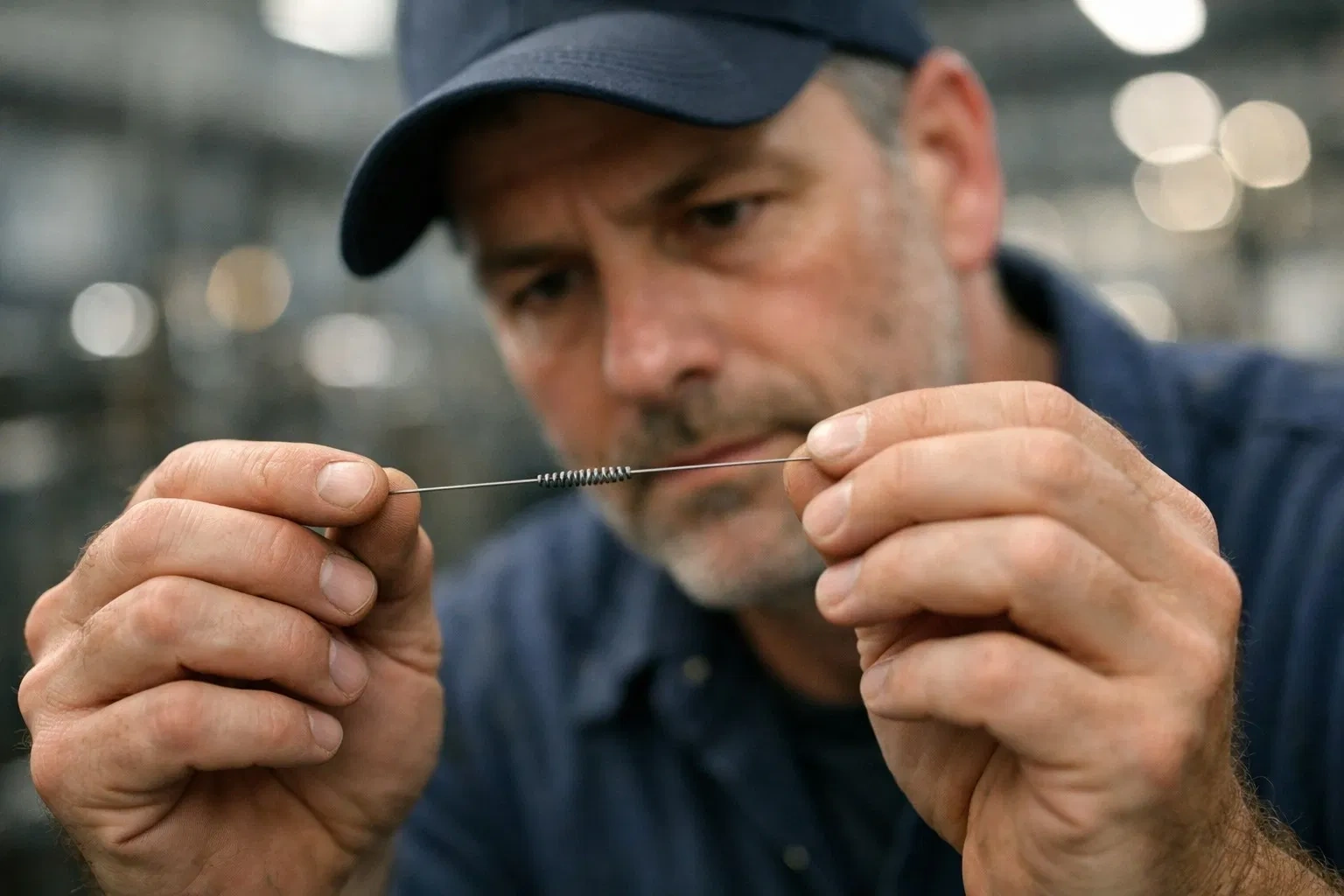
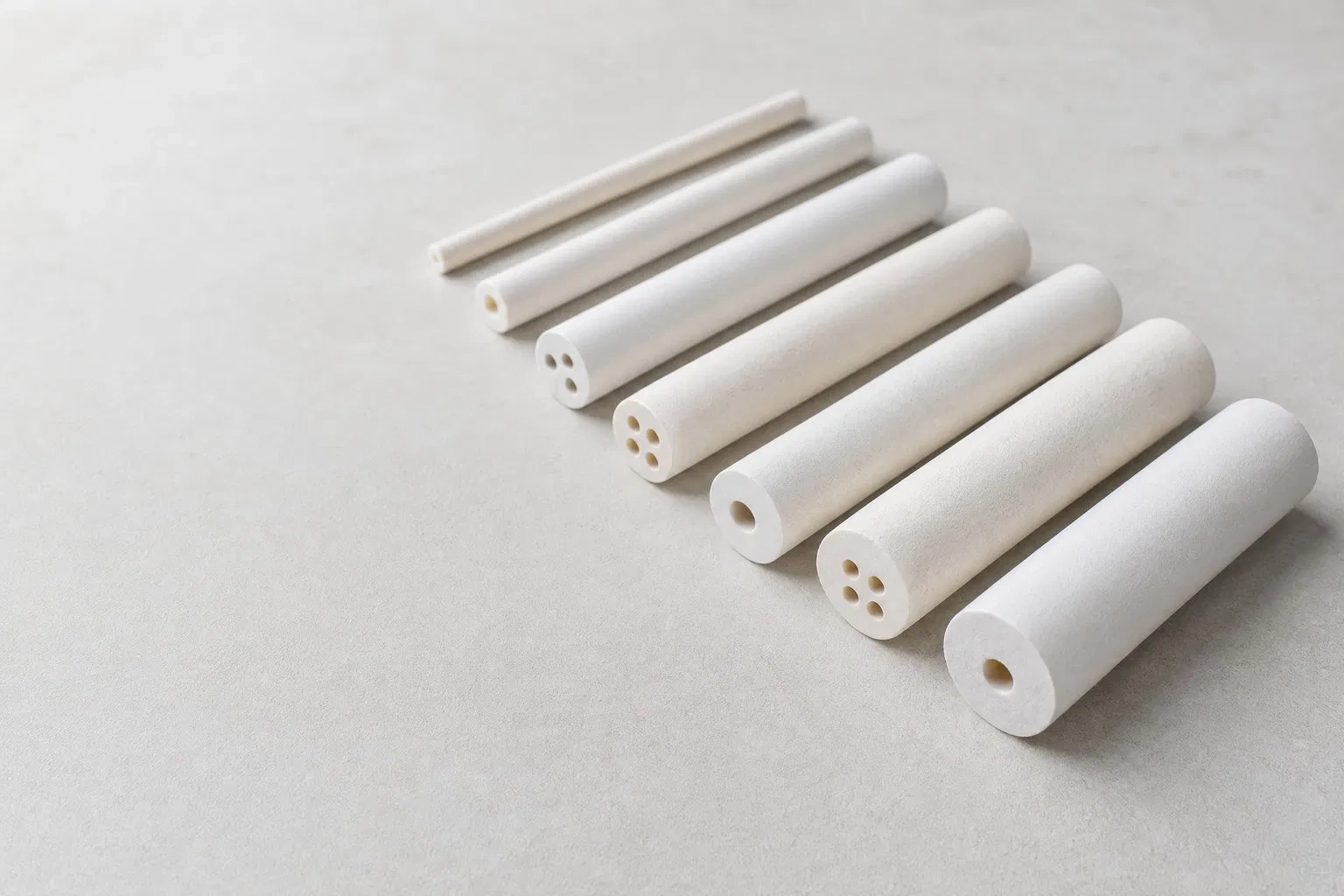
In a conventional cartridge heater, the resistance wire (typically NiCr 80/20) does not float freely inside the metal sheath. It is wound in a spiral around a rigid ceramic core — essentially a prefabricated spool or bobbin of refractory ceramic material that serves two purposes at once: it gives the winding a fixed, repeatable geometry during coiling, and it acts as the primary electrical insulator between the wire and the interior of the sheath. Once the wire-and-core assembly is inserted into the metal tube — together with the terminal pins and, in many designs, a grounding disc at one end — the remaining annular space between that assembly and the inner wall of the sheath is filled with high-purity MgO powder of controlled grain size. The finished heater is then subjected to a diameter-reduction swaging process that accomplishes three things simultaneously: it compacts the MgO powder into a dense, essentially pore-free mass; it partially collapses the original ceramic core around the pins to ensure good electrical contact between the pigtail leads and the terminals; and it reduces the insulating layer to the minimum thickness that still guarantees reliable electrical insulation, because the thinner that compacted layer is, the better the heat transfer from the wire to the sheath — and from there, to whatever process is being heated.
This combination — rigid core plus compacted powder — makes manufacturing sense because cartridge heaters are produced as discrete, relatively short pieces: the wire is coiled onto the core with a winding machine, the complete assembly is built in one step inside the sheath, the powder is filled and compacted in a single swaging operation (or a few passes) along the whole length of the finished piece. There is no need for the insulating material to flow continuously through an in-line drawing process, because the part is already at, or very close to, its final length before compaction even begins.
Crushable MgO beads in MI cable
MI cable is manufactured in a fundamentally different way, because its finished product can reach tens or hundreds of meters of continuous length starting from a short metal tube formed in-line. This is where crushable beads come in: individually preformed granules of prefused (fused) MgO ceramic, each with one or more through-holes for the metal conductors to be threaded through before the assembly enters the first reduction stage. Unlike the core of a cartridge heater, these beads are not meant to hold their shape — their function is exactly the opposite. They are loaded loose, or loosely stacked, inside the tube together with the conductor wires, acting as temporary spacers that keep the conductors from touching each other or the inner tube wall as the assembly moves through the swaging, rolling, or cold-drawing stages. On each diameter-reduction pass, the beads are crushed and merge together under pressure, literally being ground down into the same kind of continuous, compacted MgO mass that characterizes the finished MI cable, while the tube lengthens and its cross-section is progressively reduced, with intermediate annealing steps to restore the metal’s ductility before the next pass.
The reason for using preformed, holed beads instead of loose powder at this initial stage — even though the end result after drawing is, in practical terms, a compacted MgO mass comparable to that of a cartridge heater — has to do with dimensional control during a continuous process: the holes in the beads keep the conductors centered and equidistant from the very start, something that would be far harder to achieve consistently by simply pouring loose powder around wires that aren’t yet fixed on a rigid spool, especially when the cable can carry anywhere from a single conductor to eight or more, as is common in MI cables used for thermocouples or three-phase heating. The beads give the process a kind of temporary, disposable scaffolding that is deliberately destroyed during the first diameter reduction and is no longer needed once the material is compacted.
Property and characteristic comparison table
| Characteristic | Ceramic core + compacted MgO (cartridge heater) | Crushable MgO beads (MI cable) |
| Initial physical form of the MgO | Prefabricated rigid core (ceramic spool) + controlled-grain powder | Individually prefused granules with through-holes |
| Function during manufacturing | Gives the winding fixed geometry and provides electrical insulation | Temporary, disposable spacer, deliberately destroyed |
| Compaction stage | Single swaging operation (or a few passes) on a piece already at final length | Multiple swaging/rolling/drawing passes with intermediate anneals |
| Typical finished length | Centimeters to a couple of meters | Meters to hundreds of meters on a continuous coil |
| Core/bead behavior after compaction | Partially collapses around the pins | Fully crushed, merges into a continuous mass |
| Main dimensional risk | Uneven insulating layer thickness if powder filling isn’t uniform | Microvoids or air gaps if the bead doesn’t crush predictably |
| Typical number of conductors | 1 (the resistance wire itself, coiled) | 1 to 8 or more parallel conductors |
| Final geometry | Rigid, straight, fixed diameter | Flexible, can be bent in the field without losing dielectric integrity |
| Characteristic application | Insertion into a machined bore (mold, plate, die) | Distributed tracing along pipes, tanks, or surfaces |
Manufacturing methods, step by step
Cartridge heater with ceramic core:
- The NiCr resistance wire is coiled onto the prefabricated ceramic core, with pitch and turn count calculated for the required power.
- The core-and-wire assembly is loaded into the metal sheath, together with terminal pins and, depending on design, a grounding disc.
- The remaining annular space is filled with high-purity MgO powder of controlled grain size.
- Vibration or pre-compaction removes air pockets before swaging.
- Diameter-reduction swaging compacts the powder, partially collapses the core, and fixes the piece’s final geometry.
- End sealing, dielectric (Hi-Pot) testing, and resistance testing before shipment.
MI cable with crushable beads:
- The metal tube is formed in-line from a longitudinally welded strip or sheet.
- The metal conductors and the prefused MgO beads threaded onto them are fed in continuously.
- The first diameter-reduction swaging pass begins crushing the beads and compacts the material around the conductors.
- Successive cold-rolling or drawing passes follow, each with an anneal to restore the metal’s ductility before the next reduction.
- Final reduction to the specified cable diameter, with the MgO now fully crushed and compacted into a continuous mass.
- Cutting to length, moisture-sealing the ends, and dielectric/continuity testing before coiling for shipment.
Applicable industries
| Industry | Cartridge heater (core + compacted MgO) | MI cable (crushable beads) |
| Plastics injection molding | Hot runners, nozzles, mold heater plates | Tracing resin feed piping |
| Petrochemical and refining | Bench and platen heating for lab testing | Field pipe and tank tracing, classified areas |
| Food and beverage | Sealers, packaging equipment, cooking equipment | Sanitary process pipe tracing |
| Power generation | — | Heating cable for biomass plants and boilers |
| Semiconductor and lab | Precision heater plates, small furnaces | Sensors and thermocouples integrated in critical processes |
| Marine and naval | Cabin and galley heaters | Deck heat tracing and fire-protection systems |
Selection criteria
| Criterion | Favors cartridge heater | Favors MI cable |
| Installation geometry | Straight bore, fixed diameter and length | Long run, bends, elbows, irregular surfaces |
| Required power density | High density in a small footprint | Density distributed along the run |
| Field bending needed | Not applicable (rigid piece) | Yes, without losing dielectric integrity |
| Number of conductors needed | One (the winding itself) | One to several (heating, signal, thermocouple) |
| Ease of replacement | High, interchangeable standard part | Requires specialized field termination |
| Corrosive or vibration-heavy environment | Stainless steel or Incoloy sheath depending on temperature | Continuous metal sheath, good vibration resistance |
Why choose Heatecx products
Heatecx directly manufactures both the MgO raw material and the machinery used in both compaction processes, enabling end-to-end quality control: the same Shenzhen facility produces high-purity MgO powder for cartridge heaters and related components for MI cable lines, and also offers the filling, coiling, drawing, and annealing machines needed for both processes. This vertical integration between raw materials and machinery means Heatecx’s engineering team understands firsthand how powder grain size or bead microstructure affects the final result on a customer’s production line, and every batch of material goes through dielectric and purity testing before leaving the factory.
Application case
In a plastics processing plant that combines injection molding with a heat-tracing system to maintain the temperature of resin feed lines between the silo and the hopper, both technologies coexist within the same production line: cartridge heaters with ceramic cores are installed in the hot runners and mold heater plates, where high power density in a small footprint and fixed geometry are required; MI cable, by contrast, runs the length of the resin transport piping, following bends and elbows without losing dielectric continuity, and tolerating the field-installation handling that a cartridge heater could not withstand without cracking.
Frequently asked questions
Are the MgO powder used in cartridge heaters and the beads used in MI cable chemically the same? Yes, both are high-purity magnesium oxide, but they are manufactured with different processes and grain-size controls, tailored to how each is compacted in its respective technology.
Can a cartridge heater be filled with beads instead of compacted powder? That’s not standard practice. The ceramic core and compacted powder are optimized for single-pass compaction over short pieces; beads are designed for a continuous, multi-stage drawing process.
Why does MI cable need so many diameter-reduction passes while a cartridge heater doesn’t? Because MI cable starts from a short tube and is lengthened to tens or hundreds of meters through progressive drawing, while a cartridge heater is already at its final length before compaction.
Which of the two technologies offers better dielectric strength? Both can reach very high dielectric strength values when the compaction process is executed correctly; the relevant difference isn’t which technology is “better” in the abstract, but which one is designed for the geometry and installation method the application requires.