In the dynamic world of industrial manufacturing, the relentless pursuit of precision and efficiency is fundamental. Flat electric heaters are critical components in a vast range of applications, and their quality depends directly on a meticulous manufacturing process. For years, the compaction of heaters has presented significant challenges, especially concerning the uniformity and integrity of the resistive coil.
The Challenge of Traditional Heater Compaction
Historically, the process of reducing heaters was performed using a single heater rolling/compaction machine that operated with 12 or even 20 stations. This single-step reduction method, while seemingly efficient, generated a series of drawbacks that affected the final product quality. The most recurring problem was the uneven elongation of the internal resistive wire. Specifically, the central resistive coil tended to stretch between 30 and 50 mm more than the two lateral resistive coils. This disparity resulted in an inaccurate cold end length, which in turn caused a deviation in flatness of up to 0.55 mm. Furthermore, this excessive elongation led to undesirable variations in compaction density, compromising the uniformity and performance of the flat heater.
The Physics Behind Heater Compaction
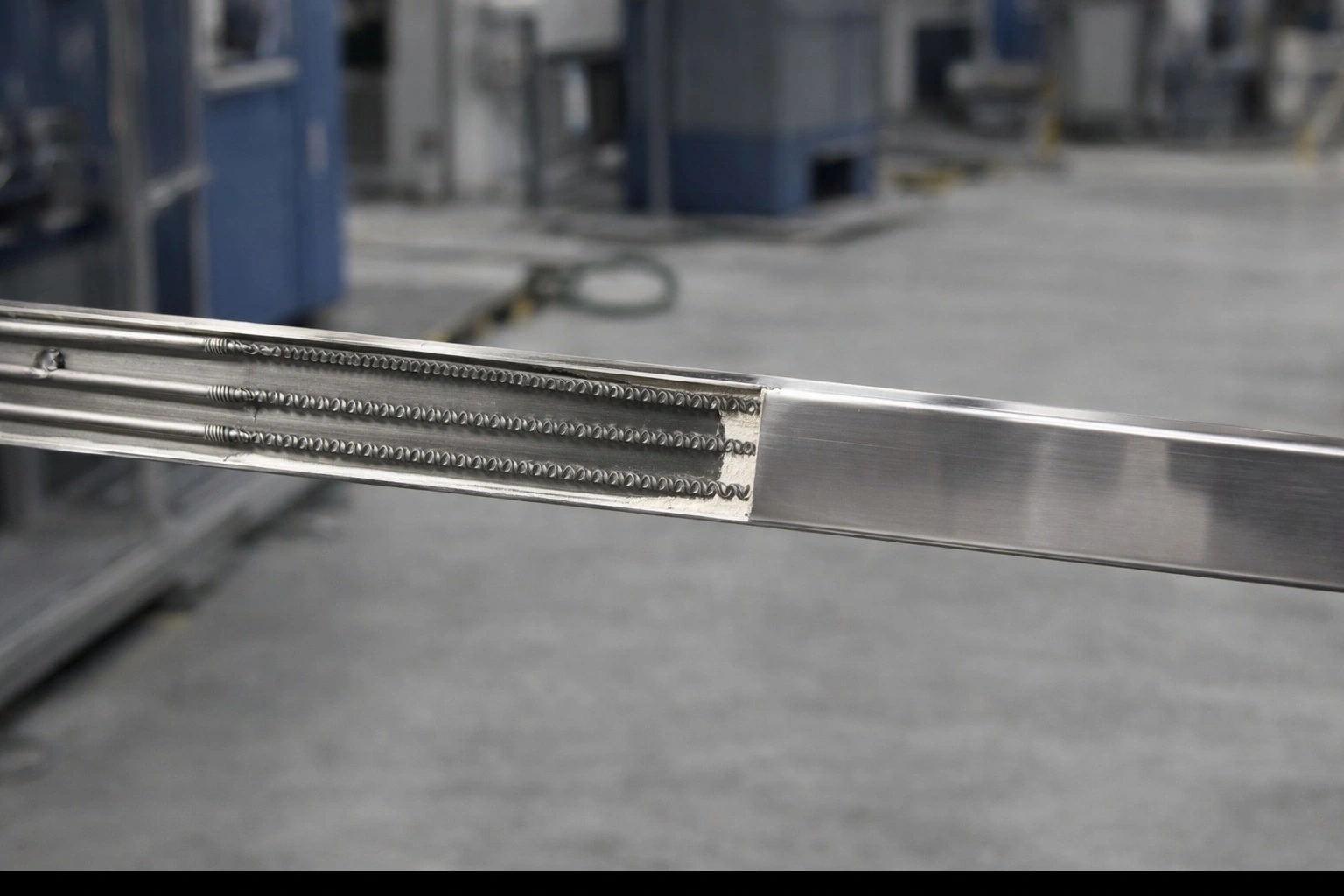
To understand the magnitude of our innovation, it is crucial to grasp the underlying physics of the heater compaction process. A flat electric heater consists of a resistive wire (or resistive coil, sometimes two or three) inserted into a metal tube and surrounded by an insulating material, typically magnesium oxide (MgO) powder. The heater rolling process aims to reduce the tube’s diameter and compact the MgO powder, increasing its density. A higher MgO density improves thermal conductivity and electrical insulation, critical factors for the heater‘s efficiency and safety.
In the traditional single-step method, the compaction force is applied abruptly and in a high number of consecutive stations. This generates significant and non-uniform mechanical stress along the resistive coil. The friction between the wire, the MgO powder, and the tube’s inner wall, combined with rapid deformation, causes the central material to experience greater flow resistance, resulting in the observed differential elongation. This elongation not only affects the cold end length but also creates microfractures or stress points in the resistive wire, reducing its service life and its ability to dissipate heat uniformly.
Our Innovative Solution: Two-Phase Compaction with Specialized Rolling Machines
Aware of these limitations, our research and development team embarked on an exhaustive study to perfect the process of compacting heaters. After several years of dedication and experimentation, we have achieved a significant breakthrough. The key to our innovation lies in implementing a two-phase reduction process, using two 6-station flat heater rolling machines. This strategic approach allows for a more controlled and gradual compaction, directly addressing the problems inherent in the single-step method.
The two-phase process distributes the workload and mechanical stress more equitably. In the first phase, the heater undergoes a controlled initial reduction, allowing the material to settle and pre-compact more homogeneously. The second phase refines this compaction, achieving the desired final density with less elongation and a more uniform force distribution. This method minimizes internal friction and the differential stretching of the resistive coil, ensuring the resistive wire maintains its structural integrity and centralized position.
Tangible Results and Benefits of Our Technology
The adoption of this two-phase heater reduction process has transformed the quality of our flat electric heaters. The benefits are clear, measurable, and summarized in the following comparative table:
| Characteristic / Process | Traditional Compaction (12/20 stations, 1 phase) | Innovative Compaction (2×6 stations, 2 phases) |
|---|---|---|
| Central Coil Elongation | 30-50 mm more than lateral coils | Uniform across the three rods |
| Cold End Length | Inaccurate | Precise and consistent |
| Flatness Deviation | 0.55 mm | 0.2 mm (63% Improvement) |
| Density Variations | Significant | Minimal, density is increased and uniform |
| Mechanical Stress | High and non-uniform | Reduced and distributed equitably |
| Heater Service Life | Potentially reduced due to stress points | Prolonged due to greater coil integrity |
| Thermal Efficiency | Suboptimal due to irregular density | Optimized due to uniform and high density |
- Uniformity of Elongation: The elongation of the cold ends of the three output rods is now remarkably uniform, eliminating the disparities that previously affected precision.
- Reduction in Total Elongation: The total elongation of the tube has been considerably reduced, contributing to greater dimensional stability of the product.
- Increase in Density: We have achieved a significant increase in compaction density, which translates to higher heater efficiency and durability.
- Drastic Improvement in Flatness: The flatness deviation, which was previously 0.55 mm, has been reduced to just 0.2 mm. This 63% improvement is a testament to the precision offered by our new process.
The Critical Importance of Density and Flatness in Industrial Applications
Compaction density and flatness are not mere technical parameters; they are determining factors in the performance and reliability of flat electric heaters in demanding industrial environments. A uniform and high MgO density ensures optimal heat transfer from the resistive coil to the tube’s surface, preventing localized hot spots that could lead to premature failures. Furthermore, superior electrical insulation is crucial for operational safety, especially in high-power or high-temperature applications.
Heater flatness is equally vital. In many applications, flat heaters are mounted on surfaces to heat plates, molds, or liquids. A significant deviation in flatness (like the 0.55 mm from the previous process) results in imperfect contact with the surface to be heated. This creates air pockets that act as thermal insulators, drastically reducing heat transfer efficiency and causing non-uniform heating. With our improvement to 0.2 mm, we ensure near-perfect contact, maximizing energy efficiency and thermal uniformity, which is indispensable in industries like plastics, packaging, or food processing, where precise and constant temperature is a non-negotiable requirement.
A Commitment to Excellence and Continuous Innovation
The implementation of our flat heater rolling machines represents not only a technological advancement but also an unwavering commitment to excellence in electric heater manufacturing. This optimized process ensures that every flat heater we produce meets the highest standards of quality and performance, offering our clients superior products and greater reliability in their industrial applications. Our investment in research and development underscores our vision of industry leadership, not only solving existing problems but also anticipating the future needs of the market.
Conclusion
The evolution in flat heater compaction is a clear example of how research and innovation can overcome ingrained industry challenges. By transitioning from a single-step process to a two-phase strategy with our 6-station flat heater rolling machines, we have not only solved elongation and flatness problems but have also set a new quality standard. This advancement reaffirms our leadership in electric heater manufacturing, providing more efficient and reliable solutions for the global market.