In industrial heating systems that must operate reliably at temperatures above 800 °C, the choice of ceramic support material is as critical as the resistive alloy itself. High-temperature ceramic for electrical heating elements provides the structural backbone that keeps resistive wires in place, separates live components from external metalwork, and ensures the system meets electrical safety standards — all while withstanding the relentless thermal cycling of continuous production.
This comprehensive guide covers the main ceramic materials used in industrial heating applications, how they are manufactured, their available geometries, the industries that rely on them, the most common installation and maintenance errors, and a practical selection framework for specifying the right material for any given process requirement.
The Role of Ceramics in Electrical Heating Systems
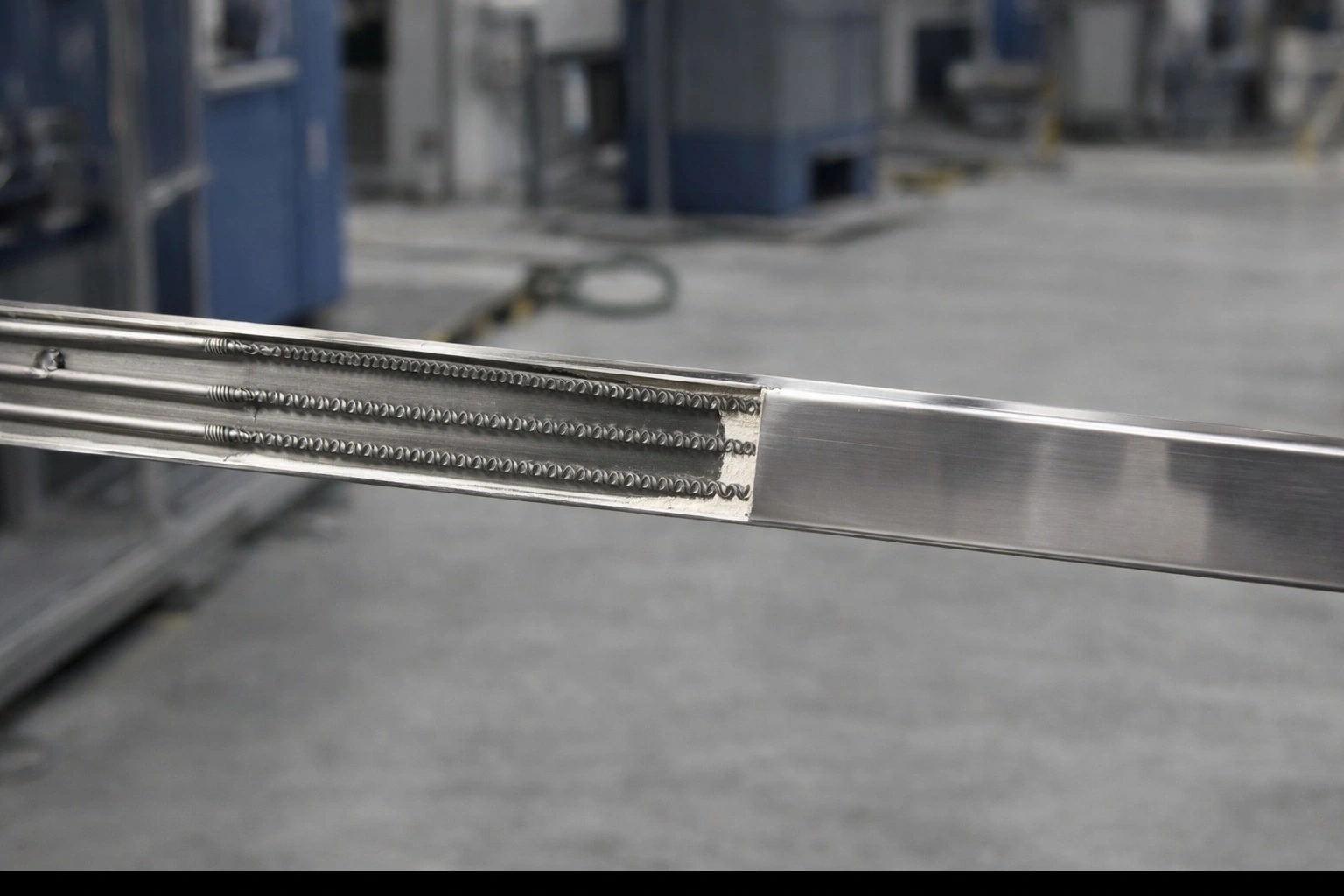
A typical industrial heating element consists of two distinct functional layers: the resistive element — usually a nickel-chrome (NiCr) or iron-chrome-aluminium (FeCrAl) alloy wire — and the ceramic support and insulator that houses it. The ceramic does not generate heat; its role is to provide electrical isolation between the live resistive wire and the surrounding metallic structure while maintaining dimensional stability at extreme temperatures.
The electrical resistivity of technical ceramics ranges from 10⁸ to 10¹⁴ Ω·cm depending on composition and temperature. This property ensures zero leakage current even in environments with moisture, vibration, or aggressive chemicals — conditions that would quickly compromise polymeric or mineral-fibre insulators.
The ceramic component performs three simultaneous functions in every heating system:
- Electrical function: dielectric barrier preventing current leakage and short circuits between the resistive wire and the metallic casing.
- Mechanical function: structural support maintaining the geometry of the resistive wire under thermal stress, preventing deformation caused by repeated expansion-contraction cycles.
- Thermal function: heat transfer channel directing energy toward the surface or fluid to be heated, with the possibility of modulating heat flux density through geometric design.
This triple role means that the quality of the ceramic support directly affects energy efficiency, heating uniformity, and the total service life of the system.
Key Properties Required in Heating Ceramics
To function as a viable support for industrial electrical resistors, a ceramic material must simultaneously satisfy several requirements that in other materials would be contradictory:
High electrical resistivity at elevated temperature: Resistivity must not fall below 10⁶ Ω·cm even when the process temperature reaches 1,000 °C. Many polymers and some low-grade ceramics lose their dielectric properties when heated.
Selective thermal conductivity: In direct-contact band heaters, high conductivity toward the heated surface is desirable. In furnace supports, low conductivity reduces structural heat losses.
Controlled coefficient of thermal expansion (CTE): Mismatches between the CTE of the ceramic and the metallic wire generate internal stresses during thermal cycling. A poorly matched CTE leads to microcracking and eventually support failure.
Thermal shock resistance: The ability to survive sudden temperature gradients without fracturing. Quantified by the thermal shock parameter R = σ·λ/(α·E), where σ is tensile strength, λ is thermal conductivity, α is CTE, and E is Young’s modulus.
Chemical inertness: Stability against process gases, molten material vapours, and environmental contaminants.
Formability: The ability to be manufactured in precise geometries (cylinders, plates, nozzles, wire guides) with dimensional tolerances matched to the application.
Ceramic Materials Used in Industrial Heating
1. Alumina (Al₂O₃)
Alumina is the most widely used technical ceramic in industrial heating, offering an outstanding balance of electrical insulation, mechanical strength, and thermal stability. Properties vary significantly with purity grade:
| Grade | Al₂O₃ (%) | Max. temp. (°C) | Resistivity (Ω·cm) | Typical application |
| Standard | 85–92 | 1,400 | 10⁸–10¹⁰ | Furnace supports, wire guides |
| High purity | 96–99 | 1,550 | 10¹¹–10¹³ | Precision resistors, laboratory |
| Ultra-pure | 99.7 | 1,600 | >10¹⁴ | Research, critical applications |
Standard-grade alumina is the workhorse material for furnace heater supports, resistor cores in high-power resistors, and wire guides in industrial heat treatment ovens. High-purity grades are reserved for applications where process contamination is a critical factor, such as semiconductor manufacturing or the sintering of advanced technical materials.
A key advantage of alumina is its compatibility with co-sintering processes (HTCC, High-Temperature Co-fired Ceramics): a tungsten or molybdenum resistive circuit is printed directly onto the green ceramic tape, and both materials are co-fired at 1,500–1,600 °C to produce a heating element where the resistance is completely encapsulated within the ceramic matrix with no additional physical interface. The resulting MCH (Metal Ceramic Heater) element can reach surface temperatures of 800 °C in under 30 seconds, making it highly attractive for rapid-cycle applications.
2. Cordierite and Aluminosilicates
Cordierite (2MgO·2Al₂O₃·5SiO₂) ceramics are engineered for applications where rapid thermal cycling is unavoidable. Their exceptionally low coefficient of thermal expansion (1–2 × 10⁻⁶ K⁻¹) makes them far more resistant to thermal shock than alumina. Their mechanical properties include:
- Compressive strength: 280–500 MPa
- Flexural strength: 50–60 MPa
- Impact resistance: 1.8–2.2 cm·kJ/m²
With an upper service temperature of approximately 1,300 °C, cordierite covers the majority of polymer processing and general industrial heating applications at a significantly lower cost than high-purity alumina. It is the core material in ceramic band heaters used on extruder barrels, injection moulding machines, and hot runner systems.
Higher-alumina aluminosilicate compositions — referred to as C530 grades in some European manufacturer catalogues — contain appreciable amounts of mullite, which improves creep resistance at high temperature while retaining good thermal shock properties.
3. Steatite (MgO·SiO₂)
Less well-known than alumina or cordierite, steatite is an excellent ceramic for electrical engineering applications where process temperatures remain below 1,000 °C. Its specific advantages include:
- High dielectric strength: ideal for applications where working voltage is high and ceramic wall thickness must be minimised.
- Easy sinterability: can be formed and sintered into a wide variety of complex geometries (washers, bushings, resistor forms, spacers) with greater ease than alumina.
- Lower manufacturing cost: raw materials (talc and calcined clay) are more accessible than high-purity alumina precursors.
Steatite is primarily used in medium-power wound-wire resistors, high-temperature connectors, and heating element supports for premium domestic appliances.
4. Mullite (3Al₂O₃·2SiO₂)
Mullite is the reference refractory ceramic for applications combining high temperature (up to 1,600 °C) with demanding creep and deformation-under-load resistance. Key properties include:
- Low CTE (comparable to cordierite).
- Excellent creep resistance up to temperatures close to its melting point (1,840 °C).
- Good thermal shock resistance, though lower than cordierite.
- Compatibility with oxidising and mildly reducing atmospheres.
In industrial heating, mullite is primarily used as the structural material of high-temperature furnaces — walls, arches, kiln furniture — rather than as a direct heater support, although in some chamber furnace configurations it serves as the support tube for SiC or MoSi₂ elements.
5. Silicon Carbide (SiC)
Silicon carbide combines high thermal conductivity with exceptional mechanical strength and a service temperature range of 1,400 to 1,600 °C in air. SiC heating elements — commonly called SiC rods, globars, or Kanthal Globar elements — are available in several geometries:
- Straight rods: the most common format in laboratory furnaces and metal heat treatment furnaces.
- U-shaped elements: allow single-end electrical connection, useful when furnace access is limited.
- Tubular elements: for direct infrared radiation heating of the processed material.
- Flat plates: for surface heating in powder sintering and glass processing applications.
A critical operational characteristic of SiC as a heating element is the progressive increase in electrical resistance over service life, a result of surface oxidation. This ageing phenomenon requires the electrical control system — adjustable transformer or power controller — to be able to increase supply voltage over time to maintain constant power output. Monitoring the current drawn by each furnace zone enables operators to track ageing rate and plan element replacement before power output drops below process requirements.
6. Molybdenum Disilicide (MoSi₂)
For processes requiring sustained temperatures above 1,600 °C and up to 1,800–1,900 °C, molybdenum disilicide is the industry benchmark. Its key differences from SiC include:
- Maximum service temperature in air: 1,800 °C (high-density elements: up to 1,900 °C).
- Forms a protective SiO₂ layer in oxidising atmospheres, providing excellent long-term oxidation resistance.
- Unlike SiC, electrical resistance decreases as temperature increases, requiring a controlled start-up with limited current to prevent thermal runaway during warm-up.
- Susceptible to the “Pest” phenomenon (powder disintegration) if held between 400 and 600 °C for extended periods — a temperature range to avoid in heating and cooling ramps.
MoSi₂ elements are manufactured by extrusion and high-temperature sintering of MoSi₂ powder. Their standard geometry is the U-shaped rod with a smaller-diameter hot zone than the cold connection terminals, concentrating heat dissipation in the active furnace zone.
7. Aluminium Nitride (AlN) and Silicon Nitride (Si₃N₄)
These advanced ceramics are becoming increasingly important in specialised high-performance heating applications:
AlN offers exceptional thermal conductivity (170–200 W/m·K versus 20–30 W/m·K for alumina) combined with excellent electrical insulation. Its primary application is in disc and ring heaters for semiconductor equipment where thermal uniformity across large wafer surfaces is a critical process requirement.
Si₃N₄ combines high mechanical strength, good thermal shock resistance, and electrical insulation. It is being progressively adopted in liquid immersion heaters where mechanical strength under hydraulic pressure is as important as thermal performance, and in automotive and aerospace applications requiring reliable operation under mechanical stress at elevated temperatures.
The Manufacturing Process of Ceramic Heating Supports
Understanding how ceramic for electrical heating is manufactured is essential for evaluating product quality and anticipating potential in-service issues.
Raw Material Preparation
Manufacturing begins with high-purity ceramic powder selection. For alumina, the powder is produced via the Bayer process (bauxite → alumina) with particle sizes controlled between 1 and 10 µm. Sintering additives (MgO, SiO₂, CaO) are added in precise proportions to control sintering temperature and final grain size. Powder blending is carried out in ball mills for 12–24 hours to achieve a homogeneous slurry with the viscosity and flowability required for the subsequent forming process.
Forming Processes
Ceramic supports for heating elements can be manufactured using several processes, selected according to geometry and production volume:
Extrusion: continuous process for manufacturing tubes, cylinders, and constant-section rods. The plasticised ceramic paste is forced through a die and cut to the required length. This is the standard process for ceramic tubes and SiC rods.
Uniaxial pressing: for flat or simple geometry parts (discs, rings, plates). Dry granulated powder is compacted in a rigid die at 50–200 MPa. High-throughput process for series production.
Cold Isostatic Pressing (CIP): the powder is compacted under uniform hydrostatic pressure from all directions. Produces more uniform density than uniaxial pressing; used for complex geometries and high-performance components.
Slip casting: liquid ceramic slurry is poured into plaster moulds that absorb the water. Enables complex geometries and thin walls. Used for irregular-geometry supports or parts with internal cavities.
Tape casting: the industrial process used to manufacture HTCC alumina substrates. The ceramic slurry is spread onto a PET film using a Doctor Blade to achieve controlled thickness (0.1–1 mm). The dried tapes are stacked, laminated, and co-fired with the printed metallic circuits.
Sintering
Regardless of the forming process, all ceramic supports undergo a sintering cycle at high temperature: alumina at 1,500–1,650 °C, cordierite at 1,250–1,350 °C, SiC at 2,100–2,200 °C (pressureless sintering with additives). During this process, particles bond through solid-state diffusion, eliminating porosity and achieving design density and mechanical strength. Heating and cooling rates during sintering are critical to prevent internal stress gradients that could generate cracks.
Finishing and Quality Control
After sintering, parts may require precision machining (grinding, drilling, turning with diamond tools) to achieve required dimensional tolerances. Quality control includes: density measurement (Archimedes method), four-point flexural strength, electrical resistivity at ambient and elevated temperature, CMM dimensional inspection, and in critical cases, ultrasonic inspection to detect internal pores or cracks.
Common Geometries of Ceramic Heating Supports
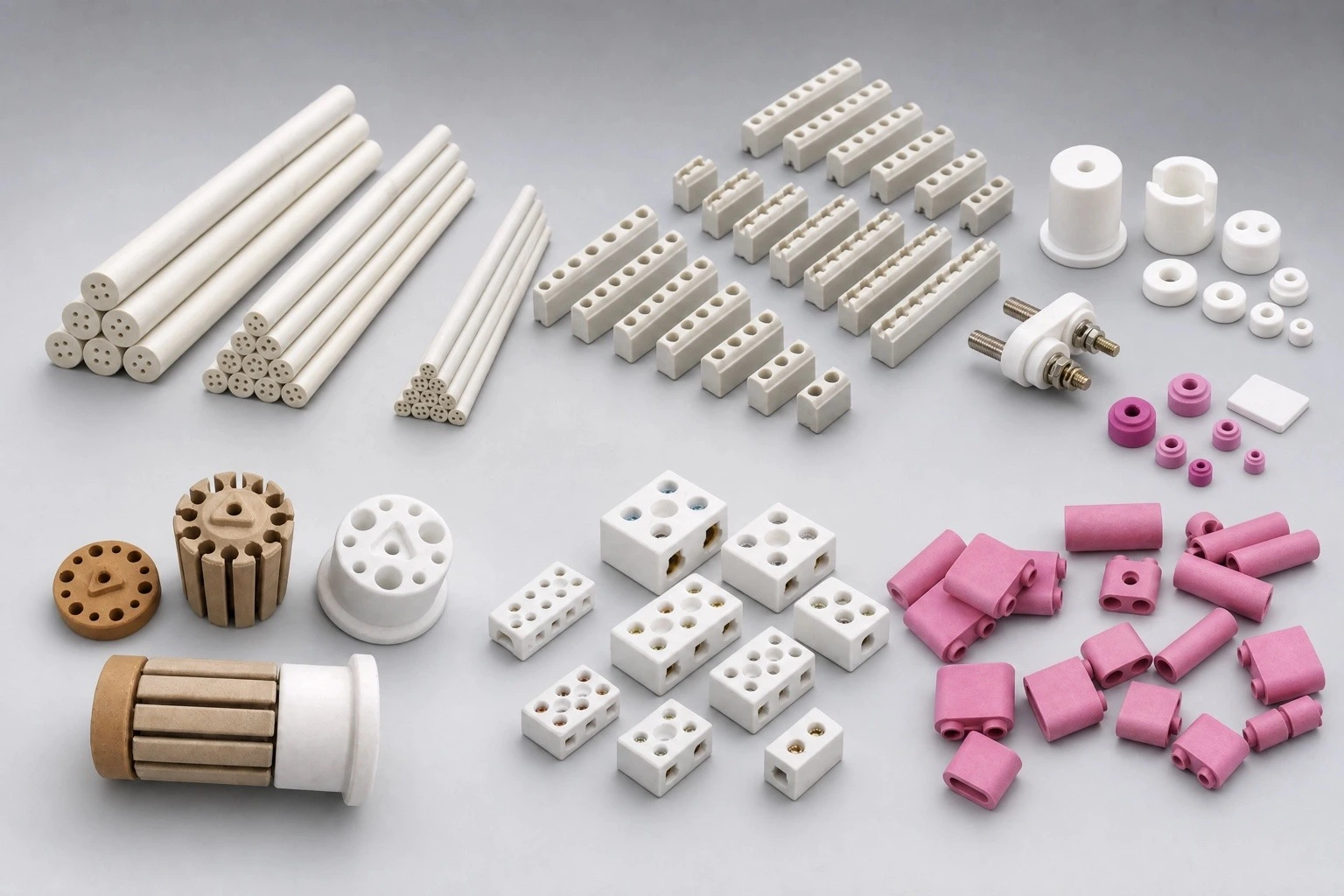
The geometry of the ceramic support directly determines the application and heat distribution pattern:
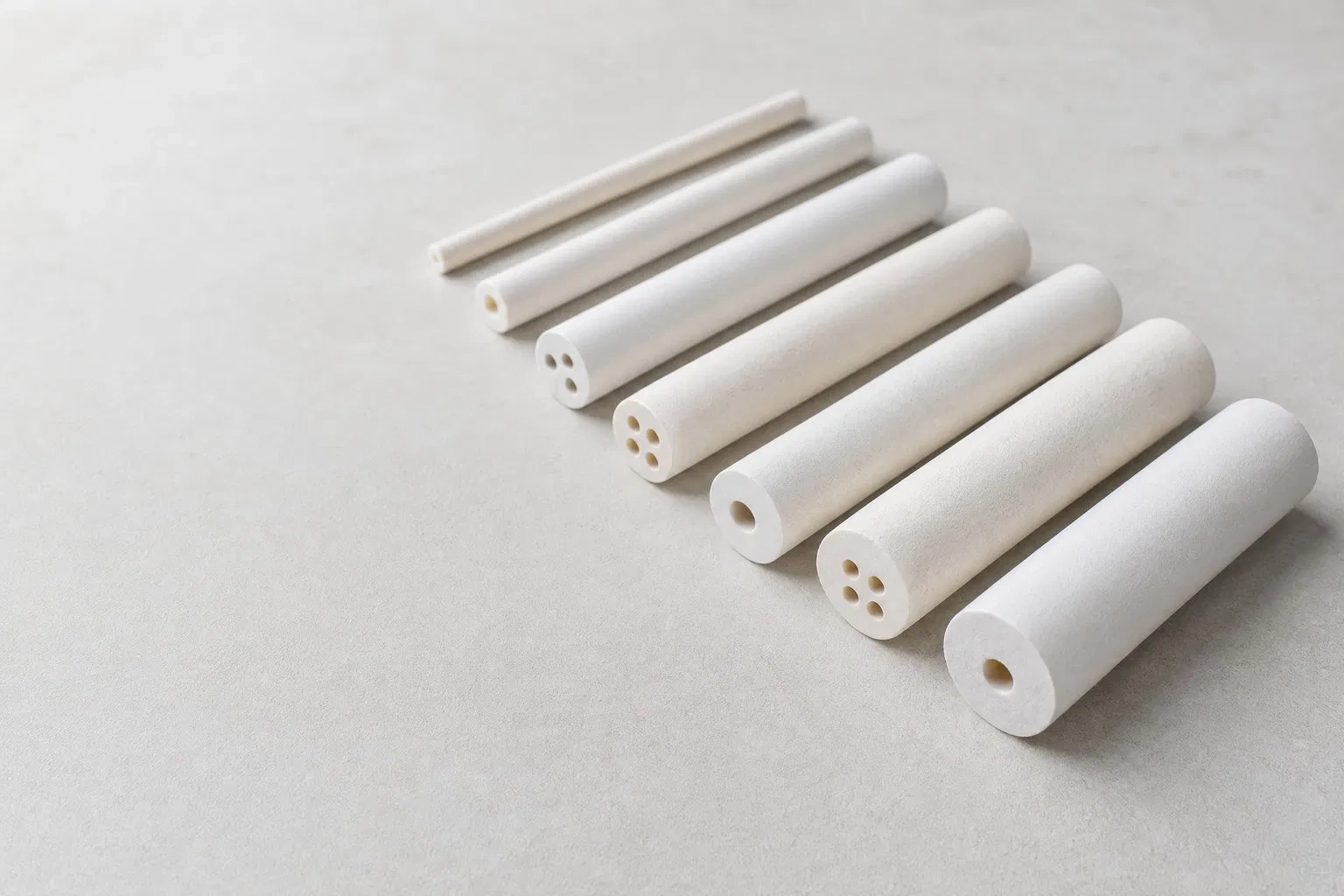
Tubes and sheaths: protect the resistive element and enable mounting within fluids or gases. The basis of ceramic-sheathed immersion heaters.
Solid cylinders and nozzles: guide the resistive wire in a spiral while keeping it separated from the metallic casing. Used in ceramic cartridge heaters and air heaters.
Flat plates and blocks: heater element supports in chamber furnaces. May incorporate machined grooves to locate the resistive wire.
Bands and collars: the characteristic geometry of extruder band heaters. The ceramic support wraps around the extruder barrel and maintains the resistive wire in direct contact with the metallic surface.
Beads and tubes (threading beads): small ceramic separators threaded onto resistive wire to prevent short circuits between turns. Typically manufactured in alumina or steatite.
SiC and MoSi₂ rods and tubes: the material itself is the heating element, with no additional metallic wire required.
Industrial Applications in Depth
Heat Treatment Furnaces
Alumina and SiC ceramic supports are essential in annealing, hardening, tempering, and case-hardening furnaces. In controlled-atmosphere furnaces (nitrogen, hydrogen, argon), ceramic grade selection must consider material reactivity with the process atmosphere at operating temperature. A properly maintained electric furnace enables periodic condition assessment through visual inspection: ceramic supports must not show fusion stains, visible cracks, deformations, or slag deposits. Electrical insulation in each zone can be checked with a megohmmeter to detect deterioration before it causes an electrical fault.
Plastics Extrusion and Injection Moulding
Ceramic band heaters deliver energy savings of 20–25 % over mica equivalents in continuous extrusion operations. This differential results from more efficient direct-contact heat transfer to the barrel: ceramic has higher conductivity toward the heated surface and better temperature retention during production cycles.
From a maintenance perspective, ceramic bands are significantly more resistant than mica to mechanical impact during mounting and dismounting, and maintain their properties better after repeated start-stop cycles. Typical operating temperatures in these applications range from 150 to 450 °C — the range where cordierite and aluminosilicates perform optimally.
Industrial Fluid Heaters
Ceramic-core tubular immersion heaters achieve the high power densities required for heating industrial oils, demineralised water, and process fluids to temperatures exceeding 200 °C. The ceramic sheath acts as a dielectric barrier between the resistive wire and the fluid, eliminating the risk of electrolysis and fluid contamination by heater element metals.
Chemical and Pharmaceutical Processing
The chemical inertness of alumina and zirconia makes ceramic insulators suitable for environments where the heating support may be exposed to acidic vapours, alkaline solutions, or aggressive solvents. In pharmaceutical processing, the absence of emissions or material shedding from the ceramic support is a regulatory requirement that high-purity technical ceramics satisfy without difficulty.
Industrial Drying and Curing
Ceramic medium and short-wave infrared emitters are the standard in paint and lacquer drying, adhesive curing, textile surface treatment, and coating drying on paper and board. Ceramic infrared radiation penetrates directly into the coating without overheating the substrate, increasing energy efficiency and reducing process cycle times.
Advanced Research and Laboratory Equipment
MoSi₂ and SiC elements are standard in materials science research furnaces, thermogravimetric analysis (TGA) systems, high-temperature X-ray diffraction setups, and material melting rigs where stability, reproducibility, and precise temperature control above 1,000 °C are mandatory requirements.
Common Installation and Maintenance Errors
Error 1: Skipping the Initial Slow Warm-Up Cycle
New ceramic supports — particularly those that have absorbed moisture during storage — must undergo a slow initial pre-heating cycle (2–5 °C/min up to 200 °C, with a 30-minute hold) before first production use. Skipping this step can cause cracking from rapid steam expansion within the ceramic pores.
Error 2: Over-Tightening Fixing Screws
Technical ceramics perform well in compression but are brittle in tension and shear. Over-tightening mechanical fixing elements generates localised tensile stresses that cause premature failure, particularly during thermal expansion cycles. Manufacturers specify maximum torque values that must be respected.
Error 3: Ignoring Minimum Spacing Requirements
In chamber furnace installations, ceramic-supported heating elements must maintain minimum spacing between elements and furnace walls to prevent electrical bridging when ceramics’ dielectric properties degrade at very high temperatures. This spacing is specified in SiC and MoSi₂ element manufacturer documentation.
Error 4: Not Tracking SiC Element Ageing
SiC rod resistance increases progressively over service life. Operating the furnace without adjusting supply voltage progressively reduces power delivered to the furnace, extending cycle times and potentially causing process quality issues. Periodic current monitoring per furnace zone enables early detection of this phenomenon.
Error 5: Cleaning Ceramics with Abrasive Products or Aggressive Solvents
Surface residues (oxide scale, process material deposits) should be removed with non-abrasive tools — soft-bristle brushes, compressed air, heat-resistant vacuum cleaners — and never with solvents that could penetrate surface porosity and react with the ceramic matrix during the next heating cycle.
Preventive Maintenance Checklist for Ceramic Heating Systems
A structured three-level maintenance programme maximises system service life:
Monthly inspection:
- Visual inspection of all ceramic supports: cracks, fusion stains, deformations.
- Electrical connection check between ceramic and metal terminals.
- Residue removal with non-abrasive tools.
Quarterly inspection:
- Insulation resistance measurement per zone with megohmmeter (minimum recommended: >1 MΩ at ambient temperature).
- Current trend recording per zone (especially in SiC-element furnaces).
- Furnace chamber insulation condition check: refractory bricks, ceramic fibre.
Annual inspection:
- Disassembly and inspection of all accessible ceramic supports.
- Preventive replacement of parts with accumulated wear exceeding 25 % of original wall section.
- PID controller calibration and thermocouple / PT100 verification.
- Ground connection verification for all equipment.
Seven Questions for Selecting the Right Ceramic Material
1. What is the maximum process temperature, including transient excursions? This defines the range of viable materials: cordierite to 1,300 °C, alumina to 1,600 °C, SiC to 1,600 °C, MoSi₂ to 1,800–1,900 °C.
2. What is the furnace or process atmosphere type? Reducing atmospheres may degrade SiC; oxidising atmospheres are ideal for MoSi₂. Alumina and cordierite are broadly compatible with both within their temperature ranges.
3. How frequently does the system start and stop? Processes with many start-stop cycles require materials with high thermal shock resistance. Cordierite and aluminosilicates outperform alumina in this respect.
4. What is the working voltage and which safety standards apply? This determines minimum ceramic wall thickness and required material purity grade (directly affecting electrical resistivity at elevated temperature).
5. Is there a risk of process contamination from the support material? In pharmaceutical, semiconductor, or advanced materials processes, ceramic purity is a critical requirement that may substantially increase material cost.
6. Is there continuous mechanical vibration or impact risk? This will determine minimum wall thickness and possibly dictate a different support geometry (tube versus plate, for example).
7. What is the available budget and what is the cost of unplanned downtime? The cost of a high-quality ceramic support is always less than the cost of a production stoppage in a continuous process. Optimisation must not sacrifice material quality.
Applicable Standards and Certifications
Ceramic supports for industrial electrical heating must comply with or be compatible with several standards depending on the application sector:
- IEC 60672: international standard for ceramics and glasses for electrical use. Defines requirements for dielectric, mechanical, and thermal properties by material class.
- IEC 60335: safety standard for household and similar appliances, including requirements for insulating materials used in heating elements.
- EN 60534 / ATEX: for installations in potentially explosive atmospheres, ceramic materials must meet additional ignition resistance requirements.
- ISO 10545: for ceramics in high-temperature processes, defines test methods for chemical and thermal shock resistance.
- UL 499: UL standard for electric heating appliances, widely required for North American market certification.
Under the EU Machinery Directive (2006/42/EC) and Low Voltage Directive (2014/35/EU), industrial heating equipment manufacturers must document that ceramic materials meet insulation requirements for the intended use conditions.
Emerging Technologies in Industrial Heating Ceramics
The ceramic materials sector for electrical heating is undergoing several relevant developments:
MCH (Metal-Ceramic Heater) elements: an emerging technology where the heating resistor is printed directly onto an alumina sheet by screen printing and the assembly is co-sintered. The element surface can reach 800 °C in under 30 seconds, making it highly attractive for rapid-cycle applications in automotive pre-heating, medical devices, and smart appliances.
Aluminium Nitride (AlN) heaters: with thermal conductivity 8–10 times higher than alumina, AlN enables heating uniformity levels unachievable with conventional ceramics. Currently standard in semiconductor wafer processing equipment, with growing adoption in EV battery thermal management and 5G infrastructure cooling.
Yttria-stabilised zirconia (YSZ) coatings: its exceptionally low thermal conductivity makes YSZ ideal as a thermal barrier coating on heating elements designed to minimise heat losses toward the support structure — a concept analogous to thermal barrier coatings in jet engine components.
Additive manufacturing of ceramics: selective laser sintering (SLS) and binder jetting of ceramic powders are enabling the production of heater support geometries previously impossible with conventional forming techniques, opening new design possibilities for non-standard furnace configurations.
Frequently Asked Questions
Can ceramic heating supports be custom-manufactured? Yes. Most specialist manufacturers offer custom geometries from customer designs, with minimum order quantities accessible for medium-size parts. For small runs, machining of standard sintered ceramic stock is typically more cost-effective than custom powder-based forming.
How long does a ceramic support last in service? Under normal operating conditions with adequate maintenance, alumina and cordierite supports have a service life of several years. SiC elements typically last 1,000–3,000 operating hours at full load; MoSi₂ elements, 1,500–5,000 hours, depending on process temperature and power control quality.
Can I replace mica heaters with ceramic in my current installation? In most cases yes, with measurable improvements in energy efficiency and service life. The replacement may require adjustment of the mechanical fixing system, as ceramic bands are more rigid than mica equivalents. Consult the heater element manufacturer before making the substitution.
Is technical ceramic conductive or insulating? Technical ceramics for electrical heating act as electrical insulators. Their high resistivity (10⁸–10¹⁴ Ω·cm) ensures that current does not flow through them. They must not be confused with high-temperature superconducting ceramics, which are entirely different materials with applications in advanced research.
What is the difference between a ceramic heater and a PTC heater? Conventional ceramic heaters use a metallic resistive wire embedded in or wound around a ceramic support. PTC (Positive Temperature Coefficient) heaters use a ceramic material — typically barium titanate — whose electrical resistance increases sharply above a transition temperature, providing self-regulation. PTC heaters are self-limiting in temperature but operate at much lower maximum temperatures than conventional ceramic-supported elements.
Conclusion
High-temperature ceramic for electrical heating elements is not a passive component — it is the structural and electrical foundation on which system reliability is built. Choosing the right material — alumina, cordierite, steatite, mullite, SiC, or MoSi₂ — based on temperature range, atmosphere, thermal cycling profile, chemical environment, and applicable standards is the decision that separates a heating system that performs consistently for years from one that generates costly maintenance calls and unplanned downtime.
Investing in a high-quality ceramic support always pays back through extended system service life, lower maintenance costs, and in many cases measurable energy savings that translate directly into operational profitability.
If you require technical support to specify the right ceramic heating support for your industrial application, our engineering team is ready to help. We design and manufacture custom ceramic solutions for industrial heating across a wide range of industries and process temperatures.