Magnesium Oxide (MgO) Powder for Electric Heating Elements
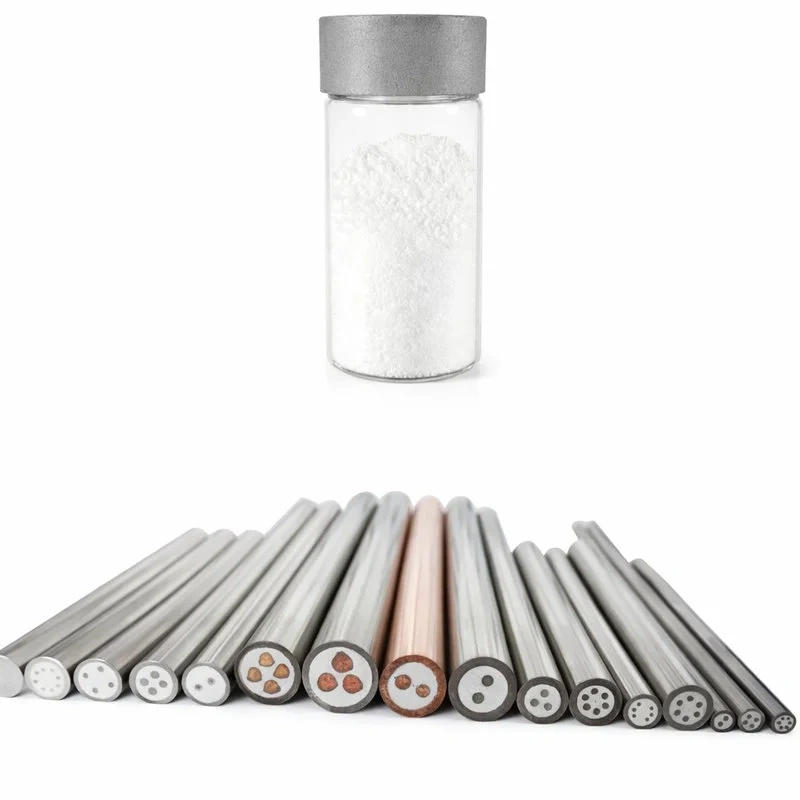
Magnesium oxide powder, universally referred to in the industry as MgO, is the insulating raw material that makes the tubular heating element possible in its modern form. Packed between the resistance wire and the outer metal sheath, this fine ceramic powder performs two jobs that few other materials can combine: it electrically isolates the resistive core to prevent current leakage and short circuits, while simultaneously conducting the heat generated by the wire outward to the tube surface with an efficiency most ceramic insulators cannot match. This rare pairing of high dielectric strength and genuinely useful thermal conductivity is the reason magnesium oxide has remained the standard insulating fill for electric heaters, from household appliances to demanding industrial process equipment.
From fused magnesia to filling powder
Electrical grade MgO powder does not come straight from natural magnesite; it starts as electro-fused magnesia, produced by melting magnesium oxide in an electric arc furnace at temperatures above 2800 °C and cooling it under controlled conditions to form a dense, compact crystalline structure. This fusion step burns off a large share of the impurities present in the raw ore and produces the periclase crystal structure responsible for the material's dielectric strength. The fused block is then crushed and milled in several stages to produce particles of specific sizes, which are blended in calculated ratios — what the industry calls mesh distribution — to achieve a powder with the flow characteristics and compaction density required for automatic tube filling on equipment such as an MgO filling machine.
Depending on the intended application, this base powder can be given an additional silicone treatment, which coats the individual particles with a hydrophobic layer and sharply reduces the powder's tendency to absorb ambient moisture — a property that becomes critical whenever the finished heater will operate in a humid environment.
The technical properties that define MgO quality
Judging the quality of an electrical grade magnesium oxide powder is never a matter of a single number; it comes down to the balance between several interdependent properties:
MgO purity. The active magnesium oxide content, usually expressed as a percentage, has a direct bearing on dielectric strength. Higher purity means fewer secondary oxides such as CaO or SiO₂, which act as weak points under electrical stress. General-purpose grades typically fall between 94% and 97% MgO, while high-demand grades exceed 97%.
Dielectric strength. This is the compacted powder's ability to withstand a voltage difference without allowing a discharge or current leakage. Measured in kV/mm, it is the single property that most directly governs the electrical safety of the finished heater, and it drops sharply if compaction is uneven or residual moisture is present.
Thermal conductivity. This determines how quickly heat generated in the resistance wire moves through the powder to the metal sheath. Insufficient thermal conductivity in heating elements creates localized hot spots on the wire, which is one of the most common causes of premature heater failure.
Bulk density and compaction density. The powder needs to flow evenly during filling and, once the tube diameter is reduced, reach a high, uniform final density. Uneven compaction leaves microscopic air pockets — dielectric voids — which are the most frequent root cause of early insulation failures.
Particle size distribution. A calculated blend of fine and coarse particles is what allows the powder to flow smoothly during automatic filling and still compact to a dense, void-free layer once the tube is reduced.
Moisture content. MgO is inherently hygroscopic — it readily absorbs moisture from the surrounding air, and that moisture is the single greatest threat to dielectric strength. Moisture control during storage, transport and handling is consequently one of the most closely monitored variables across the entire MgO supply chain.
Choosing the right temperature grade
There is no single MgO powder suited to every heating element; the correct grade depends primarily on the operating temperature of the heater and, secondarily, on the environment it will work in.
For medium-temperature applications — up to roughly 800 °C — a grade such as MgO-MidTemp offers the balance of dielectric strength, thermal conductivity and cost that makes it the default choice for general-purpose heaters in appliances and light industrial equipment.
When the heater has to operate around moisture — washing machines, immersion heaters, outdoor or agricultural equipment, or refrigeration systems prone to condensation — a silicone-treated grade such as MgO-AquaSeal becomes close to essential, since its hydrophobic surface treatment preserves dielectric strength even after prolonged exposure to humid conditions.
At the demanding end of the temperature range, up to 1200 °C, high-purity grades such as MgO-UltraTherm are formulated for industrial furnace heaters, high-power process air heaters and cartridge heaters used in plastics and mold-heating applications, where thermal stability and dielectric strength at extreme temperatures are non-negotiable.
A further specialized branch of the category covers powders formulated for mineral insulated heating cable, engineered to withstand extreme thermal peaks while preserving circuit integrity, as covered in the mineral insulation (MI) heating cable technical page.
MgO grade comparison
|
Grade
|
Temperature range
|
Typical MgO purity
|
Moisture resistance
|
Primary use
|
|
Low/medium-temperature, silicone-treated
|
Up to 600 °C
|
94–96%
|
High (hydrophobic)
|
Appliances, immersion heaters, humid environments
|
|
Standard medium-temperature
|
Up to 800 °C
|
94–97%
|
Medium
|
General-purpose heating elements, light industrial use
|
|
High-temperature
|
Up to 1200 °C
|
>97%
|
Low (requires drying/sealing)
|
Industrial furnace heaters, dryers, high-power cartridge heaters
|
|
Mineral insulated cable grade
|
Peaks up to 1000 °C
|
High-purity, granulated
|
Low (sealed application)
|
Mineral insulated heating cable, fire-resistant cables
|
Figures are indicative; exact specifications vary by grade and manufacturer.
Handling, storage and quality control
As an inherently hygroscopic material, MgO powder demands controlled storage conditions: a dry environment, relative humidity kept below 60%, and stable temperatures between 15 °C and 25 °C, always in its original sealed packaging. During transport it needs closed containers that protect against both moisture ingress and the excessive vibration or impact that can alter bulk density.
Whenever moisture absorption is suspected — from extended storage, damaged packaging or accidental exposure — the standard industry response is annealing: baking the powder at a controlled temperature, typically between 150 °C and 300 °C depending on the grade, for long enough to fully evaporate the moisture without altering the material's crystalline structure. This restores the powder's original dielectric strength and is a routine step before loading powder into filling equipment, particularly on cartridge heater lines using machines such as a cartridge heater filling machine.
Practical tips for filling MgO into tubular heating elements
The filling stage is where a tubular heating element's long-term reliability is largely decided. A high-quality MgO powder can be ruined by a poorly controlled filling process, and conversely, even a standard grade performs well when the process itself is tightly managed. A few practices consistently make the difference:
Check moisture content before loading the hopper. Even properly stored MgO should be verified before it goes into the machine, especially if it has been sitting for a while or the plant environment is humid. Loading damp powder into the hopper locks in a dielectric strength problem that no downstream step can fix.
Tune vibration intensity to the job, not a fixed setting. Too little vibration leaves the powder loose with trapped air pockets; too much can cause particle segregation, separating fine and coarse fractions and undoing the particle size distribution the grade was engineered around. The right setting depends on tube diameter, length and the specific MgO grade in use, so it's worth adjusting the MgO filling machine parameters for each product-material combination rather than running one universal setting across the whole line.
Keep the resistance wire centered throughout the process. Wire centering matters just as much as powder density: an off-center wire creates uneven insulation thickness, with thinner MgO zones where dielectric strength drops. Dual- or triple-guide catheter systems exist specifically to prevent core displacement during filling and vibration.
Reduce the tube diameter (swaging) in progressive stages. Final MgO compaction actually happens during tube reduction, not during the filling step itself. An overly aggressive single-pass reduction can introduce internal stress, deform the tube, or even damage the resistance wire; a gradual, multi-stage reduction typically produces a more uniform compaction density along the full length of the heater.
Seal the ends immediately after filling. MgO exposed to ambient air starts absorbing moisture right away. The longer a filled tube sits with open ends — particularly in plants with elevated ambient humidity — the greater the risk that dielectric strength is compromised before the heater ever reaches service.
Clean nozzles and guide tubes at the end of every shift. Residual MgO is abrasive, and if it picks up moisture it hardens inside dosing nozzles almost like cement, blocking powder flow on the next shift and undermining filling repeatability.
Verify compaction density with periodic testing. A dielectric strength test (applied voltage test) or an insulation resistance check (Megger test) on batch samples helps catch process drift early, before it affects an entire production run.
How to choose the right MgO powder: a step-by-step approach
Selecting the correct MgO grade is never just a matter of checking the maximum temperature the heater will see. A more complete approach weighs several factors in order of importance:
1. Operating temperature of the heating element. This is the starting point. Up to roughly 600 °C, low- or medium-temperature grades work well; between 600 °C and 800 °C, a standard medium-temperature grade is usually sufficient; above 800 °C and up to 1200 °C calls for a high-purity grade specifically engineered for those conditions.
2. Operating environment and moisture exposure. If the heater will be in direct or indirect contact with water, condensation, or high ambient humidity — appliances, immersion heaters, outdoor equipment — a silicone-treated grade is nearly always the right call regardless of temperature range, since moisture resistance takes priority over raw purity as the deciding factor in these cases.
3. Heater type and tube geometry. A small-diameter, high power-density cartridge heater needs a particle size distribution capable of reaching very high compaction densities in a confined space. A long tube, on the other hand, prioritizes powder flow to guarantee uniform filling along its full length without relying on excessive vibration.
4. Compatibility with the available filling equipment. Not every MgO grade behaves the same way on every machine. A powder with poor flow characteristics can jam single-centrality machines while performing well on dual- or triple-guide systems designed to handle more demanding flow requirements. It's worth confirming compatibility with your supplier before switching grades on an already-calibrated production line.
5. Regulatory or certification requirements for the finished product. Some applications — mineral insulated cable for fire protection systems, for instance — require specific certified grades to maintain circuit integrity under fire conditions, which narrows the available options regardless of other technical factors.
As a general rule, when two grades both meet the temperature requirement on paper, it's usually worth defaulting to the one with better moisture resistance whenever there's any uncertainty about storage, transport, or the end-use conditions of the finished product.
Industrial applications of MgO powder
The use of magnesium oxide as an electrical insulator extends well beyond the conventional tubular heater. It is the standard insulating fill for cartridge heaters in injection molds and the plastics industry, for immersion heaters used in chemical processing and storage tank heating, for band and finned heaters in industrial furnaces and dryers, and for mineral insulated heating cable used in pipe heat tracing where fire resistance is a regulatory requirement. MgO also plays a role, alongside materials like alumina, within technical ceramic components for industrial electric heating, where the heater design calls for a rigid ceramic core rather than loose powder fill.
At Heatecx we manufacture and supply electrical grade magnesium oxide powder for industrial and domestic heating elements of every type, alongside the filling machinery needed to process it with precision. If you're unsure which MgO grade fits your application, our technical team can advise based on your operating temperature, environment, and heater design.